


Hundreds of mourners yesterday lit incense and monks chanted prayers as Ta Mok, one of the chief architects of the Khmer Rouge's brutal rule of Cambodia during the late 1970s, was given a traditional Buddhist funeral.
They gathered at the house of one of Ta Mok's daughters in Anlong Veng, a former Khmer Rouge stronghold in northern Cambodia, where his body had been taken from the capital, Phnom Penh. He died on Friday in the Cambodian capital at the age of 80, after being in government custody since 1999.
For most of his lifetime, Ta Mok had been a feared guerrilla leader whose ruthlessness earned him the nickname "The Butcher" in the Western press.
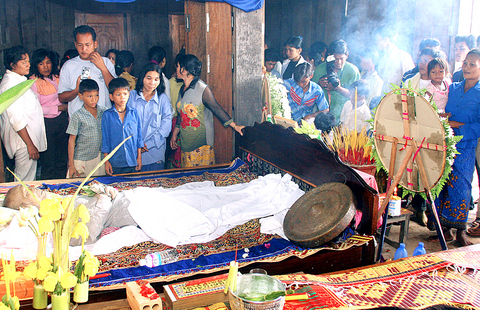
PHOTO: AFP
"His name struck terror in the hearts of people, and his troops were the cruelest of all," wrote journalist Nayan Chanda. He was the group's paramount leader in its dying days in the late 1990s after ousting and arresting the notorious Pol Pot.
In death, his body -- dressed in a simple light gray tunic and dark gray pants -- lay on an open bed, next to a wreath and a large photograph of himself. The right leg of his pants was folded up -- he lost the limb to a land mine more than two decades ago.
A steady stream of mourners, including many former followers from when he was a Khmer Rouge commander, donated money for his funeral, burned incense sticks and offered prayers before walking past to catch a glimpse of his face. Eleven Buddhist monks sat in attendance.
The ceremony, a traditional Buddhist rite, was a sharp contrast to the sinister reputation of Ta Mok and the organization he served loyally for decades. When the communist Khmer Rouge held power in 1975 to 1979, their radical policies were responsible for the deaths of an estimated 1.7 million people through starvation, overwork, disease and execution.
They herded most of the country's population into vast communes in the countryside, where everyone wore black pyjama-like uniforms designed to eliminate all traces of individuality. Religion was banned, and churches and temples sacked. The dead were disposed of unceremoniously, usually tossed in unmarked mass graves, with no mourning countenanced.
Yet yesterday, Ta Mok received the sort of memorial that he and his colleagues denied so many of their countrymen. Buddhist funeral music, blasted through a loudspeaker, wafted far into the distance. The monks chanted prayers to bless his soul as a steady stream of mourners came visiting, some in tears.
In Anlong Veng, where Ta Mok served as a tough, but seemingly generous warlord in the years after the Khmer Rouge were chased out of Phnom Penh, he is remembered with a degree of respect, partly for the public infrastructure projects he brought to the poor area.

‘CROSSING THE LINE’: China’s embassy in Seoul criticized US Forces Korea Commander General Xavier Brunson, asking if his ‘hostile’ remarks were authorized by Washington South Korea and the US are in talks over recent public remarks by the commander of US Forces Korea, Seoul’s presidential office said yesterday, after the comments drew sharp criticism from China. In a recent podcast interview, US Forces Korea Commander General Xavier Brunson described South Korea as “the dagger in the heart of Asia” from China’s east coast, prompting the Chinese embassy in Seoul to say that he had “truly crossed the line.” The interview came amid growing speculation that Washington might seek to expand the role of US Forces Korea in countering the growing regional influence of China, a key

Through the noise of rushing papers and whirring belts at a print factory in Kyoto, two creators watch their photo essay come to life in broadsheet form — part of an effort to win new audiences in the age of artificial intelligence (AI). Despite the decline of the publishing industry, self-publication and handmade “zine” magazines are growing in popularity in Japan, reflecting the nation’s enduring love of paper in the digital era. While speaking to Agence France-Presse at the plant, his hands black with ink, one of the creators, Kazuma Obara, said: “I think [paper] is a medium that engages all five

Australian researchers have trained lab-grown brain cells on a silicon computer chip to play the 1990s shooter game Doom and said they are just scratching the surface of what the neurons could be capable of doing. It is the science-fiction work of biotech boffins at Cortical Labs, who researched and developed the technology that harnesses the workings of the brain’s networking system. Each so-called “biological computer” contains about 200,000 living human brain cells, grown from stem cells that were harvested from blood donations. Having mastered the simple computer game Pong, where a paddle is moved up and down to send a ball

France experienced its hottest spring on record, the French weather service said on Tuesday, after an exceptional early heat wave that also broke highs for the season in England and Wales. Meteo-France said the average nationwide temperature over March to May was 13.8°C — about 1.7°C above the norm, and surpassing records set in 2011 and 2020. “The warmest spring since records began in 1900,” it said in a bulletin. All three months were warmer than average, but the onset of an “unprecedented heatwave” late last month pushed the mercury to highs typically seen at the height of the summer. “Our country had never


 RSS
RSS