


The bombs should be small and placed in day packs, making them harder to detect. The bombers should dress like tourists. They should not bother targeting hotels because security is too tight. Instead they should consider restaurants, discos and theaters.
A thorough survey should be done in advance by the bombers themselves. This way, they are more familiar with the sites, and no one is left behind to be hunted later by the police.
"There is no escape plan because the perpetrators will become martyrs," the planning document states. "They will go to the targets and not return."
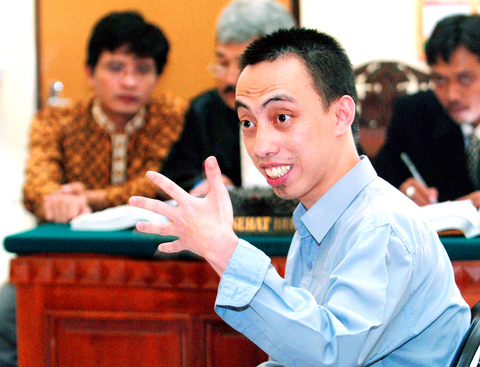
PHOTO: EPA
"5:25pm -- Pack, check out of the boarding house and synchronize watches," their minute-by-minute timetable reads.
"6:15 -- Arrive near the Hard Rock Cafe and look for a place to pray," read another of the listings.
"7:33:25 -- Make sure the delay switches are all ready and enter the restaurant."
And the final entry: "7:34 -- ALLAHU AKBAR!!!" ("God is great").
This is the minute-by-minute choreography of a suicide bombing. Indonesian police uncovered the document from the computer of one of the planners of an attack last October in Bali that killed 20 people, when three men walked into separate restaurants and blew themselves up with day packs loaded with explosives.
The document, experts say, offers a rare glimpse into the minds of terrorist plotters and the kind of meticulous planning that lies behind even a relatively simple operation. The schedule in Bali even provided for 20 minutes for the bombers to pray.
The 34-page document, titled The Bali Project, was found on the computer of Azhari Husin, a Malaysian engineer educated in Australia and Britain who became a master bomb maker and was one of the most dangerous terrorists in Southeast Asia until he was killed in a shootout with the police last November.
The document was given to the New York Times by a person who requested anonymity because it has not been officially released. It was first reported on by Tempo, a weekly English-language news magazine in Jakarta.
The author, who the police say they believe was Azhari himself, begins by asking, "Why Bali?" Because it will have a "global impact," he answers.
"Bali is known around the world, better than Indonesia itself," the author writes. "An attack in Bali will be covered by the international media."
While the targets were to be "foreign tourists from America and its allies," the bombers would have difficulty working out where the tourists were from so, "we will consider all white people the enemy."
In Section 2, "Method of Attack," he notes that the plan must differ from the first attack in Bali, in October 2002, when a minivan loaded with explosives was detonated in front of two nightclubs, killing 202 people.
Now, "security is tighter," the author writes.
The author decides that it is too risky to bring in a truck or a similarly large amount of explosives.
"The bomb must be smaller, and brought in ready to use," the document says.
"We tried to minimize the impact on Muslims," the author explains in the final section, which was written after the attack. "Nevertheless, there were still Muslim victims killed and wounded."
Azahari, who was one of Asia's most wanted men until his death, allegedly planned the attacks with compatriot Noordin Mohammad Top, who remains on the run.
Both men were key members of regional extremist network Jemaah Islamiyah (JI), but experts believe the men had largely split from JI's formal structure to form their own more radical group, though they retained some links.
ROCKY RELATIONS: The figures on residents come as Chinese tourist numbers drop following Beijing’s warnings to avoid traveling to Japan The number of Chinese residents in Japan has continued to rise, even as ties between the two countries have become increasingly fractious, data released on Friday showed. As of the end of December last year, the number of Chinese residents had increased by 6.5 percent from the previous year to 930,428. Chinese people accounted for 22.6 percent of all foreign residents in Japan, making them by far the largest group, Japanese Ministry of Justice data showed. Beijing has criticized Tokyo in increasingly strident terms since Japanese Prime Minister Sanae Takaichi last year suggested that a military conflict around Taiwan could

A pro-Iran hacking group claimed to breach FBI Director Kash Patel’s personal e-mail inbox and posted some of the contents online. The e-mails provided by the hacking group include travel details, correspondence with leasing agents in Washington and global entry, and loyalty account numbers. The e-mail address the hackers claim to have compromised has been previously tied to Patel’s personal details, and the leaked e-mails contain photos of Patel and others, in addition to correspondence with family members and colleagues. “The FBI is aware of malicious actors targeting Director Patel’s personal email information,” the agency said in a statement on

RIVALRY: ‘We know that these are merely symbolic investigations initiated by China, which is in fact the world’s most profligate disrupter of supply chains,’ a US official said China has started a pair of investigations into US trade practices, retaliating against similar probes by US President Donald Trump’s administration as the superpowers stake out positions before an expected presidential summit in May. The move, announced by the Chinese Ministry of Commerce on Friday, is a direct mirror of steps Trump took to revive his tariff agenda after the US Supreme Court last month struck down some of his duties. “China expresses its strong dissatisfaction and firm opposition to these actions,” a ministry spokesperson said in a statement, referring to the so-called Section 301 investigations initiated on March 11.

When a hiker fell from a 55m waterfall in wild New Zealand bush, rescuers were forced to evacuate the badly hurt woman without her dog, which could not be found. After strangers raised thousands of dollars for a search, border collie Molly was flown to safety by a helicopter pilot who was determined to reunite the pet and the owner. A week earlier, an emergency rescue helicopter found the woman with bruises and lacerations after a fall at a rocky spot at the waterfall on the South Island’s West Coast. She was airlifted on March 24, but they were forced to


 RSS
RSS