


Iraq's president formally designated Shiite politician Jawad al-Maliki to form a new government, as the country's parliament met yesterday to launch a political process aimed at healing wounds among ethnic and religious communities and pulling the nation out of insurgency and sectarian strife.
The move ends months of political deadlock among Shiites, Sunnis and Kurds which threatened to drag the nation into fullscale civil war. Al-Maliki has 30 days to present his Cabinet to parliament for approval.
Parliament elected President Jalal Talabani, a Kurd, to a second term and gave the post of parliament speaker to Mahmoud al-Mashhadani, a Sunni Arab. Al-Mashhadani's two deputies were to be Khalid al-Attiyah, a Shiite, and Aref Tayfour, a Kurd.
Talabani's first act was to name al-Maliki, the nominee of the dominant Shiite bloc as prime minister.
The US is banking on a national unity government to stabilize Iraq and enable it to start bringing home its more than 130,000 troops.
Maliki, an official in Iraq's oldest Islamist party, sought ahead of a scheduled session of parliament yesterday to shake off his hardline Shiite image and present himself as a man capable of uniting Shiites, Sunni Arabs and Kurds.
"We are going to form a family that will not be based on sectarian or ethnic backgrounds," he told a televised news conference.
But Maliki, who was picked by the Alliance on Friday after the bloc's original candidate, interim Prime Minister Ibrahim al-Jaafari, bowed out to end the stalemate, offered few clues on how he will run a country many say is on the verge of civil war.
"We'll work on improving the capability and efficiency of the security forces to take over security," he said.
If confirmed, Maliki will have a month to form a cabinet with officials overseeing powerful ministries, including the interior, defense and oil portfolios, which could also require difficult negotiations.
Sunni leaders have accused the Shiite-run Interior Ministry of running death squads targeting Sunnis so there may be a protracted battle over control of that portfolio. Shiites deny condoning death squads.
After delays caused by the impasse, parliament was due to sit yesterday at 3pm for only the second time since the Dec. 15 election. Before a formal vote for prime minister can be held, parliament must first debate the posts of speaker and a three-man presidential council.
US Secretary of State Condoleezza Rice said: "It looks like there's movement and that's good news."
Washington has said the four-month political vacuum in Iraq was fuelling bloodshed.
Meanwhile, suspected insurgents set off two bombs in a public market in northern Iraq yesterday, the second one timed to hit emergency crews arriving at the scene, and the blasts killed at least two Iraqis and wounded 17, police said.
The bodies of 10 Iraqis who apparently were tortured and killed in captivity also were found in other areas of Iraq, police said.
In the market attack, the first bomb exploded at 7:30am in the middle Muqdadiyah, a town about 90km north of Baghdad, causing a large fire, police in Diyala province said on condition of anonymity for security reasons.
When fire engines arrived, the second bomb went off, killing a firefighter and a civilian, and wounding 17 civilians, police said.

When a hiker fell from a 55m waterfall in wild New Zealand bush, rescuers were forced to evacuate the badly hurt woman without her dog, which could not be found. After strangers raised thousands of dollars for a search, border collie Molly was flown to safety by a helicopter pilot who was determined to reunite the pet and the owner. A week earlier, an emergency rescue helicopter found the woman with bruises and lacerations after a fall at a rocky spot at the waterfall on the South Island’s West Coast. She was airlifted on March 24, but they were forced to
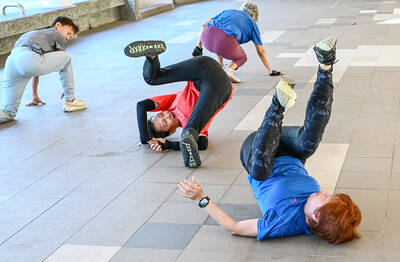
CONFIDENCE BOOSTER: ’After parkour ... you dare to do a lot of things that you think only young people can do,’ a 67-year-old parkour enthusiast said In a corner of suburban Singapore, Betty Boon vaults a guardrail, crawls underneath a slide, executes forward shoulder rolls and scales a steep slope, finishing the course to applause. “Good job,” the 69-year-old’s coach cheers. This is “geriatric parkour,” where about 20 retirees learned to tackle a series of relatively demanding exercises, building their agility and enjoying a sense of camaraderie. Boon, an upbeat grandmother, said learning parkour has aided her confidence and independence as she ages. “When you’re weak, you will be dependent on someone,” she said after sweating it out with her parkour classmates in suburban Toa Payoh,
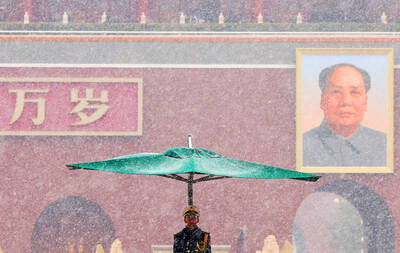
Chinese dissident artist Gao Zhen (高兟), famous for making provocative satirical sculptures of former Chinese leader Mao Zedong (毛澤東), was tried on Monday over accusations of “defaming national heroes and martyrs,” his wife and a rights group said. Gao, 69, who was detained in 2024 during a visit from the US, faces a maximum three-year prison sentence, said his wife, Zhao Yaliang (趙雅良), and Shane Yi, a researcher at the Chinese Human Rights Defenders group which operates outside the nation. The closed-door, one-day trial took place at Sanhe City People’s Court in Hebei Province neighboring the capital, Beijing, and ended without a
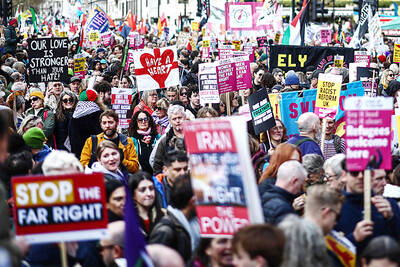
‘TOXIC CLIMATE’: ‘I don’t really recognize Labour anymore... The idea that you can implement far-right ideas in order to stop the far right is nonsense,’ a protester said Tens of thousands of people on Saturday marched through central London to protest against the far right, weeks ahead of local elections and six months after Britain saw one of its largest far-right demonstrations. Organized by hundreds of civic groups, including trade unions, anti-racism campaigners and Muslim representative bodies, Saturday’s Together Alliance event was billed as the biggest in UK history to counter right-wing extremism. A separate pro-Palestinian march had also converged with the main rally. While organizers claimed 500,000 had turned out in total, the police gave a figure of about 50,000. Protesters carrying placards with slogans such as


 RSS
RSS