


One of the many unexpected things about the small graveyard in Chongqing where Xi Qingsheng buried his mother during the mayhem of the Cultural Revolution is that it still exists.
The rusted front gate, locked for many years, opens into a walled cemetery that amounts to a time capsule from an era the Communist Party wants to forget. Revolutionary slogans, long since discredited, are etched onto huge, ornate tombstones, including the large concrete marker that Xi built for his mother when he was a teenager.
"It is my obligation to speak about this history," said Xi, 54. "It is the Communist Party's crime. Of course, they don't want to talk about it. No one wants to talk about shameful things."
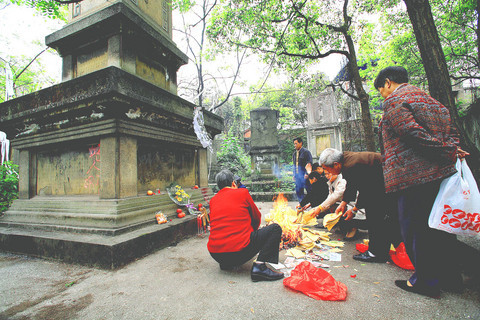
PHOTO: NY TIMES NEWS SERVICE
This year is the 40th anniversary of the Cultural Revolution, a milestone that has met with official silence and only glancing attention in the state news media. In Chongqing, the industrial hub of central China, the obscure graveyard is one of the few reminders of the bloody fighting that erupted across the city between rival factions of Red Guards.
Last Wednesday, a steady flow of people passed through the graveyard for the traditional Qingming day of mourning, when families across China honor the dead. For many families who lost relatives in the Cultural Revolution, the annual Qingming visit offers a rare public opportunity to confront the damage that was wrought.
"The Cultural Revolution brought tragedy to my family," said Liu Li, 41, who visited his father's grave with several other family members.
"My son is now 17. When I've brought him here, I tell him of the tragedy," he said.
Liu was only 2 when his father died in 1967. A year earlier, Mao Zedong (毛澤東) had exhorted the country's youth to form revolutionary committees and take power. Chongqing quickly dissolved into chaos when groups of youthful rebels known as Red Guards took control of the city. The Red Guards soon split into warring factions that partitioned the city and laid siege to one another.
Liu said his father, who was 25 when he died, was working at a factory during one battle when a stray bullet struck and killed him.
"They told me that my father was working as a faithful employee in the factory and was following Chairman Mao," Liu said.
His aunt, Liu Yufang, recalled the horror of living during what was essentially a civil war.
"It was terrifying," she said. "There were cannons and tanks going into villages. Some houses were burned into cinders."
According to local historical accounts and family members at the graveyard, fighting in Chongqing began in May 1967 and ended roughly a year later. Bloodshed was high because of the availability of weapons from the city's many munitions factories. Meanwhile, local military units threw their support behind one faction of Red Guards or the other.
As casualties mounted, members of the Red Guard group known as the 8.15 (named to commemorate an August 15 student rebellion in Chongqing) began to bring dead bodies to an open area that is now a public space known as Shaping Park. By late 1968, after the violence had been halted on orders from Beijing, family members began erecting ornate tombstones to commemorate not just their loved ones but also the revolutionary cause for which they died.
"Tombs of the Martyrs," reads an inscription on one grave marker. Poetic phrases from Mao are chiseled into the tombstones, many of which are shaped like obelisks, with some almost 8m high.
But just as weeds long ago overran many of the grave markers, so has history erased any doubt that the Cultural Revolution was a catastrophe. The Communist Party formally repudiated it in 1981 and has since sought to sweep the subject under the historical carpet. In Chongqing, several other Cultural Revolution cemeteries have been covered in concrete by development projects.
The graveyard in Shaping Park is now the city's last of the era. In the early 1980s, a city official decided to build the high wall that now surrounds the graveyard, a step that almost completely blocked it from view and may have saved it.
"The history of the Cultural Revolution should not be forgotten," said Chen Zhiyong, an amateur photographer who regularly visits the graveyard.
"History itself, whether bad or good, should not be forgotten," Chen said.
Xi, the man who built his mother's tombstone, believes the Communist Party must still air the true historical record of the era and accept full responsibility.
"There has to be a clear explanation of what happened," he said. "My mother was innocent and was shot because the groups were encouraged by Mao Zedong."
Xi said that his mother, Huang Peiying, a member of the 8.15 group, had found shelter in a quiet area at the height of the fighting, after her husband died. But when she fetched Xi and his brothers, a sniper shot her as she led her children across a street.
"The guy who shot my mother was just shooting at anyone who came into sight," said Xi, then 15, who tore off his shirt to sop his mother's blood.
"I was waving my white shirt, but they wouldn't stop shooting. When it finally quieted down, I climbed over to see my mother, but she was already dead," he said.
On Wednesday, family members left offerings at the base of the tombstones, in keeping with tradition. Xi came with two of his brothers: They brought a movie camera and set three oranges carefully into a triangle for their mother.
Not many years ago, Xi said, few people came to observe Qingming. "Now," he said, "more people are coming. I think people want to remember the tragedy in history."
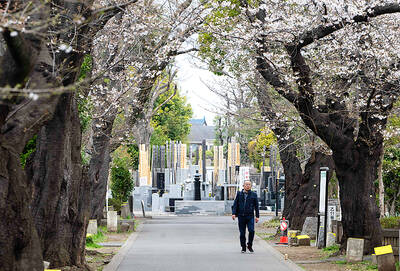
ROCKY RELATIONS: The figures on residents come as Chinese tourist numbers drop following Beijing’s warnings to avoid traveling to Japan The number of Chinese residents in Japan has continued to rise, even as ties between the two countries have become increasingly fractious, data released on Friday showed. As of the end of December last year, the number of Chinese residents had increased by 6.5 percent from the previous year to 930,428. Chinese people accounted for 22.6 percent of all foreign residents in Japan, making them by far the largest group, Japanese Ministry of Justice data showed. Beijing has criticized Tokyo in increasingly strident terms since Japanese Prime Minister Sanae Takaichi last year suggested that a military conflict around Taiwan could

A pro-Iran hacking group claimed to breach FBI Director Kash Patel’s personal e-mail inbox and posted some of the contents online. The e-mails provided by the hacking group include travel details, correspondence with leasing agents in Washington and global entry, and loyalty account numbers. The e-mail address the hackers claim to have compromised has been previously tied to Patel’s personal details, and the leaked e-mails contain photos of Patel and others, in addition to correspondence with family members and colleagues. “The FBI is aware of malicious actors targeting Director Patel’s personal email information,” the agency said in a statement on
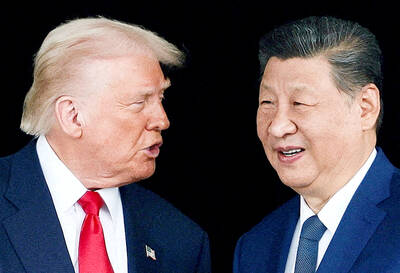
RIVALRY: ‘We know that these are merely symbolic investigations initiated by China, which is in fact the world’s most profligate disrupter of supply chains,’ a US official said China has started a pair of investigations into US trade practices, retaliating against similar probes by US President Donald Trump’s administration as the superpowers stake out positions before an expected presidential summit in May. The move, announced by the Chinese Ministry of Commerce on Friday, is a direct mirror of steps Trump took to revive his tariff agenda after the US Supreme Court last month struck down some of his duties. “China expresses its strong dissatisfaction and firm opposition to these actions,” a ministry spokesperson said in a statement, referring to the so-called Section 301 investigations initiated on March 11.

When a hiker fell from a 55m waterfall in wild New Zealand bush, rescuers were forced to evacuate the badly hurt woman without her dog, which could not be found. After strangers raised thousands of dollars for a search, border collie Molly was flown to safety by a helicopter pilot who was determined to reunite the pet and the owner. A week earlier, an emergency rescue helicopter found the woman with bruises and lacerations after a fall at a rocky spot at the waterfall on the South Island’s West Coast. She was airlifted on March 24, but they were forced to


 RSS
RSS