


Iran conducted its second major test of a new missile within days, firing a high-speed torpedo that it said no submarine or warship can escape and boasting of its strength at a time of increased tensions with the US over its nuclear program.
The tests on Sunday came during war games that Iran's elite Revolutionary Guards have been holding in the Persian Gulf and the Arabian Sea since Friday.
On the maneuvers' first day, Iran said it successfully tested the Fajr-3 missile, which can avoid radars and hit several targets simultaneously using multiple warheads.
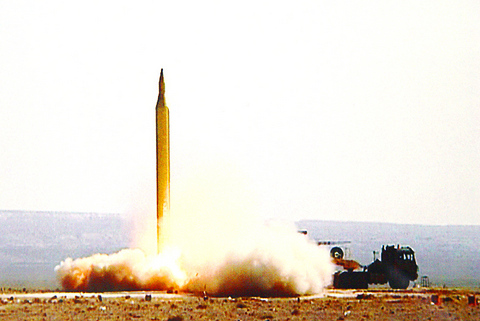
PHOTO: AP
The new torpedo, called the hoot or "whale," could raise concerns over Iran's power in the Gulf, a vital corridor for the world's oil supplies where the US Navy's 5th Fleet is based. During Iran's war with Iraq in the 1980s, Iranian ships attacked oil tankers in the Gulf and Iran and the US military engaged in limited clashes.
Iran's state television stopped its normal programs to break news of the torpedo test, showing it being launched from a ship into the Gulf waters, then hitting its target, a derelict ship.
General Ali Fadavi, deputy head of the Revolutionary Guards' Navy, said the ships that fire the Iranian-made hoot had radar-evading technology and that the torpedo -- moving at 360kph -- was too fast to elude.
"It has a very powerful warhead designed to hit big submarines. Even if enemy warship sensors identify the missile, no warship can escape from this missile because of its high speed," Fadavi told state television.
The hoot's speed would make it about three or four times faster than a normal torpedo and as fast as the world's fastest known underwater missile, the Russian-made VA-111 Shkval, developed in 1995. It was not immediately known if the hoot was based on the Shkval.
The new weapon gives Iran "superiority'' against any warship in the region, he said, in a veiled reference to US vessels in the Gulf. It was not immediately clear whether the torpedo can carry a nuclear warhead.
Commodore Jeff Breslau, spokesman for the US 5th Fleet based on the tiny Arab island nation of Bahrain in the Gulf, said no special measures were taken in reaction to the Iranian war games, even after the latest missile test.
Breslau would not comment on whether the new torpedo rep-resents a threat to US forces in the region.
"In general terms, no matter where we operate in the world, we're aware of other capabilities that exist and of other countries that aren't as friendly to the US, and we pay attention to those capabilities," he said.
Iran is now trying to show its strength amid worries of US military action over its nuclear program, which Washington says aims to produce nuclear weapons. Iran denies the accusation, saying it intends only to generate electricity.
Iran, which views the US as an arch foe and is concerned about the US military presence in neighboring Iraq and Afghanistan, says the maneuvers aim to develop the Guards' defensive capabilities.
The US and its Western allies have been watching in Iran's progress in missile capabilities with concern. Iran already possesses the Shahab-3 missile, capable of carrying a nuclear warhead and hitting US forces in the Middle East.
The upgraded version of the ballistic Shahab-3 missile can travel over 2,000km, putting Israel within its easy range.
Fadavi said Sunday's torpedo test was the outcome of six years of hard work at the Iranian Aero-space Industries, which is affiliated to the Defense Ministry.
More than 17,000 Revolutionary Guards forces are taking part in the weeklong maneuvers in the Gulf.
On Sunday, guards paratroops practiced a drop in an attack on a mock enemy position, and warships, jet fighters, helicopters and sophisticated electronic equipment were used in other exercises.
The television said Sunday's war games included measures to respond to electronic jams caused by a mock enemy.
Iran has routinely held war games over the past two decades to improve its combat readiness and test locally made equipment such as missiles, tanks and armored personnel carriers.

ROCKY RELATIONS: The figures on residents come as Chinese tourist numbers drop following Beijing’s warnings to avoid traveling to Japan The number of Chinese residents in Japan has continued to rise, even as ties between the two countries have become increasingly fractious, data released on Friday showed. As of the end of December last year, the number of Chinese residents had increased by 6.5 percent from the previous year to 930,428. Chinese people accounted for 22.6 percent of all foreign residents in Japan, making them by far the largest group, Japanese Ministry of Justice data showed. Beijing has criticized Tokyo in increasingly strident terms since Japanese Prime Minister Sanae Takaichi last year suggested that a military conflict around Taiwan could

A pro-Iran hacking group claimed to breach FBI Director Kash Patel’s personal e-mail inbox and posted some of the contents online. The e-mails provided by the hacking group include travel details, correspondence with leasing agents in Washington and global entry, and loyalty account numbers. The e-mail address the hackers claim to have compromised has been previously tied to Patel’s personal details, and the leaked e-mails contain photos of Patel and others, in addition to correspondence with family members and colleagues. “The FBI is aware of malicious actors targeting Director Patel’s personal email information,” the agency said in a statement on
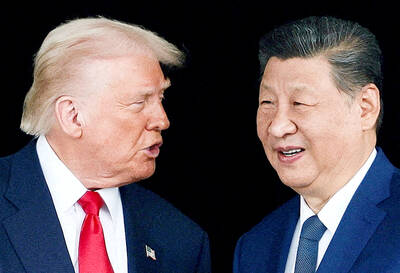
RIVALRY: ‘We know that these are merely symbolic investigations initiated by China, which is in fact the world’s most profligate disrupter of supply chains,’ a US official said China has started a pair of investigations into US trade practices, retaliating against similar probes by US President Donald Trump’s administration as the superpowers stake out positions before an expected presidential summit in May. The move, announced by the Chinese Ministry of Commerce on Friday, is a direct mirror of steps Trump took to revive his tariff agenda after the US Supreme Court last month struck down some of his duties. “China expresses its strong dissatisfaction and firm opposition to these actions,” a ministry spokesperson said in a statement, referring to the so-called Section 301 investigations initiated on March 11.
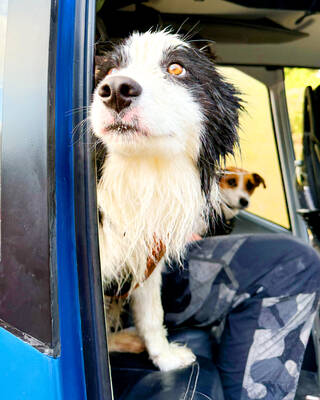
When a hiker fell from a 55m waterfall in wild New Zealand bush, rescuers were forced to evacuate the badly hurt woman without her dog, which could not be found. After strangers raised thousands of dollars for a search, border collie Molly was flown to safety by a helicopter pilot who was determined to reunite the pet and the owner. A week earlier, an emergency rescue helicopter found the woman with bruises and lacerations after a fall at a rocky spot at the waterfall on the South Island’s West Coast. She was airlifted on March 24, but they were forced to


 RSS
RSS