


He is 82 years old and on a recent day was still frail from a winter bout of pneumonia. But Kim Dae-jung is planning what could be his last great act for inter-Korean conciliation -- an inaugural train trip from Seoul to Pyongyang.
"I would like to visit North Korea by train -- the railroad connecting the North and the South has been finalized," South Korea's former president said, sketching out a rail ride that would be a terrestrial echo of his June 2000 flight to Pyongyang, the North Korean capital, which thawed half a century of war and enmity between the Koreas.
"I have plans to go North Korea," Kim said in his home here as shadows lengthened in a reception room decorated with covers of US news magazines that celebrated his first trip, a journey that won him the 2000 Nobel Peace Prize.
On Friday, general-level military talks between the Koreas ended inconclusively. In this mood of paralysis, Kim contends he can use his personal prestige in the North to inaugurate the rail line with a train trip north in June.
Kim left office in January 2003. His groundbreaking trip was soon clouded by allegations that the South Korean government and Hyundai Asan Corp had paid hundreds of millions of dollars to North Korea to ensure that the summit meeting took place. In December 2003, Park Jie-won, Kim's chief of staff, was sentenced to 12 years in prison for bribing North Korea in the case.
Roh Moo-hyun, South Korea's current president and a protege of Kim, limited the scope of the investigation to presidential aides. Since then, Kim has lived here unmolested by prosecutors, gradually becoming the grand old man of South Korean politics.
The legacy of Kim's 2000 gesture to North Korea, expensive as it was, can be seen in new numbers for last year.
Last year, inter-Korean trade grew by more than 50 percent, topping US$1 billion. Nearly 300,000 South Koreans visited Mount Kumgang, a tourism enclave in North Korea operated by Hyundai Asan, and 87,000 South Koreans visited Pyongyang, more than triple the number in 2004. This summer, Hyundai plans trial tours to a third North Korean destination, Mount Paektu.
This year, Hyundai Asan hopes to expand a fledgling industrial park in Kaesong, North Korea, to as many as 40 South Korean factories from 11.
But, in the realm of inter-Korean politics, the second shoe never dropped. Kim Jong-il, North Korea's leader, has not reciprocated Kim's gesture by visiting the south.
"I was disappointed that Kim Jong Il could not make a reciprocal visit," Kim said in the interview, noting that the North Korean leader made a weeklong trip to China in January. "The leaders of China have strongly advised him to visit here. But there is opposition from the inside, from the military, to his visiting South Korea."
North Korea's military, he said, also slows the progress in linking two railways in North Korea and South Korea, a measure that was endorsed by the two leaders at their meeting in 2000. South Korea's construction engineers are renowned worldwide for fast and efficient work, and fresh rails and ties now cross the Demilitarized Zone on the border with North Korea, but planned test runs of trains have been delayed since last October.
But North Korean officials have sent encouraging signals about the former South Korean president's request to inaugurate the rebuilt rail line.
Lee Jong-seok, South Korea's unification minister, is backing Kim's request.
To the former president, South Korea is now in a race with China for influence over North Korea.
"In North Korea, Chinese capital and products are increasingly present," Kim said.
"There is the possibility that North Korea could become another satellite state of China. As South Korean capital goes into North Korea, we can keep this in check."
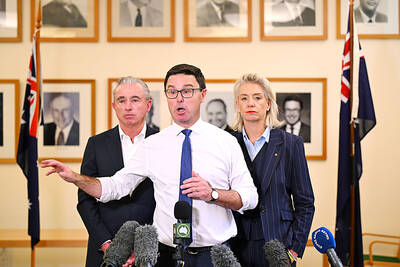
BACKLASH: The National Party quit its decades-long partnership with the Liberal Party after their election loss to center-left Labor, which won a historic third term Australia’s National Party has split from its conservative coalition partner of more than 60 years, the Liberal Party, citing policy differences over renewable energy and after a resounding loss at a national election this month. “Its time to have a break,” Nationals leader David Littleproud told reporters yesterday. The split shows the pressure on Australia’s conservative parties after Prime Minister Anthony Albanese’s center-left Labor party won a historic second term in the May 3 election, powered by a voter backlash against US President Donald Trump’s policies. Under the long-standing partnership in state and federal politics, the Liberal and National coalition had shared power

A Croatian town has come up with a novel solution to solve the issue of working parents when there are no public childcare spaces available: pay grandparents to do it. Samobor, near the capital, Zagreb, has become the first in the country to run a “Grandmother-Grandfather Service,” which pays 360 euros (US$400) a month per child. The scheme allows grandparents to top up their pension, but the authorities also hope it will boost family ties and tackle social isolation as the population ages. “The benefits are multiple,” Samobor Mayor Petra Skrobot told reporters. “Pensions are rather low and for parents it is sometimes

CONTROVERSY: During the performance of Israel’s entrant Yuval Raphael’s song ‘New Day Will Rise,’ loud whistles were heard and two people tried to get on stage Austria’s JJ yesterday won the Eurovision Song Contest, with his operatic song Wasted Love triumphing at the world’s biggest live music television event. After votes from national juries around Europe and viewers from across the continent and beyond, JJ gave Austria its first victory since bearded drag performer Conchita Wurst’s 2014 triumph. After the nail-biting drama as the votes were revealed running into yesterday morning, Austria finished with 436 points, ahead of Israel — whose participation drew protests — on 357 and Estonia on 356. “Thank you to you, Europe, for making my dreams come true,” 24-year-old countertenor JJ, whose
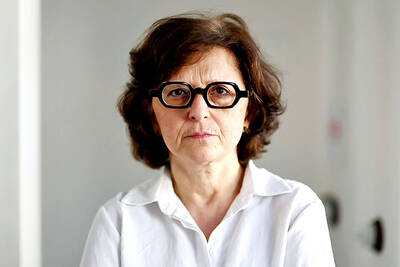
A documentary whose main subject, 25-year-old photojournalist Fatima Hassouna, was killed in an Israeli airstrike in Gaza weeks before it premiered at Cannes stunned viewers into silence at the festival on Thursday. As the cinema lights came back on, filmmaker Sepideh Farsi held up an image of the young Palestinian woman killed with younger siblings on April 16, and encouraged the audience to stand up and clap to pay tribute. “To kill a child, to kill a photographer is unacceptable,” Farsi said. “There are still children to save. It must be done fast,” the exiled Iranian filmmaker added. With Israel


 RSS
RSS