


Working six-hour days at one of this city's busier intersections, where he cajoles pedestrians to respect the traffic signals, Li Debao has a hard-earned insight.
"Chinese people have some bad habits, and a lack of awareness of traffic rules is one of them," said the 36-year-old crossing guard. "Two-thirds of the people ignore the rules, and simply can't be bothered."
In rain, snow or the merciless heat of the Shanghai summer, crossing guards like Li can be seen during daylight hours at every major intersection in this city, trying their best to hold back groaning, impatient crowds with little more than a sharply blown whistle and some well-chosen words.
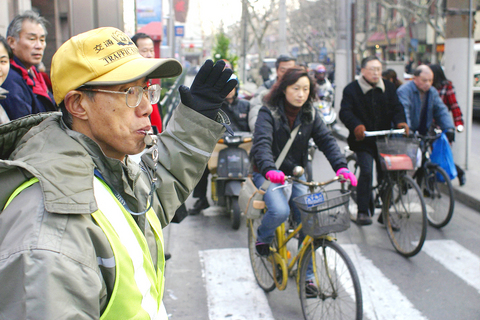
PHOTO: NY TIMES NEWS SERVICE
Shanghai's traffic, horrendous at peak hours and steadily growing worse with the city's runaway growth, would be frozen in perpetual gridlock without the traffic assistants, especially given the penchant of pedestrians here to flock across the street against red lights or even dash headlong into oncoming traffic, as oblivious to what is happening at ground level as an outfielder locked in on a pop fly.
Powerless
That the guards have no powers of arrest, or even the ability to issue tickets, allows many pedestrians to feel free to ignore them. What is worse, they are frequent targets of aggression from crowds of sneering and cursing pedestrians. According to the city government they are physically assaulted at a rate of about 20 times a month.
"This is not an easy job to do," said Li, expressing with considerable understatement the frustrations of a weaponless army of 8,000 in a pushy, adrenaline-fueled city of 17 million. "Particularly when you feel people look down upon you. We've even come to calling ourselves fifth-class citizens."
The traffic assistants each have their own ways of coping, their own strategies for managing the impossible.
Short of stature, and with a lively, expressive face that puts some pedestrians on guard even before she makes a gesture, Li Hong, a two-year veteran of the force who works on the city's most famous business street, Nanjing Road, is a study in quiet persuasion.
"Hey, you two, the intersection is going to lock up if you cross now," she says gently to a couple of men who started out against the traffic into the street. "The light will change in just a minute. Try to wait another moment, OK?"
With that, the two men look at each other and return to the curb sheepishly, their hands buried deep in their pockets.
Working diagonally across the same intersection during the peak traffic flow of lunch hour, another woman, Zhou Genlan, tall and severe, waves her arms and whistles like a force of nature.
"Hey you, off the bike," she says to a man in his thirties who is riding on the sidewalk, extending her arm and pointing her finger like Uncle Sam in the famous recruiting poster.
The rider quickly dismounts.
Zhou, like all of the city's traffic assistants, is dressed in a billed cap, light brown pants and shirt, a reflective vest and thick soled black shoes. Each agent receives two uniforms from the city each year.
Lost generation
Most of the people in this job, which was created by Shanghai three years ago, are in their late 40s or into their 50s, the country's so-called lost generation -- casualties of the sharp change of course from a communist economy composed of state enterprises that provided lifetime employment to freewheeling capitalism, where layoffs and corporate restructuring are the rule, and people without higher degrees in sought-after fields are the first to go.
If each of the traffic assistants brings his or her own style to the job, what seems to unite them is a deep wonder about what puts people in such a hurry nowadays, and an almost philosophical resignation about their powerlessness to do anything about it.
"You see these five fingers," said Wu Wei, a 54-year-old agent who works in the heart of the commercial district. "Some of them are long and some of them are short, and it's the same with the people you meet every day. Some are poor, some are scalawags, and they all have different educational levels.
"What can be done other than accepting reality?" he asked.
ROCKY RELATIONS: The figures on residents come as Chinese tourist numbers drop following Beijing’s warnings to avoid traveling to Japan The number of Chinese residents in Japan has continued to rise, even as ties between the two countries have become increasingly fractious, data released on Friday showed. As of the end of December last year, the number of Chinese residents had increased by 6.5 percent from the previous year to 930,428. Chinese people accounted for 22.6 percent of all foreign residents in Japan, making them by far the largest group, Japanese Ministry of Justice data showed. Beijing has criticized Tokyo in increasingly strident terms since Japanese Prime Minister Sanae Takaichi last year suggested that a military conflict around Taiwan could

A pro-Iran hacking group claimed to breach FBI Director Kash Patel’s personal e-mail inbox and posted some of the contents online. The e-mails provided by the hacking group include travel details, correspondence with leasing agents in Washington and global entry, and loyalty account numbers. The e-mail address the hackers claim to have compromised has been previously tied to Patel’s personal details, and the leaked e-mails contain photos of Patel and others, in addition to correspondence with family members and colleagues. “The FBI is aware of malicious actors targeting Director Patel’s personal email information,” the agency said in a statement on

RIVALRY: ‘We know that these are merely symbolic investigations initiated by China, which is in fact the world’s most profligate disrupter of supply chains,’ a US official said China has started a pair of investigations into US trade practices, retaliating against similar probes by US President Donald Trump’s administration as the superpowers stake out positions before an expected presidential summit in May. The move, announced by the Chinese Ministry of Commerce on Friday, is a direct mirror of steps Trump took to revive his tariff agenda after the US Supreme Court last month struck down some of his duties. “China expresses its strong dissatisfaction and firm opposition to these actions,” a ministry spokesperson said in a statement, referring to the so-called Section 301 investigations initiated on March 11.

When a hiker fell from a 55m waterfall in wild New Zealand bush, rescuers were forced to evacuate the badly hurt woman without her dog, which could not be found. After strangers raised thousands of dollars for a search, border collie Molly was flown to safety by a helicopter pilot who was determined to reunite the pet and the owner. A week earlier, an emergency rescue helicopter found the woman with bruises and lacerations after a fall at a rocky spot at the waterfall on the South Island’s West Coast. She was airlifted on March 24, but they were forced to


 RSS
RSS