


An Australian inquiry into alleged kickbacks paid to Iraq under the UN oil-for-food program claimed its first scalp yesterday with the resignation of the chief executive of the Australian Wheat Board (AWB).
The resignation of AWB boss Andrew Lindberg came in the fourth week of an inquiry which has detailed how the wheat exporter allegedly paid some US$220 million in kickbacks to secure US$2.3 billion in wheat contracts with the regime of former Iraqi president Saddam Hussein under the 1996-2003 oil-for-food program.
Lindberg will relinquish all executive responsibilities immediately and officially step down from his post on April 30, the AWB, which has been at the center of the inquiry since it began last month, said in a statement.
"The board thanks Mr Lindberg for his contribution to the company and for making this decision, believing that it is in the best interests of the company," AWB said.
The inquiry was established by Prime Minister John Howard after a UN report into the oil-for-food program named AWB as one of more than 2,000 companies which had paid kickbacks to Baghdad when ruled by Saddam Hussein.
AWB holds a monopoly on Australian wheat exports and was a government owned company until it listed on the stock exchange in mid-1999.
It allegedly paid more in kickbacks to Baghdad than any other company named by the UN.
However, AWB executives have said they were duped into believing that fees paid to Baghdad were meant to cover the costs of transporting grain to Iraq.
The Sydney inquiry also heard yesterday from the AWB's former global marketing chief Nigel Of-ficer that the UN and Australian government were never told all the details of the contracts involving Iraq.
He said the true nature of deals with the Iraqi Grain Board in 1999 were not disclosed in contracts sent to the UN and the Australian Department of Foreign Affairs and Trade (DFAT) because it was felt it could jeopardize UN approval.
"We did not go out of our way not to draw it to the attention of DFAT," said Officer, who left the AWB in 2000.
Under questioning, he agreed the department had been left uninformed, adding AWB culture was forged by the knowledge that it operated in some countries where Australian "moral and ethical" business practices were not observed.
"At the end of the day, if there were gray areas it was perhaps left so that sometimes the an-swers that you might not like to hear weren't heard," he said.
Officer said he had spoken to then-chairman Trevor Flugge on one occasion about the "grayness" of trucking fees paid to Alia and suggested AWB not make those payments directly.
"His response would have been along the lines that `We're in the business of maximizing opportunities and sales returns,'" he told the inquiry.
Alia, 49 percent owned by the Iraqi government, collected trucking fees from AWB which were channeled through to Baghdad.
Officer said that Flugge and former CEO Murray Rogers approved the "trucking fees" which were never questioned by other executives.
"Without their support and authority the contractual changes could not occur," he said.
"At no stage did either Trevor or Murray disagree with the contractual changes or the payment of the trucking fees that had been proposed and they understood those reasons," he said.

‘CROSSING THE LINE’: China’s embassy in Seoul criticized US Forces Korea Commander General Xavier Brunson, asking if his ‘hostile’ remarks were authorized by Washington South Korea and the US are in talks over recent public remarks by the commander of US Forces Korea, Seoul’s presidential office said yesterday, after the comments drew sharp criticism from China. In a recent podcast interview, US Forces Korea Commander General Xavier Brunson described South Korea as “the dagger in the heart of Asia” from China’s east coast, prompting the Chinese embassy in Seoul to say that he had “truly crossed the line.” The interview came amid growing speculation that Washington might seek to expand the role of US Forces Korea in countering the growing regional influence of China, a key

Through the noise of rushing papers and whirring belts at a print factory in Kyoto, two creators watch their photo essay come to life in broadsheet form — part of an effort to win new audiences in the age of artificial intelligence (AI). Despite the decline of the publishing industry, self-publication and handmade “zine” magazines are growing in popularity in Japan, reflecting the nation’s enduring love of paper in the digital era. While speaking to Agence France-Presse at the plant, his hands black with ink, one of the creators, Kazuma Obara, said: “I think [paper] is a medium that engages all five

Australian researchers have trained lab-grown brain cells on a silicon computer chip to play the 1990s shooter game Doom and said they are just scratching the surface of what the neurons could be capable of doing. It is the science-fiction work of biotech boffins at Cortical Labs, who researched and developed the technology that harnesses the workings of the brain’s networking system. Each so-called “biological computer” contains about 200,000 living human brain cells, grown from stem cells that were harvested from blood donations. Having mastered the simple computer game Pong, where a paddle is moved up and down to send a ball
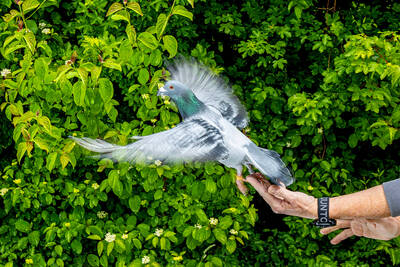
A surprising gut feeling may help pigeons find their way home. Animals use various techniques to navigate, including following the stars and remembering key landmarks. Birds, fish and turtles orient themselves using Earth’s magnetic field as a compass, but it is not yet clear how exactly they do this. Pigeons are a well-known group of frequent flyers that can traverse hundreds of kilometers in a single day. For thousands of years, humans have used them to carry news, notes and military messages. Scientists have long tried to untangle how pigeons travel without getting lost. Some think the birds detect magnetic cues using light-sensitive


 RSS
RSS