


The West Bank city of Ramallah, Fatah's political headquarters, went to sleep on Wednesday night to the sound of celebratory gunfire as the party's young supporters drove through the streets cheering exit polls which suggested victory.
By Thursday morning the euphoria had turned to shock as Palestinians tried to assess the effects of Hamas' victory.
What happens now, was the most frequently asked question in the most secular of Palestinian cities. Not many people had answers, but several joked about having a last alcoholic drink before it is banned by the Islamic movement that won four out of five seats in the city, formerly a Fatah stronghold.
Bassem Khoury, a Christian restaurant owner, said he feared Christians would be persecuted and that corruption among Fatah politicians would be replaced by corruption by Hamas.
"I can't see any problems with Hamas in the first year or six months. But once they get comfortable in their positions they may promote social change and my wife will be forced to wear headscarves and an abaya," said Khoury.
"If they declare that secular law has priority over Islamic law I will relax, but if they elevate Islamic law, I will pack my bags. It is not only Christians that are scared. Moderate Muslims who live a modern life are also fearful," he said.
According to Khoury, the son of a Hamas leader dined at his restaurant this week. He did not drink, but sat by racks of wine.
"He told me that we had nothing to worry about because Hamas would respect individual liberties, but I know that has not been the case in Gaza," said Khoury.
Nearby, Mahmoud Muhammad, 28, waited outside a mosque for the start of a Hamas victory parade. Unlike Fatah supporters, who celebrate with guns, Hamas supporters carried only their green flags.
"I am astonished by our victory. Things can only get better for the Palestinian people. I want Hamas to form a government and I don't want there to be any partnership with Fatah," he said.
"We have clean hands so all the money we receive will go directly to the people and not the pockets of the corrupt. Not everyone regards us as terrorists and we have our ways of raising money," he said.
Muhammad joined the crowds marching through Ramallah to the parliament building where Hamas now has a majority.
Supporters climbed the walls of the building and replaced Palestinian flags with the green flag of Hamas.
Two Fatah supporters then climbed the building and threw the flags into the crowd, who replied by throwing stones which hit them and smashed windows.
Police arrived as the Hamas supporters drifted away to mosques, answering the call to prayer.
A furious police chief ordered the Palestinian flag to be raised again and screamed over a loudspeaker: "No one takes down the Palestinian flag."
It was the first confrontation between Hamas and Fatah since the election but many fear it will not be the last.
Hishab Abu Ghosh, a member of the Democratic Front for the Liberation of Palestine, a leftist group which won four seats, said he was concerned about Hamas' ability to turn their emotional appeal into practical policies.
"Now they will have to deal with creating paradise on the earth not just in the heavens. They have no real political programme. What will they say to the World Bank? What will they say to the United Nations?" he said.
Hamas: The facts
What is Hamas?
In Arabic it means "zeal", but it also stands for Harakat al-Muqawamah al-Islamiyyah, or Islamic Resistance Movement. It began as an offshoot of Egypt's Muslim Brotherhood in the 1970s. The movement's goal is to establish an Islamic theocracy in Israel, the West Bank and Gaza Strip. Hamas is committed to the destruction of the state of Israel, which it does not recognize.
How does it operate?
Hamas has built a strong grassroots base through preaching and its network of health, education and welfare services throughout Gaza and the West Bank. It preaches armed resistance against Israel and has carried out dozens of suicide bombings and other attacks against Israeli targets, killing hundreds.
How is it funded?
Its community services are financed by Arab agencies and Islamic charities. Israel claims funding for its military wing comes from Iran, Syria and Palestinians living abroad.
Who are its leaders?
Ismail Haniya, 45, heads the Hamas national list of candidates. He teaches at the Islamic University in Gaza City and owes his prominence in the movement to his previous close relationship to the assassinated former leader Sheik Yassin.
Mahmoud Zahar, 51, is also believed to be a leader of Hamas, although he only appeared at number six in their national list of candidates. Israel bombed his home in Gaza City in 2003, killing his son and injuring him and his wife. Zahar is a surgeon and teaches medicine at the Islamic University.
Mohamed Deif, believed to be in his 40s, has not been seen in public for years but as head of the Hamas military wing, the Izz al-Din Qassam Brigades, he is possibly the most influential Hamas leader. It is rumored that he is partially blinded and crippled from an Israeli assassination attempt in 2003.
Khaled Mashaal, who is based in Damascus, is also seen as an important figure in Hamas despite his absence from the West Bank and Gaza. He survived an Israeli assassination attempt in Jordan in 1997.

Through the noise of rushing papers and whirring belts at a print factory in Kyoto, two creators watch their photo essay come to life in broadsheet form — part of an effort to win new audiences in the age of artificial intelligence (AI). Despite the decline of the publishing industry, self-publication and handmade “zine” magazines are growing in popularity in Japan, reflecting the nation’s enduring love of paper in the digital era. While speaking to Agence France-Presse at the plant, his hands black with ink, one of the creators, Kazuma Obara, said: “I think [paper] is a medium that engages all five
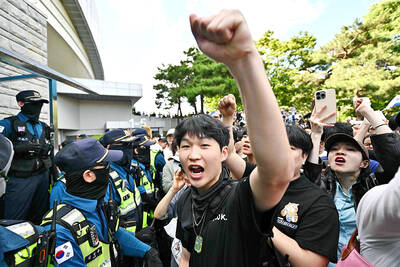
‘ABSURD MISTAKE’: The election commission said that there had been a failure to anticipate turnout after 14 polling stations ran short of ballot papers South Korean riot police yesterday cleared protesters from a Seoul polling station after a 35-hour blockade sparked by a shortage of ballot papers during local elections earlier this week. Wednesday’s election was the first nationwide vote since South Korean President Lee Jae-myung took office following the ouster of Yoon Suk-yeol over his short-lived martial law declaration. Lee’s ruling Democratic Party swept most races, but failed to flip the crucial Seoul mayoral seat. The South Korean National Election Commission apologized, blaming a failure to anticipate turnout after 14 polling stations in Seoul ran short of ballot papers. Some polling stations stayed open until 10pm to

Australian researchers have trained lab-grown brain cells on a silicon computer chip to play the 1990s shooter game Doom and said they are just scratching the surface of what the neurons could be capable of doing. It is the science-fiction work of biotech boffins at Cortical Labs, who researched and developed the technology that harnesses the workings of the brain’s networking system. Each so-called “biological computer” contains about 200,000 living human brain cells, grown from stem cells that were harvested from blood donations. Having mastered the simple computer game Pong, where a paddle is moved up and down to send a ball

France experienced its hottest spring on record, the French weather service said on Tuesday, after an exceptional early heat wave that also broke highs for the season in England and Wales. Meteo-France said the average nationwide temperature over March to May was 13.8°C — about 1.7°C above the norm, and surpassing records set in 2011 and 2020. “The warmest spring since records began in 1900,” it said in a bulletin. All three months were warmer than average, but the onset of an “unprecedented heatwave” late last month pushed the mercury to highs typically seen at the height of the summer. “Our country had never


 RSS
RSS