


The city's best-known candidate campaigns in an armored Chevy Suburban with tinted windows and room for the ruling Fatah Party bodyguards who shadow him around the West Bank. One of his main rivals drives his own dented Hyundai with a green Hamas flag tied to the radio antenna.
But there's more here than the general snapshot of Jan. 25 elections for the Palestinian parliament -- which has come down to a battle between the old guard Fatah bosses who sought peace with Israel and the new political wing of Hamas militants who call for Israel's destruction.
In Hebron, it's brother against brother. For Fatah: one of the late Yasser Arafat's most swaggering proteges, Jibril Rajoub. On the Hamas slate: his younger brother, Nayef, a longtime student and beekeeper who has picked up the Hamas lingo of Islamic values and the need to uproot the corruption and cronyism of Arafat's era.
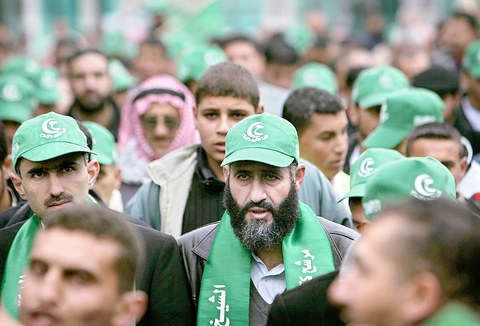
PHOTO: AP
The contest shows the depths of the ideological splits among Palestinians. A poll last month predicted the brothers to be among the top vote-getters in the important Hebron district.
They also offer vivid lessons on the passions driving Hamas and Fatah's attempts to display an image of maturity and self-correction after the demagoguery of Arafat.
Few were closer to Arafat than Jibril Rajoub. After being jailed and expelled by Israel, he became part of Arafat's inner circle in the late 1980s when the Palestine Liberation Organization (PLO) was based in Tunisia. Jibril later rose to become the powerful security chief in the West Bank, sometimes called the "the king."
His campaign entourage is a bevy of armed escorts, handlers and hangers-on. Jibril works hard to play his two most important cards: his ties with Arafat and how he was not afraid to go his own way. Four years ago -- with Arafat feeling threatened by Jibril's influence -- tensions reached a point where Arafat pull his pistol and tried to punch him.
"I'm an obedient soldier in Fatah," he said before meeting a group of business and cultural leaders in Hebron's best hotel on Friday. But he openly talks of the need for a Fatah facelift with more accountability and public outreach after the imperious ways of the "the godfather."
"Arafat did build some sort of patriach regime that we accepted voluntarily," said Jibril, 52, a hefty man who favors Western business suits. "Since his [death], there is a real problem in Fatah ... but I'm not worried or concerned about Fatah."
Fatah, he said, is not in a political intensive care unit.
Hamas loyalists might disagree. The newly formed political arm has been making deft moves.
Its attacks on perceived corruption in Fatah resonate strongly with ordinary Palestinians who have watched the economy nosedive but leaders able to maintain villas and luxury cars. Hamas promises are tangible -- improved roads, more clinics, better schools.
Other parts of the Hamas agenda are less clear. Its pro-Islamic credentials are proclaimed, but it makes no pledges to bring to the West Bank the type of strict lifestyle rules, like a ban on alcohol, that some Hamas factions press in the violence-torn Gaza Strip, which was turned over to Palestinian control last year with Israel's withdrawal.
In the village of Idna -- part of the Hebron district -- nearly 200 people turned out in a chilly rain last week for Nayef and several other candidates wearing casual clothes, green Hamas baseball caps and scarves with verses from the Koran, the Muslim holy book. The crowd carried poster-size portraits of other Hamas candidates in Israeli jails. Hamas, they chanted, "is the foundation for everything."
"Hamas is the eyes, ears and heart of the people," said the bearded Nayef, 48, inside an unheated community center.

‘CROSSING THE LINE’: China’s embassy in Seoul criticized US Forces Korea Commander General Xavier Brunson, asking if his ‘hostile’ remarks were authorized by Washington South Korea and the US are in talks over recent public remarks by the commander of US Forces Korea, Seoul’s presidential office said yesterday, after the comments drew sharp criticism from China. In a recent podcast interview, US Forces Korea Commander General Xavier Brunson described South Korea as “the dagger in the heart of Asia” from China’s east coast, prompting the Chinese embassy in Seoul to say that he had “truly crossed the line.” The interview came amid growing speculation that Washington might seek to expand the role of US Forces Korea in countering the growing regional influence of China, a key

Through the noise of rushing papers and whirring belts at a print factory in Kyoto, two creators watch their photo essay come to life in broadsheet form — part of an effort to win new audiences in the age of artificial intelligence (AI). Despite the decline of the publishing industry, self-publication and handmade “zine” magazines are growing in popularity in Japan, reflecting the nation’s enduring love of paper in the digital era. While speaking to Agence France-Presse at the plant, his hands black with ink, one of the creators, Kazuma Obara, said: “I think [paper] is a medium that engages all five

Australian researchers have trained lab-grown brain cells on a silicon computer chip to play the 1990s shooter game Doom and said they are just scratching the surface of what the neurons could be capable of doing. It is the science-fiction work of biotech boffins at Cortical Labs, who researched and developed the technology that harnesses the workings of the brain’s networking system. Each so-called “biological computer” contains about 200,000 living human brain cells, grown from stem cells that were harvested from blood donations. Having mastered the simple computer game Pong, where a paddle is moved up and down to send a ball

France experienced its hottest spring on record, the French weather service said on Tuesday, after an exceptional early heat wave that also broke highs for the season in England and Wales. Meteo-France said the average nationwide temperature over March to May was 13.8°C — about 1.7°C above the norm, and surpassing records set in 2011 and 2020. “The warmest spring since records began in 1900,” it said in a bulletin. All three months were warmer than average, but the onset of an “unprecedented heatwave” late last month pushed the mercury to highs typically seen at the height of the summer. “Our country had never


 RSS
RSS