


China has started the trial of a local Chinese Communist Party chief for his role in one of the bloodiest in a wave of rural riots to strike the country in recent years, state media said yesterday.
In June, hired thugs killed six villagers and injured dozens of others staging a sit-in on land confiscated by a state-owned power plant to protest against low compensation in Shengyou Village, Hebei Province.
"The open trial of the 27 defendants involved in the June 11 case, including former Dingzhou city party secretary He Feng, began yesterday," the Beijing News said. Dingzhou is the city with jurisdiction over Shengyou.
The violence in Shengyou was one of a series of protests in rural areas, many of which have focused on land rights as rapid development encroaches on farmland. Corruption and a growing gap between rich and poor have also been flashpoints for unrest.
The government has said China saw some 74,000 protests last year involving 100 or more people.
All 27 in the Dingzhou case were charged with "intentionally inflicting injury upon others," the Beijing News said. If convicted, they could face the death penalty.
He was sacked along with the Dingzhou mayor Guo Zhenguang after a Beijing newspaper broke the news of the clash. The report did not say if Guo was also on trial.
Previous reports said police had arrested 31 and detained another 131 at the time. The villagers later won back the land when the government decided not to go ahead with the requisition.
However, Beijing remains virtually silent 10 days after police shot and killed at least three villagers in a land dispute similar to Shengyou's in Guangdong Province.
The government said the police commander who gave the order to shoot had been detained.
But it also rounded up those involved in the protest and has insisted "instigators" were to blame for the violence.
Meanwhile, a woman who rose in the ranks of provincial politics has been sentenced to death for taking bribes, state media reported yesterday.
Han Guizhi, the former deputy party secretary for Heilongjiang Province, was sentenced on Thursday to death with a two-year reprieve, the China Daily said. The Beijing No. 1 Intermediate People's Court found Han guilty of accepting 7 million yuan (US$875,000) in bribes between 1992 and 2002, the newspaper said.

Crowds in Bangladesh are flocking to snap photographs with an unlikely social media star — an albino buffalo with flowing blond hair nicknamed “Donald Trump” that is due to be sacrificed within days. Owner Zia Uddin Mridha, 38, said his brother named the 700kg bull over its flowing helmet of hair resembling the signature look of the US president. “My younger brother picked this name because of the buffalo’s extraordinary hair,” he said at his farm in Narayanganj, just outside the capital, Dhaka. Mridha said that a constant stream of curious visitors — social media fans, onlookers and children — have come throughout
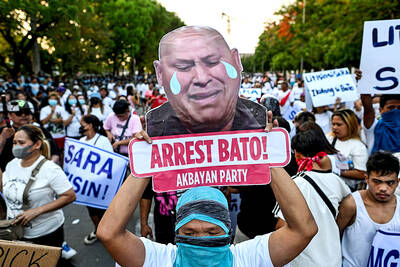
The Philippines said it has asked the country’s Supreme Court to allow it to arrest former Philippine president Rodrigo Duterte’s chief drug war enforcer to stand trial in an international tribunal. The International Criminal Court (ICC) last week unsealed an arrest warrant against Philippine Senator Ronald dela Rosa, accusing him along with Duterte and other “coperpetrators” of the “crime against humanity of murder.” Dela Rosa briefly sought refuge in the Philippine Senate last week while asking the Philippine Supreme Court to stop an ongoing attempt by government agents to arrest him. “By his own conduct, he has placed himself outside the protection of

The researchers in Ireland looked at their computer screen, marveling at a medieval book tracked down in a Roman library. They flipped through its digitized pages and found their sought-after treasure: the oldest surviving English poem. “We were extremely surprised. We were speechless. We couldn’t believe our eyes when we first saw that,” said Elisabetta Magnanti, a visiting research fellow at Trinity College Dublin’s school of English. The poem was also within the main body of Latin text, she said, calling it “extraordinary.” Composed in Old English by a Northumbrian agricultural worker in the 7th century, Caedmon’s Hymn appears within some copies of

It began as a satirical online project. Now millions of young people in India are flocking to it as an outlet for their frustration. A parody political party called the Cockroach Janta Party, with the insect as its symbol, has exploded across India’s social media by turning absurdist humor into protest. Memes and short videos mocking corruption, joblessness and political dysfunction have flooded social media sites, where millions of users are embracing the cockroach — known for its ability to survive harsh conditions — as a tongue-in-cheek symbol of endurance. The online movement’s rise has been unusually rapid. The Cockroach Janta Party (CJP)


 RSS
RSS