


The UN war crimes tribunal said on Tuesday it will consider next week splitting the case of former Yugoslav president Slobodan Milosevic into separate trials, as proceedings were again delayed by his ill health.
UN judges ordered Milosevic and prosecutors to prepare arguments on whether the court should issue a separate verdict on the 1998-1999 Kosovo war and later deal with charges related to the earlier wars in Croatia and Bosnia. A hearing will be held on Tuesday.
Both the prosecution and members of Milosevic's legal team said they would oppose breaking up the case at this stage.
Dragging on
Such a ruling could speed up the landmark trial that has dragged on for nearly four years and would likely secure a verdict in at least one of the three indictments against the former Serbian leader.
Zdenko Tomanovic, the legal adviser for Milosevic's, said in Belgrade that splitting the case would be "a huge blow for the defense."
He said that the defense planned to question several witnesses, including senior foreign officials, who can testify about all the charges, and to call them near the end of the joint trial.
"Those are key witnesses for the whole case, and not only for Kosovo, Bosnia and Croatia," Tomanovic said. "I can only hope that there will be no splitting of the case."
In Kosovo, Milosevic is charged with five counts for the murders of at least 900 Kosovo Albanians, 800,000 deportations and sexual assault by Serbian forces. Kosovo is considered by legal experts to be the strongest case against Milosevic because he was president when the crimes took place in the Albanian-dominated Serbian province.
Milosevic, who is defending himself, is due to finish presenting his case in March -- barring further delays due to several ailments including a chronic heart condition.
So far, he has used nearly 75 percent of the 360 courtroom hours allotted to him -- the same amount as used to present the prosecution's case -- and has spent nearly all of it discussing Kosovo.
Too ill
The trial was canceled this week because Milosevic complained that he felt too ill to question his witnesses. The three judges ordered another round of medical tests, and will consider the doctors' report at Tuesday's hearing, a court statement said.
The trial has been interrupted 18 times since it opened on Feb. 12, 2002, amounting to several months of delays.
Milosevic was initially charged in three separate indictments, but the cases for Bosnia, Croatia and Kosovo were merged into one in 2002 in an effort to streamline the proceedings. The court will now consider reversing that decision, apparently with the intention of at least finishing one case as early as possible.
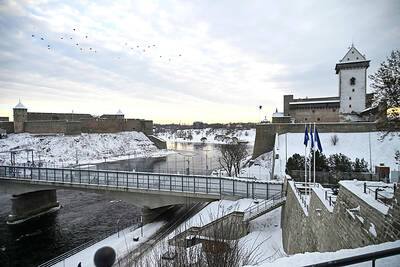
Two medieval fortresses face each other across the Narva River separating Estonia from Russia on Europe’s eastern edge. Once a symbol of cooperation, the “Friendship Bridge” connecting the two snow-covered banks has been reinforced with rows of razor wire and “dragon’s teeth” anti-tank obstacles on the Estonian side. “The name is kind of ironic,” regional border chief Eerik Purgel said. Some fear the border town of more than 50,0000 people — a mixture of Estonians, Russians and people left stateless after the fall of the Soviet Union — could be Russian President Vladimir Putin’s next target. On the Estonian side of the bridge,

Jeremiah Kithinji had never touched a computer before he finished high school. A decade later, he is teaching robotics, and even took a team of rural Kenyans to the World Robotics Olympiad in Singapore. In a classroom in Laikipia County — a sparsely populated grasslands region of northern Kenya known for its rhinos and cheetahs — pupils are busy snapping together wheels, motors and sensors to assemble a robot. Guiding them is Kithinji, 27, who runs a string of robotics clubs in the area that have taken some of his pupils far beyond the rural landscapes outside. In November, he took a team
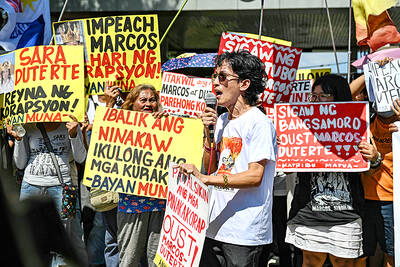
Civil society leaders and members of a left-wing coalition yesterday filed impeachment complaints against Philippine Vice President Sara Duterte, restarting a process sidelined by the Supreme Court last year. Both cases accuse Duterte of misusing public funds during her term as education secretary, while one revives allegations that she threatened to assassinate former ally Philippine President Ferdinand Marcos Jr. The filings come on the same day that a committee in the House of Representatives was to begin hearings into impeachment complaints against Marcos, accused of corruption tied to a spiraling scandal over bogus flood control projects. Under the constitution, an impeachment by the
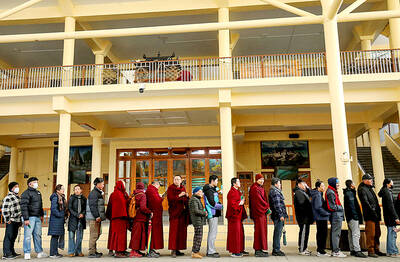
Exiled Tibetans began a unique global election yesterday for a government representing a homeland many have never seen, as part of a democratic exercise voters say carries great weight. From red-robed Buddhist monks in the snowy Himalayas, to political exiles in megacities across South Asia, to refugees in Australia, Europe and North America, voting takes place in 27 countries — but not China. “Elections ... show that the struggle for Tibet’s freedom and independence continues from generation to generation,” said candidate Gyaltsen Chokye, 33, who is based in the Indian hill-town of Dharamsala, headquarters of the government-in-exile, the Central Tibetan Administration (CTA). It


 RSS
RSS