


The fledgling Maori party was poised yesterday to play a leading role in determining New Zealand's next government after a cliffhanger election.
The election night results Saturday gave Helen Clark's ruling Labour Party 50 seats and the main opposition National Party 49 in the 122-seat parliament, forcing both parties into a a scramble for support from six minor parties holding the remaining 23 seats.
Because of historical differences, both Labour and National would want to avoid dealing with the 15-month old Maori Party if they can. But they may be forced to seek the support of its legislators if rifts between other potential coalition partners cannot be healed.
Tariana Turia formed the Maori Party as an independent voice for New Zealand's indigenous people, who make up about 15 percent of the population.
She resigned from Labour last year over its legislation to block a court ruling that Maori had a right to claim foreshore and seabed areas.
But the party also has little in common with National, which wants to do away with the seven seats set aside for Maori.
Turia was adamant she would not be approaching either Clark or National leader Don Brash. "I think if they want to talk they will call us," she said.
Turia, 61, sees Labour's actions as a betrayal of traditional Maori support for the Labour Party, worse in some ways than the National Party's plans.
"One of them, at least, has stabbed us in the front and the other has stabbed us in the back. Now [our people] see them as being as bad as each other," she said recently.
Clark, who said before the election that she regards the Maori Party as "the last cab off the rank", could form a government if she can command the support of the small United Future and New Zealand First parties.
But both are opposed to working with her main ally, the Greens. If that rift cannot be healed she will have to hail the last cab, and the cab might not be too keen to come.
Turia's co-leader, academic Pita Sharples, has not ruled out talks with National if National is "desperate" -- and if it is desperate, it might have to backtrack on its Maori seats policy.
With emotions running high, Maori Party president Whatarangi Winiata has condemned actions by the two main parties as a move to abrogate the Treaty of Waitangi, signed in 1840 between Maori chiefs and Britain.
New Maori MP Hone Harawira has compared the policies of Brash to those of Adolf Hitler.
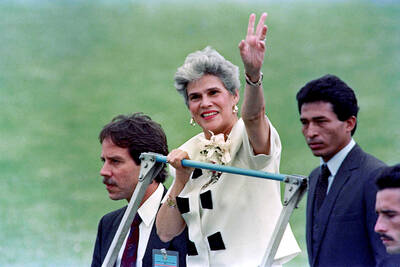
Former Nicaraguan president Violeta Chamorro, who brought peace to Nicaragua after years of war and was the first woman elected president in the Americas, died on Saturday at the age of 95, her family said. Chamorro, who ruled the poor Central American country from 1990 to 1997, “died in peace, surrounded by the affection and love of her children,” said a statement issued by her four children. As president, Chamorro ended a civil war that had raged for much of the 1980s as US-backed rebels known as the “Contras” fought the leftist Sandinista government. That conflict made Nicaragua one of
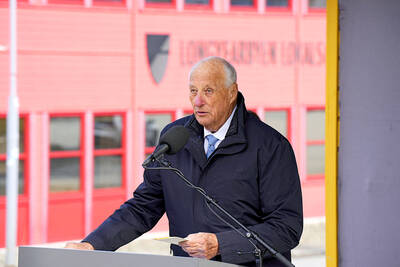
COMPETITION: The US and Russia make up about 90 percent of the world stockpile and are adding new versions, while China’s nuclear force is steadily rising, SIPRI said Most of the world’s nuclear-armed states continued to modernize their arsenals last year, setting the stage for a new nuclear arms race, the Stockholm International Peace Research Institute (SIPRI) said yesterday. Nuclear powers including the US and Russia — which account for about 90 percent of the world’s stockpile — had spent time last year “upgrading existing weapons and adding newer versions,” researchers said. Since the end of the Cold War, old warheads have generally been dismantled quicker than new ones have been deployed, resulting in a decrease in the overall number of warheads. However, SIPRI said that the trend was likely
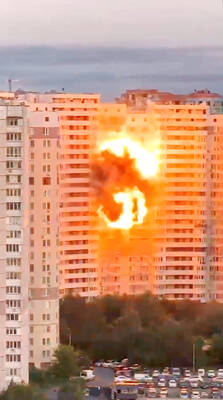
BOMBARDMENT: Moscow sent more than 440 drones and 32 missiles, Volodymyr Zelenskiy said, in ‘one of the most terrifying strikes’ on the capital in recent months A nighttime Russian missile and drone bombardment of Ukraine killed at least 15 people and injured 116 while they slept in their homes, local officials said yesterday, with the main barrage centering on the capital, Kyiv. Kyiv City Military Administration head Tymur Tkachenko said 14 people were killed and 99 were injured as explosions echoed across the city for hours during the night. The bombardment demolished a nine-story residential building, destroying dozens of apartments. Emergency workers were at the scene to rescue people from under the rubble. Russia flung more than 440 drones and 32 missiles at Ukraine, Ukrainian President Volodymyr Zelenskiy
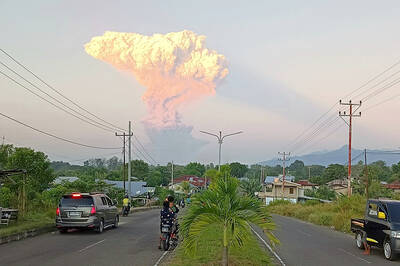
Indonesia’s Mount Lewotobi Laki-Laki yesterday erupted again with giant ash and smoke plumes after forcing evacuations of villages and flight cancelations, including to and from the resort island of Bali. Several eruptions sent ash up to 5km into the sky on Tuesday evening to yesterday afternoon. An eruption on Tuesday afternoon sent thick, gray clouds 10km into the sky that expanded into a mushroom-shaped ash cloud visible as much as 150km kilometers away. The eruption alert was raised on Tuesday to the highest level and the danger zone where people are recommended to leave was expanded to 8km from the crater. Officers also


 RSS
RSS