


A former Chinese diplomat granted a visa to live in Australia yesterday urged locals engaged in spying for China to quit.
Chen Yonglin (陳用林) produced documents he said proved that Beijing had a network of spies operating in his adopted country.
Chen, who went into hiding after leaving his job at the Chinese consulate-general in Sydney on May 26, was last week granted a permanent resident visa to stay in the country.
agents and informers
The former political officer claimed after his defection that Beijing had 1,000 spies operating as "agents and informers" -- a claim rubbished by Chinese Ambassador Fu Ying (
To back his claim, Chen made public three consulate general documents relating to adherents of the Falun Gong spiritual movement he said showed the Chinese community in Australia was being spied on.
Beijing views Falun Gong as an evil sect and punishes its followers.
"In the Chinese community there are a lot of informants, of course," Chen told Australia's AAP news agency. "Today, I don't want to publicize all these names, I just want to warn these people to stop doing that. I want to tell these informants from the bottom of my heart, I look down upon them."
open floodgates
Fu last week urged Canberra not to let Chen stay and promised that no harm would come to him if he returned home. She warned Canberra that granting him a visa would open the floodgates to other applications.
"We have some Chinese who don't like China that much and want to profit from their own personal agenda," Fu said. "They would move to Switzerland, Australia and the USA. Mr. Chen is an example. He now appears to be hating China so much, but China offered him the best a young man can have."
Two other Chinese officials are bidding for protection visas that would allow them to make Australia their home. The defections come at the start of Canberra's negotiations towards a free trade agreement with China.
In his nine years as prime minister, critics allege John Howard has put trade ahead of human rights concerns in his dealings with Beijing. China is Australia's third largest trade partner, after Japan and the US, with annual trade worth A$28 billion (US$21 billion).
Chen seems determined to prove that securing a visa would not be enough to silence him. Before he was given his visa, he alleged that China was engaged in a campaign to influence Australian policies and break its military alliance with the US.
He said Canberra ignored human rights abuses in China and was even complicit in the persecution of local Falun Gong followers.

‘CROSSING THE LINE’: China’s embassy in Seoul criticized US Forces Korea Commander General Xavier Brunson, asking if his ‘hostile’ remarks were authorized by Washington South Korea and the US are in talks over recent public remarks by the commander of US Forces Korea, Seoul’s presidential office said yesterday, after the comments drew sharp criticism from China. In a recent podcast interview, US Forces Korea Commander General Xavier Brunson described South Korea as “the dagger in the heart of Asia” from China’s east coast, prompting the Chinese embassy in Seoul to say that he had “truly crossed the line.” The interview came amid growing speculation that Washington might seek to expand the role of US Forces Korea in countering the growing regional influence of China, a key

Through the noise of rushing papers and whirring belts at a print factory in Kyoto, two creators watch their photo essay come to life in broadsheet form — part of an effort to win new audiences in the age of artificial intelligence (AI). Despite the decline of the publishing industry, self-publication and handmade “zine” magazines are growing in popularity in Japan, reflecting the nation’s enduring love of paper in the digital era. While speaking to Agence France-Presse at the plant, his hands black with ink, one of the creators, Kazuma Obara, said: “I think [paper] is a medium that engages all five

Australian researchers have trained lab-grown brain cells on a silicon computer chip to play the 1990s shooter game Doom and said they are just scratching the surface of what the neurons could be capable of doing. It is the science-fiction work of biotech boffins at Cortical Labs, who researched and developed the technology that harnesses the workings of the brain’s networking system. Each so-called “biological computer” contains about 200,000 living human brain cells, grown from stem cells that were harvested from blood donations. Having mastered the simple computer game Pong, where a paddle is moved up and down to send a ball
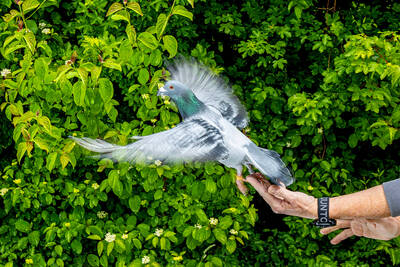
A surprising gut feeling may help pigeons find their way home. Animals use various techniques to navigate, including following the stars and remembering key landmarks. Birds, fish and turtles orient themselves using Earth’s magnetic field as a compass, but it is not yet clear how exactly they do this. Pigeons are a well-known group of frequent flyers that can traverse hundreds of kilometers in a single day. For thousands of years, humans have used them to carry news, notes and military messages. Scientists have long tried to untangle how pigeons travel without getting lost. Some think the birds detect magnetic cues using light-sensitive


 RSS
RSS