


Dozens of teenagers dressed in blue Hindustan Times T-shirts are the latest soldiers in a media war stirring on the streets of India's financial and entertainment capital.
The youngsters, who stop Mumbai citizens to ascertain what they would like to read every day, are preparing for the New Delhi-based paper's launch in Mumbai later in the summer.
They are in battle with the Daily News and Analysis, or DNA, which will also hit the newsstands in September and has put up more than 150 billboards in the city as well as fielding its own team of bright young market researchers.
Both newspapers are hoping to break the local domination by leading English-language daily Times of India and capture a growing pool of advertisers and readers in the city of almost 20 million people.
In an early counterattack, the Times of India's parent company Bennett Coleman on Monday launched the Mumbai Mirror, an English-language daily tabloid, to deflect the new competition.
The Mirror's inaugural 48-page edition carried a typical range of newspaper features including city, state, international, sports pages and 12 pages of classifieds. The lead story was of Bollywood legend Amitabh Bachchan's fallout with elder brother Ajitabh over financial issues, in a story titled "Brothers set for hatchet job."
A media scrap is intensifying nationwide because India's newspaper market is defying an international trend -- it's growing -- and advertisers are eager to tap a booming consumer market. Mumbai is at the center of the war.
Even as print media in the rest of the world goes through a rough patch, with US print readership down 8 percent last year, the Indian market is growing steadily and is expected to cover 20 percent of the 1 billion-plus population in the next three years.
Official data shows that the total number of newspapers sold, including in English, reached 142 million last year, compared with around 55 million in the US.
Priced at 2 rupees (US$0.05) an issue, newspapers are also the main source of news in India followed by television, with Internet lagging behind because of low penetration and high costs.
India has around 10 computers for every 1,000 people against 500 in the US and 200 in China. Sales of computers in China are around 13 million units annually, compared to 3 million in India.
"A low computer penetration in the country is helping the print media as Internet access and online news reading is still in the infant stage," says Prateesh Krishnan, an analyst at SBI Capital Markets.
A strong advertising market is the other key driver for the new entrants as print advertising rose 14 percent to 55 billion rupees (US$1.3 billion) last year, of which over 10 billion rupees was spent in Mumbai alone, the bulk grabbed by the Times of India.
The only competition for the Times of India in Mumbai is an afternoon tabloid called Mid-Day with a circulation of around one-third of its morning rival's 560,000 copies a day.
"The advertiser in Mumbai has been exploited with high prices by the Times, while advertisement in other publications gets a low response. So a second paper is essential for everyone's benefit," says Kumar Ketkar, veteran analyst and editor of the leading local Marathi-language regional daily, Loksatta. "So there is a market, there are advertisers ready to explore new avenues and there are readers."
DNA, the brainchild of former Times of India marketing chief Pradeep Guha, is aimed at dethroning his old employer.
"It is for the first time that Times of India is facing the heat," DNA marketing director Suresh Balakrishnan says.
"The size and scale of DNA has scared the Times and it is already reacting by rapidly changing its content," he claims.
Industry sources claim DNA, a 50-50 joint venture between television group Zee and the Bhaskar group, is armed with a war chest of six billion rupees (US$140 million), including a pre-launch advertising budget of 600 million rupees.

An American scientist convicted of lying to US authorities about payments from China while he was at Harvard University has rebuilt his research lab in Shenzhen, China, to pursue technology the Chinese government has identified as a national priority: embedding electronics into the human brain. Charles Lieber, 67, is among the world’s leading researchers in brain-computer interfaces. The technology has shown promise in treating conditions such as amyotrophic lateral sclerosis and restoring movement in paralyzed people. It also has potential military applications: Scientists at the Chinese People’s Liberation Army have investigated brain interfaces as a way to engineer super soldiers by boosting
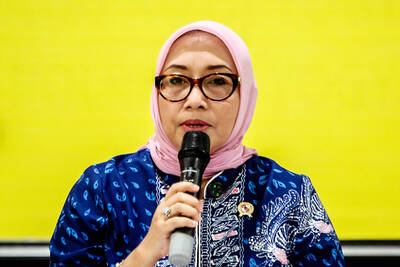
Indonesian police have arrested 13 people after shocking images of alleged abuse against small children at a daycare center went viral, sparking outrage across the nation, officials said on Monday. Police on Friday last week raided Little Aresha, a daycare center in Yogyakarta on Java island, following a report from a former employee. CCTV footage circulating on social media showed children, most younger than two, lying on the floor wearing only diapers, their hands and feet bound with rags. The police have confirmed that the footage is authentic. Police said they also found 20 children crammed into a room just 3m by 3m. “So
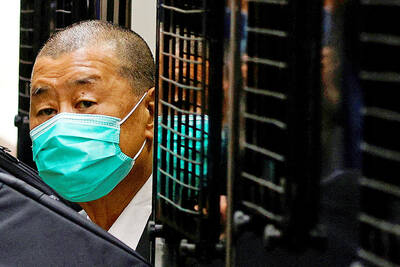
Jailed media entrepreneur Jimmy Lai (黎智英) has been awarded Deutsche Welle’s (DW) freedom of speech award for his contribution to Hong Kong’s pro-democracy movement. The German public broadcaster on Thursday said Lai would be presented in absentia with the 12th iteration of the award on June 23 at the DW Global Media Forum in Bonn. Deutsche Welle director-general Barbara Massing praised the 78-year-old founder of the now-shuttered news outlet Apple Daily for standing “unwaveringly for press freedom in Hong Kong at great personal risk.” “With Apple Daily, he gave journalists a platform for free reporting and a voice to the democracy movement in
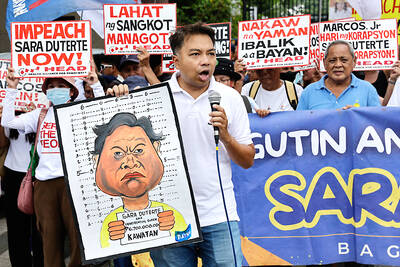
PHILIPPINE COMMITTEE: The head of the committee that made the decision said: ‘If there is nothing to hide, there is no reason to hide, there is no reason to obstruct’ A Philippine congressional committee on Wednesday ruled that there was “probable cause” to impeach Philippine Vice President Sara Duterte after hearing allegations of unexplained wealth, misuse of state funds and threats to have the president assassinated. The unanimous decision of the 53-member committee in the Philippine House of Representatives sends the two impeachment complaints to deliberations and voting by the entire lower chamber, which has more than 300 lawmakers. The complaints centered on Duterte’s alleged illegal use and mishandling of intelligence funds from the vice president’s office, and from her time as education secretary under Philippine President Ferdinand Marcos Jr. Duterte and the


 RSS
RSS