


China has launched a new effort to prevent anti-Japanese violence before a sensitive anniversary, warning against protests and calling on the public to express patriotism sensibly.
"Express patriotism rationally. Don't take part in illegal protests. Don't make trouble," said a text message sent by Beijing police to millions of mobile phone users in the capital. Warnings also were spread by text message and state media in several other cities in the campaign, launched Saturday.
Chinese leaders have demanded calm following weeks of protests that damaged Japan's Beijing embassy and a consulate, warning of possible damage to important economic ties with Tokyo.
But official concern could be especially acute as China marks the anniversary on Wednesday of an anti-Japanese protest on May 4, 1919, that has become a symbol of resistance to foreign domination.
The anniversary is awkward for Chinese leaders, because the protesters in 1919 complained that China's leaders were weak in the face of Japanese aggression -- a charge that current rulers are eager to avoid. The 1919 protests erupted after Japan was awarded Germany's former colonies in China following World War I. Despite public pressure, Chinese leaders failed to recover the territory from Tokyo, which expanded its control to much of China during the 1930s and early 40s.
The latest wave of anti-Japanese protests began with complaints about new Japanese schoolbooks that critics say minimize Tokyo's wartime abuses, as well as opposition to Japan's campaign for a permanent UN Security Council seat and disputes over territory in the East China Sea.
There was no word of any new protests Saturday. Last weekend also passed without demonstrations, following three straight weekends when thousands of people held rallies in Beijing, Shanghai and other cities. Police in Beijing and Shanghai denied rumors that they approved public gatherings and warned that demonstrators could face legal action. Chinese leaders including Premier Wen Jiabao (
Some have suggested communist leaders might have allowed earlier protests in order to undermine Tokyo's Security Council campaign. But now they apparently fear that permitting more demonstrations might damage relations with Japan and encourage people with other grievances to take to the streets.
"To ensure social stability, police will not approve any rally, demonstration or protest in the near future," said a notice from Shanghai police that appeared in newspapers and was read on local television.

An American scientist convicted of lying to US authorities about payments from China while he was at Harvard University has rebuilt his research lab in Shenzhen, China, to pursue technology the Chinese government has identified as a national priority: embedding electronics into the human brain. Charles Lieber, 67, is among the world’s leading researchers in brain-computer interfaces. The technology has shown promise in treating conditions such as amyotrophic lateral sclerosis and restoring movement in paralyzed people. It also has potential military applications: Scientists at the Chinese People’s Liberation Army have investigated brain interfaces as a way to engineer super soldiers by boosting

Indonesian police have arrested 13 people after shocking images of alleged abuse against small children at a daycare center went viral, sparking outrage across the nation, officials said on Monday. Police on Friday last week raided Little Aresha, a daycare center in Yogyakarta on Java island, following a report from a former employee. CCTV footage circulating on social media showed children, most younger than two, lying on the floor wearing only diapers, their hands and feet bound with rags. The police have confirmed that the footage is authentic. Police said they also found 20 children crammed into a room just 3m by 3m. “So
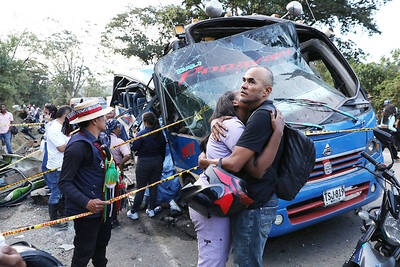
A highway bomb attack in a restive region of southwestern Colombia on Saturday killed 14 people and injured at least 38, the latest spate of violence ahead of next month’s presidential election. Authorities blamed the attack in the Cauca department — a conflict-ridden, coca-growing region — on dissidents of the now-disbanded FARC guerrilla army, who have been sowing violence across the country. “Those who carried out this attack ... are terrorists, fascists and drug traffickers,” Colombian President Gustavo Petro said on social media. “I want our very best soldiers to confront them,” he added. The leftist leader blamed the bombing
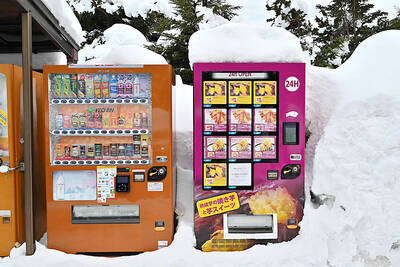
From post offices and parks to stations and even the summit of Mount Fuji, Japan’s vending machines are ubiquitous, but with the rapid pace of inflation cooling demand for their drinks, operators are being forced to rethink the business. Last month beverage giant DyDo Group Holdings announced it would remove about 20,000 vending machines — about 7 percent of their stock nationwide — by January next year, to “reconstruct a profitable network.” Pokka Sapporo Food & Beverage, based in Nagoya, also said last month it would sell its 40,000-machine operation to Osaka-based Lifedrink Co. “The strength of the vending machine


 RSS
RSS