


It's early morning and an armored personnel carrier belonging to UN peacekeepers from China warily moves through a small market in Cite Soleil, a huge dilapidated suburb of the Haitian capital that is home to about 700,000 people.
The patrol, which also includes two vehicles with grille-covered windows, attracts little attention.
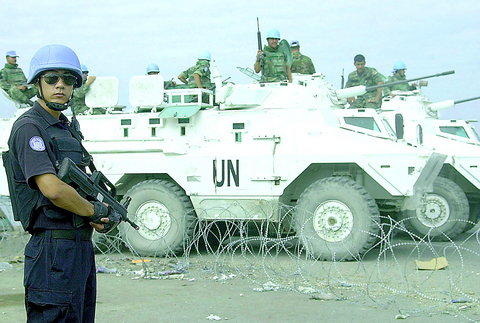
PHOTO: AFP
A few Haitian vendors wave as the Chinese soldiers drive by. It is because of the UN patrols that commercial activities have resumed here.
"But, we don't have any buyers," complains a woman, with a note of despair in her voice.
"This is our first mission in the Western hemisphere," says Shao Weimin, the deputy commander of the Chinese contingent.
The officer speaks proudly of the job the Chinese troops have been doing in Haiti in general and in this poverty-stricken shantytown, located close to downtown Port-au-Prince.
Cite Soleil is a stronghold of paramilitary groups known as chimeres that supported deposed president Jean Bertrand Aristide. The ex president fled Haiti about a year ago under the threat of an armed uprising and has been living in exile in South Africa ever since.
Violence routinely flares on the shantytown, but at this time of day the chimeres are hiding.
The luckiest among the youngsters of the neighborhood go to the few schools that still exist here. Others hang around a small police outpost manned by 12 Chinese police officers clad in black.
"We keep Cite Soleil secure," says Shao. "We want to bring back some order and safety to the locals here."
China has contributed 138 police officers -- 125 men and 13 women -- to the UN stabilization force that has been deployed in Haiti for eight months.
Police officers from Nepal, Pakistan and Jordan also take part in the patrols, he points out.
Shao's only foreign tongue is English, while Haitians speak French and Creole.
When a local boy comes up asking for water, he seeks help from 27-year-old interpreter Lee Hua, who sports a sidearm.
Lee knows a few sentences in Creole, but has to consult her notes often to produce answers.
Most of the time the answer is "no."
It is given every time youngsters or unemployed men ask her for cigarettes or demand her wristwatch.
However, Lee smiles all the time, and Haitians love people who smile.
As part of their public relations campaign, Chinese police officers distribute food, take care of the wounded and play soccer with local boys.
"At least the Chinese are talking to us, which cannot be said of others," says one of the local boys hanging around.
As he speaks, three UN armored carriers full of soldiers arrive in a cloud of dust
"We want all these people to go home and Aristide to return," remarks 10-year-old Lababa, who boasts of being able to handle an M-16 automatic rifle he insists he has at home.
"Life has never been the same in Cite Soleil since his [Aristide's] departure. We have a lot of weapons and we'll fight the military. They are all cowards. They hide at night in their armored carriers and retreat," the youngster says.
Shao admits that while the neighborhood is mostly calm by day, once night falls the area can become violent. Shooting occasionally erupts and people get wounded.
The Chinese officer hopes the Haitian police will soon resume patrols in Cite Soleil, but local residents might not react favorably to such patrols.
Nearby, a group of Haitian policemen are holed up in their station at the entrance to the shantytown and rely for their own security on the UN troops.

An American scientist convicted of lying to US authorities about payments from China while he was at Harvard University has rebuilt his research lab in Shenzhen, China, to pursue technology the Chinese government has identified as a national priority: embedding electronics into the human brain. Charles Lieber, 67, is among the world’s leading researchers in brain-computer interfaces. The technology has shown promise in treating conditions such as amyotrophic lateral sclerosis and restoring movement in paralyzed people. It also has potential military applications: Scientists at the Chinese People’s Liberation Army have investigated brain interfaces as a way to engineer super soldiers by boosting
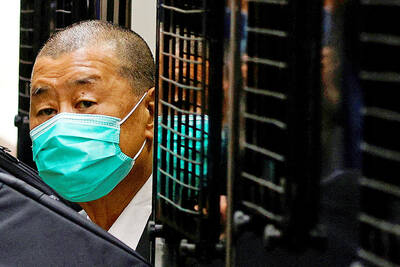
Jailed media entrepreneur Jimmy Lai (黎智英) has been awarded Deutsche Welle’s (DW) freedom of speech award for his contribution to Hong Kong’s pro-democracy movement. The German public broadcaster on Thursday said Lai would be presented in absentia with the 12th iteration of the award on June 23 at the DW Global Media Forum in Bonn. Deutsche Welle director-general Barbara Massing praised the 78-year-old founder of the now-shuttered news outlet Apple Daily for standing “unwaveringly for press freedom in Hong Kong at great personal risk.” “With Apple Daily, he gave journalists a platform for free reporting and a voice to the democracy movement in
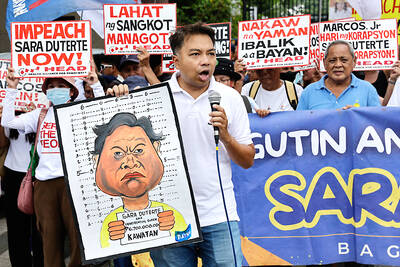
PHILIPPINE COMMITTEE: The head of the committee that made the decision said: ‘If there is nothing to hide, there is no reason to hide, there is no reason to obstruct’ A Philippine congressional committee on Wednesday ruled that there was “probable cause” to impeach Philippine Vice President Sara Duterte after hearing allegations of unexplained wealth, misuse of state funds and threats to have the president assassinated. The unanimous decision of the 53-member committee in the Philippine House of Representatives sends the two impeachment complaints to deliberations and voting by the entire lower chamber, which has more than 300 lawmakers. The complaints centered on Duterte’s alleged illegal use and mishandling of intelligence funds from the vice president’s office, and from her time as education secretary under Philippine President Ferdinand Marcos Jr. Duterte and the
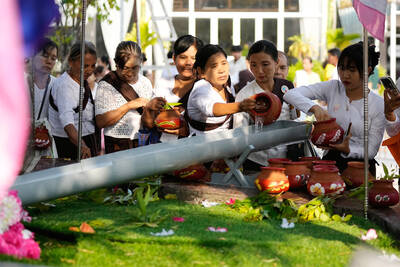
Burmese President Min Aung Hlaing yesterday cut all prisoners’ sentences by one-sixth, a blanket measure that a source close to deposed leader Aung San Suu Kyi said would further shorten her detention. Aung San Suu Kyi has been sequestered since a 2021 military coup, but the senior member of her dissolved National League for Democracy (NLD) party said that while her term had been reduced, her remaining sentence is still unclear. “We also don’t know exactly how many years she has left,” the source told reporters, speaking on condition of anonymity for security reasons. The military toppled Aung San Suu Kyi’s elected government


 RSS
RSS