


Former Chinese party chief Zhao Ziyang (趙紫陽) was cremated in a tightly controlled funeral yesterday as Beijing signaled it had no intention of changing its stance on the reformist leader purged for opposing the 1989 Tiananmen Massacre.
"Comrade Zhao Ziyang, who passed away on January 17 at the age of 85, was cremated at the Babaoshan Revolutionary Cemetery in western Beijing Saturday morning," the official Xinhua news agency said in a brief dispatch.
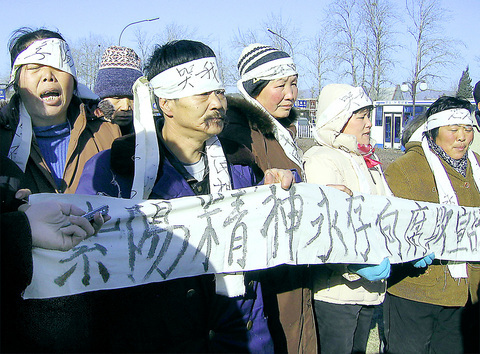
PHOTO: AFP
The cremation followed a nearly three-hour funeral attended by an estimated 2,000 people, with hundreds of plainclothes police and government workers keeping a tight watch on proceedings.
Shortly afterwards, China indicated it had no plans to change its assessment of Zhao, who was under house arrest for the past 15 years for sympathizing with the prodemocracy movement, later crushed in a military crackdown.
"During the early period of reform and opening, Comrade Zhao Ziyang ... made useful contributions towards the party and the people," Xinhua said.
But it reiterated: "In the political turbulence during the Spring and Summer of 1989, Comrade Zhao Ziyang made a grave mistake."
State television briefly mentioned the cremation, marking the first time his death had been announced on TV and the first time the ousted Communist Party chief's name was mentioned on television since 1989.
The funeral was entirely controlled by the government, said witnesses.
"People were only allowed to go in, take a bow and come out," Zhao's nephew, who declined to be named, told reporters.
"Guests could not even bring their own flowers. They had to use wreaths brought there by the government and they could not even write their own inscriptions on wreaths."
Instead the phrases were fixed by the government, including: "Commemorating Zhao Ziyang with a heavy heart."
"It's very insensitive to people's feeling, unreasonable," he said.
The family, dressed in traditional Chinese mourning clothes, were overcome with grief and wept.
"There was an air of deep sadness. A lot of the mourners were crying," said Wang Zhiwei, one of Zhao's former secretaries.
"The body was draped with a Communist Party flag. He looked thin. The hair was white."
Guests were given white paper flowers as they entered the funeral hall but guards demanded the flowers back as they left.
Police ringed the cemetery, stopping vehicles, demanding to see identification documents and ordering journalists to leave, even those with entry passes.
The government had sought to keep Zhao's death and the ceremony low-key to prevent the event becoming a rallying point for those dissatisfied with the Communist Party.
The funeral was delayed by a dispute between family members and the government over his official legacy, the guest list and where his ashes should be placed.
Zhao's family had strongly objected to the words "grave mistake" being included in an official summary of his life, which is issued following the death of a Chinese leader.
"We basically have no rights to say how the funeral will be held. It's completely an official ceremony," Zhao's daughter Wang Yannan told reporters on the eve of the funeral.
"We will never agree with their arrangements and conclusions. I agreed to have the funeral on this date only because of our feelings for our father. We wanted him to be put to rest as soon as possible."
"Absolutely! This whole thing is organized by the officials," the nephew said after the funeral.
Jia Qinglin (
Few people knew about Zhao's death, but a group of about 30 elderly protesters wearing headbands with the words "Mourning for Ziyang" called on the government to respect human rights outside the funeral site yesterday.
They were detained briefly and released.
Zhao's ashes were taken to his Beijing home where they will be placed for now, said his son Zhao Sijun. The family had wanted them stored in a mausoleum reserved for top leaders, but the government refused.
Zhao said the family was "not surprised" by the government's actions, but felt it had done its duty.
"We did what we were responsible for -- sending off the elderly," he said.
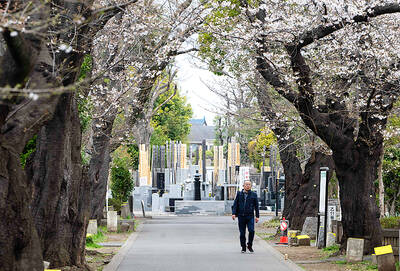
ROCKY RELATIONS: The figures on residents come as Chinese tourist numbers drop following Beijing’s warnings to avoid traveling to Japan The number of Chinese residents in Japan has continued to rise, even as ties between the two countries have become increasingly fractious, data released on Friday showed. As of the end of December last year, the number of Chinese residents had increased by 6.5 percent from the previous year to 930,428. Chinese people accounted for 22.6 percent of all foreign residents in Japan, making them by far the largest group, Japanese Ministry of Justice data showed. Beijing has criticized Tokyo in increasingly strident terms since Japanese Prime Minister Sanae Takaichi last year suggested that a military conflict around Taiwan could
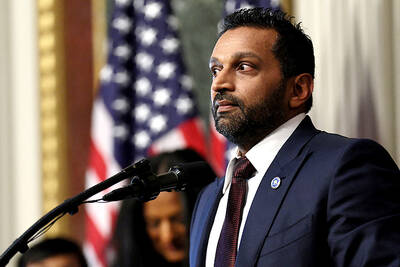
A pro-Iran hacking group claimed to breach FBI Director Kash Patel’s personal e-mail inbox and posted some of the contents online. The e-mails provided by the hacking group include travel details, correspondence with leasing agents in Washington and global entry, and loyalty account numbers. The e-mail address the hackers claim to have compromised has been previously tied to Patel’s personal details, and the leaked e-mails contain photos of Patel and others, in addition to correspondence with family members and colleagues. “The FBI is aware of malicious actors targeting Director Patel’s personal email information,” the agency said in a statement on
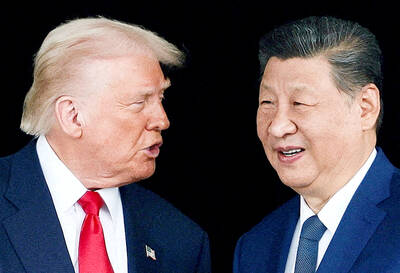
RIVALRY: ‘We know that these are merely symbolic investigations initiated by China, which is in fact the world’s most profligate disrupter of supply chains,’ a US official said China has started a pair of investigations into US trade practices, retaliating against similar probes by US President Donald Trump’s administration as the superpowers stake out positions before an expected presidential summit in May. The move, announced by the Chinese Ministry of Commerce on Friday, is a direct mirror of steps Trump took to revive his tariff agenda after the US Supreme Court last month struck down some of his duties. “China expresses its strong dissatisfaction and firm opposition to these actions,” a ministry spokesperson said in a statement, referring to the so-called Section 301 investigations initiated on March 11.

When a hiker fell from a 55m waterfall in wild New Zealand bush, rescuers were forced to evacuate the badly hurt woman without her dog, which could not be found. After strangers raised thousands of dollars for a search, border collie Molly was flown to safety by a helicopter pilot who was determined to reunite the pet and the owner. A week earlier, an emergency rescue helicopter found the woman with bruises and lacerations after a fall at a rocky spot at the waterfall on the South Island’s West Coast. She was airlifted on March 24, but they were forced to


 RSS
RSS