


The oil-rich Indonesian province of Aceh was one of the few places hit by both southern Asia's massive earthquake and the tsunamis it caused -- a double blow that killed thousands and wreaked so much devastation that separatists fighting a decades-long insurgency called a temporary ceasefire.
Streets in the province's capital, Banda Aceh -- about 240km from the quake's epicenter -- were filled with bloated corpses, dead cows and animals and overturned cars. The city's only shopping mall was reduced to a pile of rubble, the minaret of the city's 150-year-old mosque leaned precariously, and thousands of homeless families huddled together in mosques and schools.
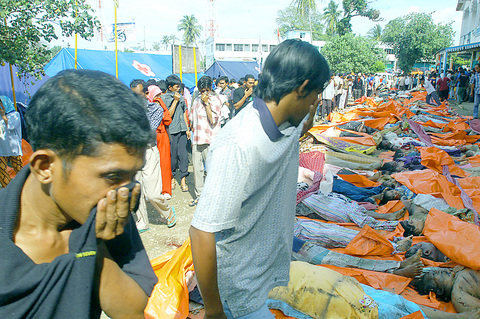
PHOTO: AP
Remote coastal villages were washed away in the province, the home of 3,000 of Indonesia's 5,000 confirmed dead. Officials feared that once the devastation from Aceh was fully known, the country's death toll could reach 10,000.
It was a stunning tragedy for the territory at the northern tip of Sumatra island that supplies around 30 percent of Indonesia's oil production and has been torn for years by conflict between separatist rebels and government forces.
The Free Aceh Movement's announcement Monday that it would abide by a ceasefire so that relief agencies could safely deliver supplies into the province. "We will not be on the offensive, but we will be on the defensive," said Baktiar Abdullah, a guerrilla spokesman.
About half the 10,000 troops deployed in the province to fight the insurgency were shifted to the relief effort, the government said. During a visit to Banda Aceh, President Susilo Bambang Yudhoyono called on both sides in the conflict to unite.
"To my brothers who still hold weapons, please come together and unite to redevelop our beloved Aceh," Yudhoyono told reporters.
The government also eased a ban on foreigners traveling to Aceh, allowing foreign reporters to travel freely through the war-torn province and international relief agencies to fly in medicines, food and other basic necessities.
"The government has requested international assistance which it hasn't done since I've been here," said Michael Elmquist, who has headed the UN's Office for Coordination of Humanitarian Affairs in Jakarta the past four years.
"The indication is that there shouldn't be a problem," he said. "We've been told that the vice president has instructed the air force to facilitate the arrival of foreign assistance upon arrival. They will allow flights from abroad to land in Banda Aceh without any problems."
Guerrillas have been fighting since 1976 for an independent homeland in Aceh. At least 13,000 people have been killed since then, including 2,300 since Jakarta launched its latest military offensive in early last year. Since May this year, the government eased up on martial law and Yudhoyono has been calling for peace there -- offering amnesty and promising economic development. But there has been no movement toward new peace negotiations, and several dozen are still killed every week in clashes.
The local subsidiary of US petroleum giant Exxon Mobil Corp suffered a temporary "minor disruption" in its natural gas liquefaction operations from Sunday's disaster, a company spokesman said. Indonesia, the only Asian member of the Organization of Petroleum Exporting Countries, is the world's largest liquefied natural gas exporter.
On Monday, residents of Aceh province -- where many are deeply conservative Muslims -- were reeling. In Banda Aceh, a city of 400,000, dazed relatives scoured rows of corpses laid out in the afternoon sun for dead loved ones. Mothers -- some holding their dead children -- cried for help.
In the village of Pidie, witnesses said the tsunami tossed boats about like toys and destroyed hundreds of wooden houses.
Abdul Dahlan, a 27-year-old fisherman, said he was waiting on the beach for his brother to return from sea when he noticed a strange silence. The water then rapidly receded and then a 4.5m wave came barreling toward them.
"We yelled out: The sea is drying out! It's drying out," he said.

An American scientist convicted of lying to US authorities about payments from China while he was at Harvard University has rebuilt his research lab in Shenzhen, China, to pursue technology the Chinese government has identified as a national priority: embedding electronics into the human brain. Charles Lieber, 67, is among the world’s leading researchers in brain-computer interfaces. The technology has shown promise in treating conditions such as amyotrophic lateral sclerosis and restoring movement in paralyzed people. It also has potential military applications: Scientists at the Chinese People’s Liberation Army have investigated brain interfaces as a way to engineer super soldiers by boosting

Indonesian police have arrested 13 people after shocking images of alleged abuse against small children at a daycare center went viral, sparking outrage across the nation, officials said on Monday. Police on Friday last week raided Little Aresha, a daycare center in Yogyakarta on Java island, following a report from a former employee. CCTV footage circulating on social media showed children, most younger than two, lying on the floor wearing only diapers, their hands and feet bound with rags. The police have confirmed that the footage is authentic. Police said they also found 20 children crammed into a room just 3m by 3m. “So
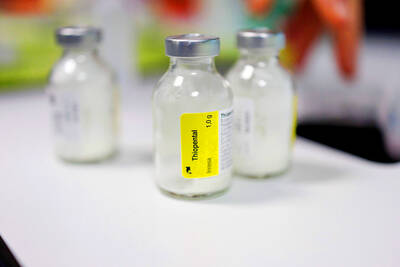
A grieving mother has ended her life at a clinic in Switzerland four years after the death of her only child. Wendy Duffy, 56, a physically healthy woman, died at the Pegasos clinic in Basel after struggling to cope with the death of her 23-year-old son, Marcus. The former care worker, from the West Midlands, England, had previously attempted to take her own life. The case comes as assisted dying would not become law in England and Wales after proposed legislation, branded “hopelessly flawed” by opponents, ran out of time. Ruedi Habegger, the founder of Pegasos, described Duffy’s death as
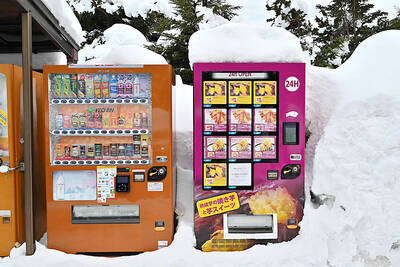
From post offices and parks to stations and even the summit of Mount Fuji, Japan’s vending machines are ubiquitous, but with the rapid pace of inflation cooling demand for their drinks, operators are being forced to rethink the business. Last month beverage giant DyDo Group Holdings announced it would remove about 20,000 vending machines — about 7 percent of their stock nationwide — by January next year, to “reconstruct a profitable network.” Pokka Sapporo Food & Beverage, based in Nagoya, also said last month it would sell its 40,000-machine operation to Osaka-based Lifedrink Co. “The strength of the vending machine


 RSS
RSS