


In his four decades as Palestinian president, Yasser Arafat has run a murky financial empire that includes far-flung PLO investments in airlines, banana plantations and high-tech companies, and money hidden in bank accounts across the globe.
Jaweed al-Ghussein, a former PLO finance minister, told reporters it was worth US$3 billion to US$5 billion when he quit in 1996. No one will say how much it's worth now -- some estimates say as little as a few million. But as 75-year-old Arafat fights for life in a hospital near Paris, Palestinians fear that what's left will disappear or be pocketed by Arafat cronies.
"It's the money of the Palestinian people," said Palestinian legislator Hassan Khreishe, adding that he would urge a parliamentary investigation.
That could prove difficult. Arafat has long resisted proper accounting for the funds, which include Arab payments to the PLO in the 1970s and 1980s, and Western aid to his self-rule government, the Palestinian Authority, after interim peace deals with Israel in the 1990s.
Arafat lived frugally, but needed large sums to maintain loyalties. He would register investments and bank accounts in the names of loyalists, both to buy their support and protect the holdings from scrutiny and seizure, al-Ghussein said.
Only Arafat had the full picture, he said, and it's not clear whether he left a will or financial records.
Arafat never divulged his finances. Pressed at a February meeting with leaders of his Fatah movement, he cut them short, saying "there are no assets," according to one participant.
Mohammed Rashid, Arafat's financial adviser, denied his boss was rich.
"Arafat has no personal property in any part in the world," he told al-Arabiya television on Sunday. "He doesn't even have a tent, a house, an orchard or any account that we can call personal in the name of Yasser Arafat."
However, Forbes magazine ranked him No. 6 on last year's list of the richest "kings, queens and despots," estimating he was worth at least US$300 million. Shalom Harari, a former top Israeli intelligence official, said Arafat may have stashed away up to US$700 million, part of it for an emergency such as a new exile, especially with Israel threatening to expel him.
Two names frequently come up in connection with Arafat's money -- Rashid and Arafat's wife, Suha.
In the past 10 years, Rashid has handled hundreds of millions of dollars in Palestinian Authority revenue Arafat diverted from the treasury -- though a reformist finance minister, Salam Fayyad, said the money was invested on behalf of the Palestinian Authority and has since been restored to public control.
Suha Arafat, Arafat's wife of 13 years and mother of his daughter, lives in Paris and has received monthly payments of US$100,000 from the Palestinian coffers, according to a senior official in Arafat's office. This year, French prosecutors launched a money-laundering probe into transfers of US$11.4 million into her accounts. She has refused to talk to reporters about Palestinian finances.
Al-Ghussein, speaking by telephone from London, said the big money from the Arab world started flowing in 1979. For a decade, the PLO received about US$200 million a year, US$85 million of it from Saudi Arabia, he said.
Al-Ghussein, who headed the Palestinian National Fund, the PLO treasury, said during that period, he would hand Arafat a check for US$10.25 million (on) every month from the PLO budget, ostensibly for payments to PLO fighters and families of those killed in battle. He said Arafat refused to account for his spending, citing national security.
The PLO investments are said to have ranged from an airline in the Maldives to a Greek shipping company, banana plantations, a diamond mine in Africa and real estate throughout the Arab world.
The holdings were registered in the names of dozens of Arafat loyalists, according to a retired PLO financier in Gaza and to a Palestinian economist in the West Bank who began following the money trail at the request of some Fatah officials this year. Both spoke on condition of anonymity.
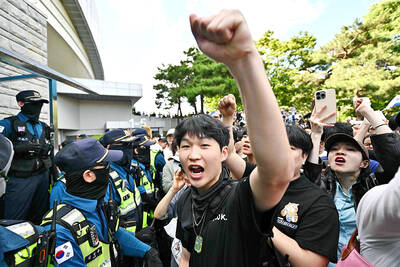
‘ABSURD MISTAKE’: The election commission said that there had been a failure to anticipate turnout after 14 polling stations ran short of ballot papers South Korean riot police yesterday cleared protesters from a Seoul polling station after a 35-hour blockade sparked by a shortage of ballot papers during local elections earlier this week. Wednesday’s election was the first nationwide vote since South Korean President Lee Jae-myung took office following the ouster of Yoon Suk-yeol over his short-lived martial law declaration. Lee’s ruling Democratic Party swept most races, but failed to flip the crucial Seoul mayoral seat. The South Korean National Election Commission apologized, blaming a failure to anticipate turnout after 14 polling stations in Seoul ran short of ballot papers. Some polling stations stayed open until 10pm to
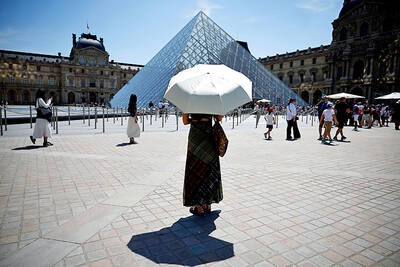
France experienced its hottest spring on record, the French weather service said on Tuesday, after an exceptional early heat wave that also broke highs for the season in England and Wales. Meteo-France said the average nationwide temperature over March to May was 13.8°C — about 1.7°C above the norm, and surpassing records set in 2011 and 2020. “The warmest spring since records began in 1900,” it said in a bulletin. All three months were warmer than average, but the onset of an “unprecedented heatwave” late last month pushed the mercury to highs typically seen at the height of the summer. “Our country had never
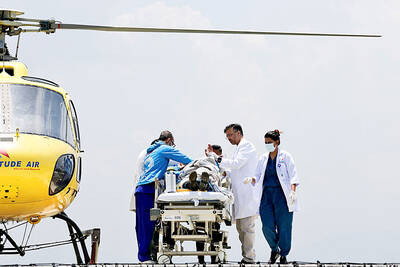
A Sherpa guide was found crawling to base camp on Mount Everest a week after he went missing and was reunited with his family, who had given up hope he would return. Dawa Sherpa was last seen on Friday last week descending the mountain, but he did not reach base camp even though his client did. The pair were among the last climbers on the mountain as the climbing season came to an end and the route was dismantled. Dawa was located by a cleaning crew on Thursday morning as he was crawling down the snowy slopes around the Khumbu Icefall, just above
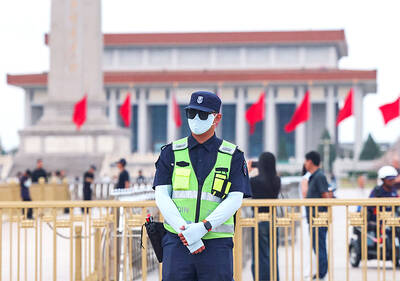
Chinese authorities are snuffing out any remembrance of the deadly 1989 military crackdown on student-led pro-democracy protests in Tiananmen Square, which happened 37 years ago yesterday, in a further tightening of a years-long campaign to erase what happened from public memory. Police told relatives of the victims they would not be allowed to visit a cemetery in Beijing on the anniversary of the crackdown, a person with knowledge of the matter said. Relatives of the victims visited the cemetery on the anniversary for more than 30 years to read memorial statements with police keeping watch, Amnesty International said. Hundreds of people,


 RSS
RSS