


Abkhazian President Vladislav Ardzinba dismissed his prime minister, presidential candidate Raul Khadzhimba, to dispel any accusations of favoritism following the separatist region's inconclusive election.
Ardzinba named Nodar Khashba, former mayor of the separatist capital, Sukhumi, to the position late on Wednesday, according to reports in Russian media.
Abkhazia's first openly contested presidential election ended in confusion as election officials repeatedly delayed announcing vote totals and Khadzhimba, the government-supported candidate, alleged widespread violations.
Disputed district
On Wednesday, the Central Election Commission agreed to throw out the results from Sunday's vote in one district and ordered a repeat vote there -- a move that critics say violates the law.
Ardzinba accused opposition candidate Sergei Bagapsh, who was the acknowledged leader in the race, of sparking a crisis that could lead to civil war by appealing for the new vote.
"We are facing one task -- to ensure that the elections are conducted normally and to transfer power to the new, legally elected president," Khashba was quoted as saying by the ITAR-Tass news agency.
He said he planned to meet yesterday with the presidential candidates "to discuss the situation surrounding the presidential elections in order to return it to the legal path," the Interfax news agency said.
Abkhazia's Supreme Court has been asked to issue a decision on the legality of holding a repeat vote in only one district, as opposed to the entire region.
The Gali district, where the revote is scheduled for Oct. 17, was the site of most of the alleged voting violations. It is a region dominated by ethnic Georgians.
Abkhazia has run its own affairs since driving out Georgian government troops in 1993, cultivating close ties with Russia. The region is not recognized internationally, and Georgian officials have called the election illegal.
All five candidates pledged to maintain Abkhazia's de facto independence. Khadzhimba, the dismissed prime minister, had the backing of the Kremlin as well as the support of Ardzinba, who had run Abkhazia since its time as an autonomous region inside the then-Soviet republic of Georgia.
Impartiality
Khashba said on Abkhazian television that the president's decision to dismiss Khadzhimba was made in a bid to counter "the appearance of paralysis in the government" and the impression that the government wasn't acting impartially toward all candidates.
The election focused on promises to improve Abkhazia's poor economy and win more international recognition. Most Abkhazians are unemployed and crime is rampant.
Georgian President Mikhail Saakashvili has vowed to re-establish control by his government not only in Abkhazia, but also in South Ossetia, another breakaway area with close links to Russia.
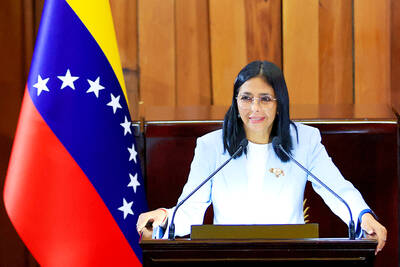
VAGUE: The criteria of the amnesty remain unclear, but it would cover political violence from 1999 to today, and those convicted of murder or drug trafficking would not qualify Venezuelan Acting President Delcy Rodriguez on Friday announced an amnesty bill that could lead to the release of hundreds of prisoners, including opposition leaders, journalists and human rights activists detained for political reasons. The measure had long been sought by the US-backed opposition. It is the latest concession Rodriguez has made since taking the reins of the country on Jan. 3 after the brazen seizure of then-Venezuelan president Nicolas Maduro. Rodriguez told a gathering of justices, magistrates, ministers, military brass and other government leaders that the ruling party-controlled Venezuelan National Assembly would take up the bill with urgency. Rodriguez also announced the shutdown
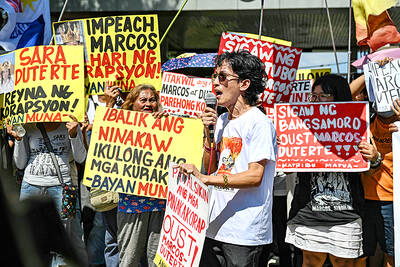
Civil society leaders and members of a left-wing coalition yesterday filed impeachment complaints against Philippine Vice President Sara Duterte, restarting a process sidelined by the Supreme Court last year. Both cases accuse Duterte of misusing public funds during her term as education secretary, while one revives allegations that she threatened to assassinate former ally Philippine President Ferdinand Marcos Jr. The filings come on the same day that a committee in the House of Representatives was to begin hearings into impeachment complaints against Marcos, accused of corruption tied to a spiraling scandal over bogus flood control projects. Under the constitution, an impeachment by the
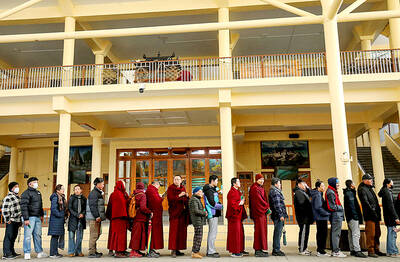
Exiled Tibetans began a unique global election yesterday for a government representing a homeland many have never seen, as part of a democratic exercise voters say carries great weight. From red-robed Buddhist monks in the snowy Himalayas, to political exiles in megacities across South Asia, to refugees in Australia, Europe and North America, voting takes place in 27 countries — but not China. “Elections ... show that the struggle for Tibet’s freedom and independence continues from generation to generation,” said candidate Gyaltsen Chokye, 33, who is based in the Indian hill-town of Dharamsala, headquarters of the government-in-exile, the Central Tibetan Administration (CTA). It

China executed 11 people linked to Myanmar criminal gangs, including “key members” of telecom scam operations, state media reported yesterday, as Beijing toughens its response to the sprawling, transnational industry. Fraud compounds where scammers lure Internet users into fake romantic relationships and cryptocurrency investments have flourished across Southeast Asia, including in Myanmar. Initially largely targeting Chinese speakers, the criminal groups behind the compounds have expanded operations into multiple languages to steal from victims around the world. Those conducting the scams are sometimes willing con artists, and other times trafficked foreign nationals forced to work. In the past few years, Beijing has stepped up cooperation


 RSS
RSS