


Russian soldiers fled as shooting broke out in the spasm of violence that ended the school siege here, and unprepared special forces were forced to borrow bullets from armed locals.
As Beslan buried more victims a week after the siege ended, questions linger over authorities' handling of the three-day standoff that left at least 330 hostages dead.
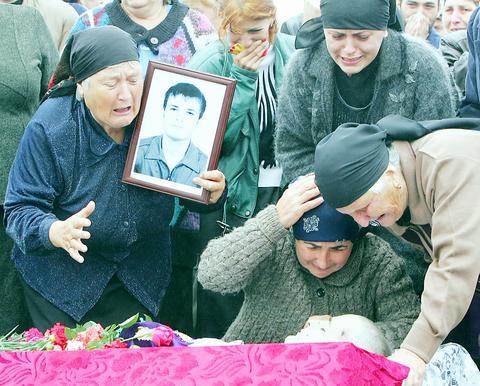
PHOTO: EPA
"One of the most painful questions that that whole world is asking -- why all the events surrounding the Beslan school No. 1 looked so out of control ... probably has an answer: Because nobody was in charge of the operation, -- the Russian daily Russkiy Kuryer said in an editorial on Friday.
Residents said they had rushed to the scene after hearing officials drastically understate the number of captives at 350 -- when they knew there were more than 1,200 inside.
Locals feared it meant authorities would storm the building and then lie about how many people were killed, also possibly provoking the terrorists.
"From the start, (authorities) weren't doing things right," said Artur Belikov, 35, attending a wake at the graves of his relatives Albina Budayeva, 38, and her 3-year-old daughter, Valeria. He said armed locals charged ahead of troops to prevent them from moving in.
But Katya Tsikayeva, 69, also at a wake at Beslan's cemetery, argued that troops should have immediately stormed the building. "Why did they wait a second day, a third day, to let so many die?"
Another Beslan resident said he arrived soon after the siege started and stood guard throughout the entire standoff.
He said conscript soldiers fled as the fighting began. "They were worried about their own lives," said Robert, 31, who had several relatives inside.
Locals handed their clips of ammunition to elite troops who didn't have enough bullets, Robert said. "They weren't ready," he said.
The arrival of some of the elite troops also was delayed because they didn't have bulletproof vests.
An Interior Ministry warrant officer from a nearby region who wasn't involved in the battle, also said it appeared authorities had no plans for what to do when mayhem broke out.
The siege left 11 soldiers from Russia's special forces units dead, according to official statements -- their largest number killed in a single battle. Some reports have said they were shot in the back by overanxious locals at the scene.
Lamenting the corruption and lapses in duty that allowed the attackers to bring their arsenal of weapons to the school, residents have appealed for the truth to be known about the circumstances that made the attack possible, as well as how it all ended.

An American scientist convicted of lying to US authorities about payments from China while he was at Harvard University has rebuilt his research lab in Shenzhen, China, to pursue technology the Chinese government has identified as a national priority: embedding electronics into the human brain. Charles Lieber, 67, is among the world’s leading researchers in brain-computer interfaces. The technology has shown promise in treating conditions such as amyotrophic lateral sclerosis and restoring movement in paralyzed people. It also has potential military applications: Scientists at the Chinese People’s Liberation Army have investigated brain interfaces as a way to engineer super soldiers by boosting
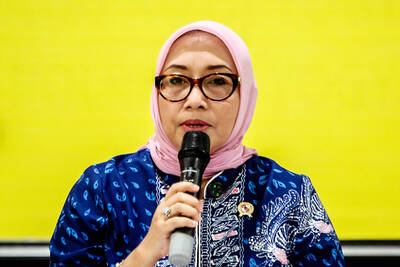
Indonesian police have arrested 13 people after shocking images of alleged abuse against small children at a daycare center went viral, sparking outrage across the nation, officials said on Monday. Police on Friday last week raided Little Aresha, a daycare center in Yogyakarta on Java island, following a report from a former employee. CCTV footage circulating on social media showed children, most younger than two, lying on the floor wearing only diapers, their hands and feet bound with rags. The police have confirmed that the footage is authentic. Police said they also found 20 children crammed into a room just 3m by 3m. “So
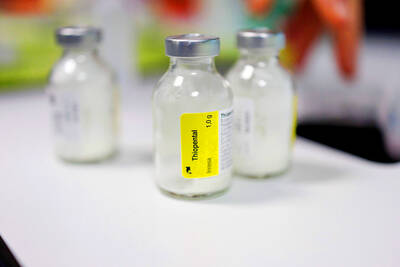
A grieving mother has ended her life at a clinic in Switzerland four years after the death of her only child. Wendy Duffy, 56, a physically healthy woman, died at the Pegasos clinic in Basel after struggling to cope with the death of her 23-year-old son, Marcus. The former care worker, from the West Midlands, England, had previously attempted to take her own life. The case comes as assisted dying would not become law in England and Wales after proposed legislation, branded “hopelessly flawed” by opponents, ran out of time. Ruedi Habegger, the founder of Pegasos, described Duffy’s death as
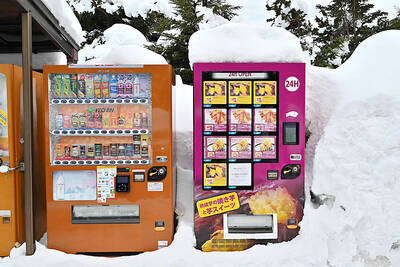
From post offices and parks to stations and even the summit of Mount Fuji, Japan’s vending machines are ubiquitous, but with the rapid pace of inflation cooling demand for their drinks, operators are being forced to rethink the business. Last month beverage giant DyDo Group Holdings announced it would remove about 20,000 vending machines — about 7 percent of their stock nationwide — by January next year, to “reconstruct a profitable network.” Pokka Sapporo Food & Beverage, based in Nagoya, also said last month it would sell its 40,000-machine operation to Osaka-based Lifedrink Co. “The strength of the vending machine


 RSS
RSS