


Palestinian President Yasser Arafat received the strongest challenge yet from a protege when Mohammad Dahlan, a former interior minister, accused him of squandering US$5 billion and "sitting on the corpses" of Palestinians.
He said that if Arafat did not begin to reform the Palestinian Authority there would be massive demonstrations on Aug. 10 in Gaza City.

PHOTO: AFP
In an interview with the Kuwaiti newspaper Al Watan, he said: "Arafat is sitting on the corpses and destruction of the Palestinians at a time when they're desperately in need of a new mentality."
All of the funds which foreign countries had donated to the Palestinian Authority, a total of US$5 billion, "have gone down the drain, and we don't know to where," he added.
Arafat's policies had brought about a situation in which Palestinian lives were in ruin, Dahlan said.
"The Palestinian situation is not putting up with any more corruption, and there is no escape aside from reforms that Arafat himself has authorized," he said.
Dahlan is rumored to have instigated a series of incidents against Gaza security chiefs appointed by Arafat and accused of corruption.
But this is the first time he has publicly attacked him and placed himself at the head of an emerging reform movement.
Dahlan, 43, has broad support in the Gaza Strip and is respected by Israel and the US. Like all critics of Arafat, he believes it is vital that he should remain leader of the Palestinians but more efficient managers should handle Palestinian affairs.
Israel's proposal to withdraw from settlements in the Gaza Strip has created a sense of urgency about reforming the authority and removing a generation of bureaucrats appointed by Arafat and seen as corrupt and incompetent.
On Sunday, gunmen loyal to Arafat broke up a conference attended by Palestinian legislators in Ramallah, saying the meeting was part of a conspiracy against him.
Seventy members of Fatah, Arafat's faction, were meeting to discuss reform and growing anarchy in the Palestinian territories when the 20 men burst in and fired into the ceiling.
The meeting was ended, but not before a letter was drafted to Arafat denouncing the lawlessness and corruption in the authority.
"President Arafat, this may be the last chance for reforming our situation before reaching the end. We need a revolution within our Fatah movement," it said.
Last month militants kidnapped Ghazi Jabali, the chief of police, and demanded his dismissal.
Arafat's proposed replacement, his relative Moussa Arafat, was seen as even more corrupt and he was forced to withdraw the appointment.
Since Arafat returned to the Palestinian territories in 1994 he has been accused of presiding over an almost feudal regime in which his appointees grow rich on public funds in return for their loyalty.
Since Israeli Prime Minister Ariel Sharon proposed withdrawing from the Gaza settlements, Palestinian leaders appear to have had no strategy to improve the position of their people.
Israeli intelligence officers say they believe Arafat is hoping for a Democratic victory in the US presidential election to give him more room to maneuver.
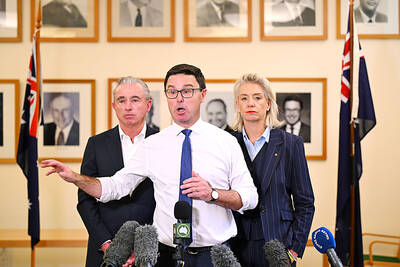
BACKLASH: The National Party quit its decades-long partnership with the Liberal Party after their election loss to center-left Labor, which won a historic third term Australia’s National Party has split from its conservative coalition partner of more than 60 years, the Liberal Party, citing policy differences over renewable energy and after a resounding loss at a national election this month. “Its time to have a break,” Nationals leader David Littleproud told reporters yesterday. The split shows the pressure on Australia’s conservative parties after Prime Minister Anthony Albanese’s center-left Labor party won a historic second term in the May 3 election, powered by a voter backlash against US President Donald Trump’s policies. Under the long-standing partnership in state and federal politics, the Liberal and National coalition had shared power

CONTROVERSY: During the performance of Israel’s entrant Yuval Raphael’s song ‘New Day Will Rise,’ loud whistles were heard and two people tried to get on stage Austria’s JJ yesterday won the Eurovision Song Contest, with his operatic song Wasted Love triumphing at the world’s biggest live music television event. After votes from national juries around Europe and viewers from across the continent and beyond, JJ gave Austria its first victory since bearded drag performer Conchita Wurst’s 2014 triumph. After the nail-biting drama as the votes were revealed running into yesterday morning, Austria finished with 436 points, ahead of Israel — whose participation drew protests — on 357 and Estonia on 356. “Thank you to you, Europe, for making my dreams come true,” 24-year-old countertenor JJ, whose

A documentary whose main subject, 25-year-old photojournalist Fatima Hassouna, was killed in an Israeli airstrike in Gaza weeks before it premiered at Cannes stunned viewers into silence at the festival on Thursday. As the cinema lights came back on, filmmaker Sepideh Farsi held up an image of the young Palestinian woman killed with younger siblings on April 16, and encouraged the audience to stand up and clap to pay tribute. “To kill a child, to kill a photographer is unacceptable,” Farsi said. “There are still children to save. It must be done fast,” the exiled Iranian filmmaker added. With Israel

Africa has established the continent’s first space agency to boost Earth observation and data sharing at a time when a more hostile global context is limiting the availability of climate and weather information. The African Space Agency opened its doors last month under the umbrella of the African Union and is headquartered in Cairo. The new organization, which is still being set up and hiring people in key positions, is to coordinate existing national space programs. It aims to improve the continent’s space infrastructure by launching satellites, setting up weather stations and making sure data can be shared across


 RSS
RSS