


A respected US bank discreetly helped former Chilean dictator Augusto Pinochet to hide millions of dollars over an eight-year period, even after he was arrested in London in 1998 and a court froze his assets, a US Senate report said on Thursday.
Executives of the Washington-based Riggs Bank approached Pinochet in Chile in 1994 and invited him to open an account, Senator Carl Levin said as he delivered the conclusions of the document in the Senate Permanent Subcommittee on Investigations.
Levin, calling the 88-year-old Pinochet a "notorious military leader accused of involvement with death squads, corruption, arms sales and drug trafficking," said the former general agreed to open the account.
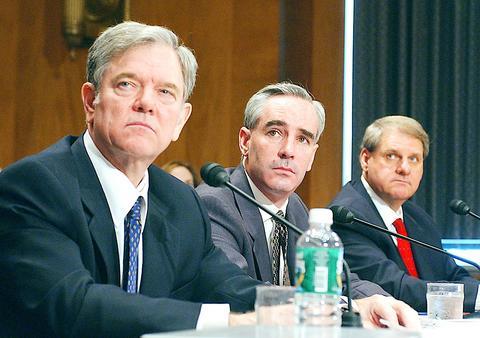
PHOTO: AP
"The bank opened an account for him personally, helped him establish two offshore shell corporations in the Bahamas called Ashburton and Althorp, and then opened more accounts in the name of those shell corporations both here and in the UK," Levin said.
From 1994 to 2002, Pinochet deposited between US$4 million and US$8 million in his Riggs accounts, the report said.
Pinochet, who ruled Chile with an iron fist from 1973 to 1990, was arrested in London in October 1998 after Spanish judge Baltasar Garzon demanded his extradition in order to try him on charges of human-rights abuses.
He was allowed to return to Chile in 2000 after being released on grounds of failing health.
"In 1998, when Mr. Pinochet was arrested in London on charges of crimes against humanity and a court issued an order seeking to freeze his bank accounts, Riggs quietly helped him move money from London to the United States," Levin said.
In March 1999, while Pinochet was still under arrest, the bank authorized the transfer of US$1.6 million from a London account of Althorp to a new account in the US, despite a court order to freeze the accounts, the report said.
"Needless to say, [the bank] didn't alert law enforcement or the courts to his accounts," Levin said. "We can't allow our financial systems to be misused by corrupt dictators, terrorists or other criminals."
In testimony before the committee, Riggs president Lawrence Hebert said the bank "has not been accused of money laundering" and is "fully and actively cooperating with all law enforcement efforts."
But the Senate subcommittee's chairman, Republican Senator Norm Coleman, lamented the bank's decision to keep Pinochet's accounts secret from regulators.
"For eight years, Riggs officials did not verify the source of his wealth, nor did they disclose the existence of these accounts to the Office of the Comptroller of the Currency," Coleman said.
In Santiago, Chilean President Ricardo Lagos said that if the report were confirmed, an investigation would be appropriate.
"If the result of the US Senate investigation determines that level of accounts, and who the account holder is, some kind of commission probably should be set up to investigate" to determine "the nature of those accounts," Lagos said.


Through the noise of rushing papers and whirring belts at a print factory in Kyoto, two creators watch their photo essay come to life in broadsheet form — part of an effort to win new audiences in the age of artificial intelligence (AI). Despite the decline of the publishing industry, self-publication and handmade “zine” magazines are growing in popularity in Japan, reflecting the nation’s enduring love of paper in the digital era. While speaking to Agence France-Presse at the plant, his hands black with ink, one of the creators, Kazuma Obara, said: “I think [paper] is a medium that engages all five
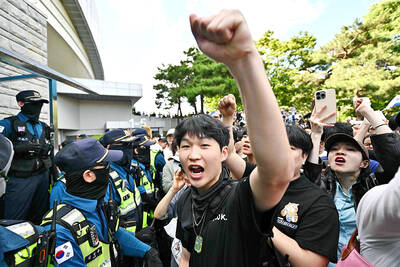
‘ABSURD MISTAKE’: The election commission said that there had been a failure to anticipate turnout after 14 polling stations ran short of ballot papers South Korean riot police yesterday cleared protesters from a Seoul polling station after a 35-hour blockade sparked by a shortage of ballot papers during local elections earlier this week. Wednesday’s election was the first nationwide vote since South Korean President Lee Jae-myung took office following the ouster of Yoon Suk-yeol over his short-lived martial law declaration. Lee’s ruling Democratic Party swept most races, but failed to flip the crucial Seoul mayoral seat. The South Korean National Election Commission apologized, blaming a failure to anticipate turnout after 14 polling stations in Seoul ran short of ballot papers. Some polling stations stayed open until 10pm to

France experienced its hottest spring on record, the French weather service said on Tuesday, after an exceptional early heat wave that also broke highs for the season in England and Wales. Meteo-France said the average nationwide temperature over March to May was 13.8°C — about 1.7°C above the norm, and surpassing records set in 2011 and 2020. “The warmest spring since records began in 1900,” it said in a bulletin. All three months were warmer than average, but the onset of an “unprecedented heatwave” late last month pushed the mercury to highs typically seen at the height of the summer. “Our country had never

A Sherpa guide was found crawling to base camp on Mount Everest a week after he went missing and was reunited with his family, who had given up hope he would return. Dawa Sherpa was last seen on Friday last week descending the mountain, but he did not reach base camp even though his client did. The pair were among the last climbers on the mountain as the climbing season came to an end and the route was dismantled. Dawa was located by a cleaning crew on Thursday morning as he was crawling down the snowy slopes around the Khumbu Icefall, just above


 RSS
RSS