


Nadhim Zahawi was headed home on his scooter earlier in the year when a car lurched his way, hurling him into the middle of a busy road.
As he lay in an ambulance at the scene, his left leg broken like a breadstick, an incredulous bystander ran up to his stretcher to inform him that a parking enforcement officer had just ticketed his mangled scooter. In that instant, Zahawi became a poster boy of sorts for a parking enforcement system "gone mad," as he puts it.
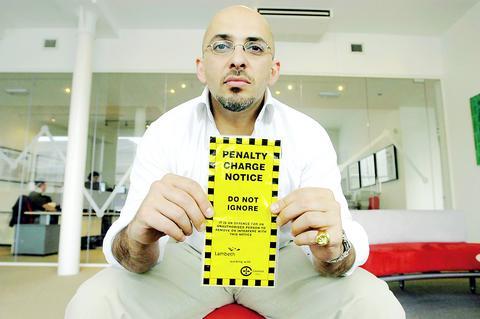
PHOTO: NY TIMES NEWS SERVICE
"They are totally ruthless," said Zahawi, the managing director of YouGov, a polling company. "The system needs reining back."
Zahawi appealed against his US$180 ticket, and won, but not before being told that the parking official erred only because she did not realize it was the scene of an accident.
"I mean, there was debris everywhere," Zahawi said. "I was in the back of an ambulance. I don't know how she could have missed a great big ambulance and a police van."
In a place as densely packed as England, clashes between motorists and "parking attendants" have risen to absurd heights.
Stories from aggrieved motorists, who say they feel tricked, dogged and hunted, while their pleas for mercy go ignored, are legion. Mothers with babes in arms, disabled people in wheelchairs, people weak with cancer have all complained publicly about the heartlessness of the system.
Derek Scott, for example, stopped to ask a parking attendant in London for directions, only to be ticketed by a second attendant as he listened to the instructions. Brian and Sheila Sharp received a London parking ticket by mail -- but they had not been in London in 20 years.
The most common complaints revolve around ghost tickets -- tickets people never receive, yet are penalized for not paying.
"It is getting close to meltdown out there because of the number of scams," said Barrie Segal, founder of AppealNow.com, a popular Web site that helps motorists appeal tickets.
On the flip side, parking attendants, routinely spat upon and lashed with expletives, now face an increase in serious violence. In Oxfordshire last month, one was pummeled by a gang of youths in broad daylight, and in Lincolnshire one was mowed down by a car. In London this year, attendants have been variously threatened with a broken bottle, sprayed with cement, kicked in the groin and smashed in the face with a bat.
It is no wonder that parking attendants, many of them recent immigrants -- a fact that has led some columnists to say racism plays a role in the abuse -- are calling to be outfitted with stab-proof vests in at least one neighborhood. That is, if they have not already quit their US$11-an-hour job. Turnover, say the spokesmen for the private companies who employ them, is quite high.
The face-off between motorist and parking attendant began with a 1991 law that shifted parking enforcement from the police to local councils. The local councils, in turn, have mostly farmed the work out to private companies, who sign contracts that often specify how many tickets parking attendants are expected to issue. Local councils -- London has 34 -- can keep the revenue so long as they invest it in transportation.
Westminster, in central London, faces a daily onslaught of 135,000 cars trying to park in 43,000 parking spaces. This imbalance brought the Westminster City Council, which has been accused of running a revenue mill, nearly US$50 million in its last fiscal year. In all, councils in London collected an estimated US$296 million from some 9.6 million tickets, according to a survey by AppealNow.Com.
"It's pretty big business, it's fair to say," said a council spokesman.
Critics say the shift from police to local councils changed the emphasis from ensuring smooth traffic to enriching councils.
"The old-style traffic warden would march up and down roads all day, telling people to hop to it," said Kevin Delaney, head of traffic and road safety for the Royal Automobile Club. "You only got a ticket if you ignored him. The parking attendant will watch you park illegally, wait until you've left and give you a ticket." he said.
"That's how we got to where we are now," he added.

Arsenio Butil Jr fell to his knees and began to pray when last week’s deadly magnitude 7.8 earthquake began shaking his home on the coast of the southern Philippines. When he opened his eyes, he saw a once-familiar shoreline changing in real time, with swathes of previously submerged coral suddenly pushing above the waterline. The June 8 quake, driven by a shifting of the nearby Cotabato Trench, toppled buildings, triggered landslides and killed at least 76 people on the southern island of Mindanao. The tectonic forces at work also thrust chunks of the island’s coastline upward in a phenomenon known as “coastal uplift,”
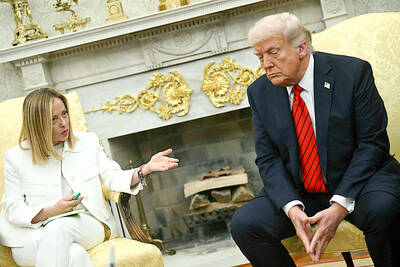
NATO ALLIES: The Italian PM accused Trump of ‘constant, unprovoked ... senseless’ attacks and said ‘my popularity is none of your concern. I suggest you focus on yours’ Italian Prime Minister Giorgia Meloni on Saturday fired back at US President Donald Trump, saying his “constant, unprovoked attacks are senseless” after he escalated a diplomatic row by accusing her of repeatedly seeking a photograph with him. The clash has opened an unusually personal rift between Trump and one of Europe’s most prominent right-wing leaders, who had sought to cast herself as a bridge between Washington and the continent during Trump’s return to power. Trump had initially told Italian broadcaster La7 that Meloni “begged” him for a picture at last week’s G7 summit in France, saying he agreed only because
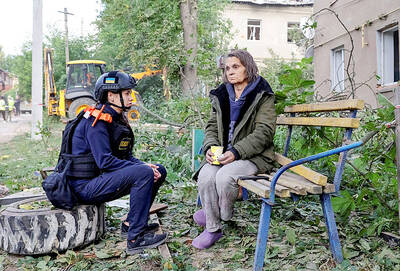
President Volodymyr Zelenskiy on Saturday said that Russian forces were preparing an impending massive attack on Ukraine and warned residents to take special care as Russian strikes in different regions killed at least six people. “Tonight and in the coming hours, it is especially important to pay close attention to air raid warnings,” Zelenskiy said in his nightly video address. “The Russians have prepared for a massive attack. Please take care of yourselves.” Russian forces have staged a series of heavy attacks on Kyiv in the past few weeks and in other major cities. Strikes on Monday last week killed
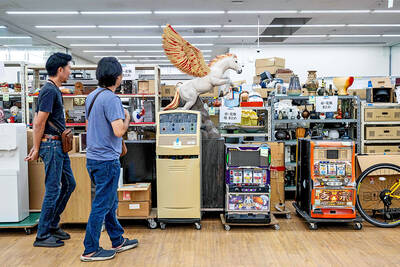
YUCK OR YUM? While it is difficult to sell second-hand goods that are more than seven years old in Japan, they are still popular in foreign markets, an executive said Under a scorching sun in a Bangkok suburb, a whistle blew, and shouts filled the air as dozens of shoppers rushed into a warehouse bearing the sign “Japanese Second-Hand Store.” From bags and bicycles to surfboards and suitcases, the Japanese second-hand market is booming, with quality-conscious buyers in other Asian countries increasingly tapping into the circular economy trend. “What is considered garbage for them can still be useful in Thailand,” said 36-year-old Lookpoo Sathitpanyapon, who runs an online store selling toy keychains. “That bag, that bag,” one shopper shouted while racing through the warehouse, filled with everything from colorful toys


 RSS
RSS