


They call him the "Motion King," and it's not for the way he moves.
During the past seven years as a delegate to the National People's Congress (NPC), the southern China businessman and Communist Party member has put forward hundreds of motions, or proposals, to China's nominal legislature.
Zhao Linzhong has suggested barring young people from Internet cafes. He has pushed to mandate lower prices for commercial housing. This year, he is proposing a law to safeguard medical benefits for entrepreneurs.

PHOTO: AP
"I do put forth more motions than other delegates, but it's not good to call me a king," said Zhao, a sharply dressed man with an easy smile who exudes an energy younger than his 50 years.
"It doesn't sound right," he said.
Zhao sees himself as an "earnest public servant" with a strong sense of social responsibility. He is among the thousands of government-appointed delegates who come to Beijing each year to participate in China's version of representative democracy.
While delegates can put forward any number of ideas, new laws are crafted by a small group of top leaders and rubber-stamped by the congress during its annual two-week session, which this year runs through Sunday. Dissenting votes are rare. But this doesn't seem to bother Zhao.
"It's not like I propose something and the government will immediately take it up," explained Zhao, who has put forward about 500 motions since he became a delegate in 1998. "But if they think it has merit, then they could consider it."
Though none of his motions have gone directly into the law books and most -- on subjects from mental health to public security to unemployment -- end up merely as talking points for delegate meetings, Zhao still feels he serves a valuable purpose.
"The government stands above and the ordinary people stand below, while we delegates serve as a bridge between the two," he said..
Zhao's ideas come mainly from issues raised by his constituents in Zhuji County, Zhejiang Province.
The province, famous for its Shaoxing rice wine and Dragon Well tea, is one of China's wealthiest. Zhao himself heads a publicly listed textile manufacturing company, the Furun Group, worth 480 million yuan (US$58 million).
"When I first took on this position, I wracked my brains for a method I could use to canvas public opinion," Zhao said. "Finally, I came up with a system similar to what I use as a business manager."
Zhao gets the provincial media -- both newspapers and TV stations -- to solicit suggestions from the public. The notices cost him nothing. Responses, in the form of faxes, e-mails and letters, then pour in.
"I can't meet with anyone in person," he said with a shrug. "I still have my day job."
At this year's congress, he is submitting around 80 motions -- well above the average handful submitted by most delegates. Last year, the NPC received a total of 1,050 motions from 2,984 participating delegates. If a similar number of motions is submitted this year, Zhao will be responsible for nearly 10 percent of them.

ROCKY RELATIONS: The figures on residents come as Chinese tourist numbers drop following Beijing’s warnings to avoid traveling to Japan The number of Chinese residents in Japan has continued to rise, even as ties between the two countries have become increasingly fractious, data released on Friday showed. As of the end of December last year, the number of Chinese residents had increased by 6.5 percent from the previous year to 930,428. Chinese people accounted for 22.6 percent of all foreign residents in Japan, making them by far the largest group, Japanese Ministry of Justice data showed. Beijing has criticized Tokyo in increasingly strident terms since Japanese Prime Minister Sanae Takaichi last year suggested that a military conflict around Taiwan could
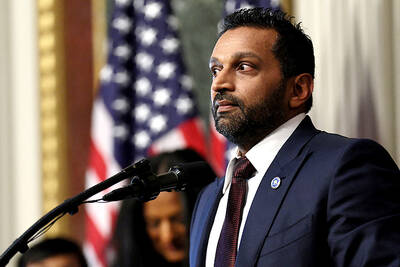
A pro-Iran hacking group claimed to breach FBI Director Kash Patel’s personal e-mail inbox and posted some of the contents online. The e-mails provided by the hacking group include travel details, correspondence with leasing agents in Washington and global entry, and loyalty account numbers. The e-mail address the hackers claim to have compromised has been previously tied to Patel’s personal details, and the leaked e-mails contain photos of Patel and others, in addition to correspondence with family members and colleagues. “The FBI is aware of malicious actors targeting Director Patel’s personal email information,” the agency said in a statement on
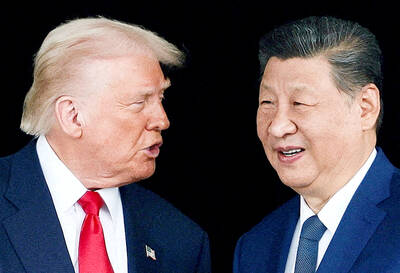
RIVALRY: ‘We know that these are merely symbolic investigations initiated by China, which is in fact the world’s most profligate disrupter of supply chains,’ a US official said China has started a pair of investigations into US trade practices, retaliating against similar probes by US President Donald Trump’s administration as the superpowers stake out positions before an expected presidential summit in May. The move, announced by the Chinese Ministry of Commerce on Friday, is a direct mirror of steps Trump took to revive his tariff agenda after the US Supreme Court last month struck down some of his duties. “China expresses its strong dissatisfaction and firm opposition to these actions,” a ministry spokesperson said in a statement, referring to the so-called Section 301 investigations initiated on March 11.

When a hiker fell from a 55m waterfall in wild New Zealand bush, rescuers were forced to evacuate the badly hurt woman without her dog, which could not be found. After strangers raised thousands of dollars for a search, border collie Molly was flown to safety by a helicopter pilot who was determined to reunite the pet and the owner. A week earlier, an emergency rescue helicopter found the woman with bruises and lacerations after a fall at a rocky spot at the waterfall on the South Island’s West Coast. She was airlifted on March 24, but they were forced to


 RSS
RSS