


A senior commander of Colombia's Marxist rebel FARC was arrested in neighboring Ecuador. He is the highest-ranked member of the guerrilla group to be captured in four decades of war with the government.
Simon Trinidad, a commander of the Revolutionary Armed Forces of Colombia, known by its Spanish acronym FARC, was arrested by Colombian and Ecuadorean authorities late on Friday while he was being treated in the capital Quito for a flesh-eating insect-borne disease, Colombian police said.
But Ecuadorean police gave a different account of the arrest, saying Trinidad was captured in a Quito street during an immigration check and was not carrying documents.
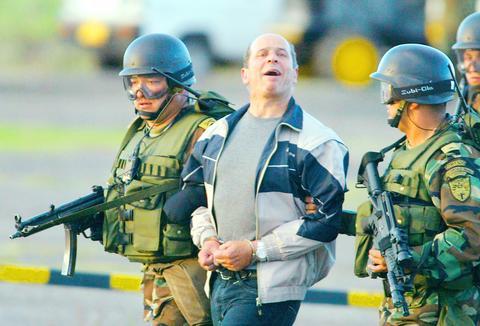
PHOTO: AP
The capture of Trinidad, a former negotiator in failed talks with the government, is a huge boost for the US-backed military, which has been criticized for failing to capture senior rebels leaders in a war that claims the lives of thousands of people every year.
Arriving in Bogota's military airport on Saturday escorted by heavily-armed soldiers, a defiant Trinidad raised his handcuffed left fist and screamed "Long Live the FARC!"
Trinidad, who had a reward of US$820,000 on his head, faces 30 criminal counts, including murder, terrorism, rebellion and kidnapping, officials said. He will be held in a secret location for security reasons.
President Alvaro Uribe, a close US ally who has stepped up military spending and launched an offensive against rebels, pledged to push forward until "terror is totally dismantled."
"This proves terror will never rule," Uribe, who has often criticized army generals in public for failing to produce more results in the battlefield, said in a speech to the nation.
There were conflicting reports about the arrest. The Colombian military first said the capture took place on the border with Ecuador. The Colombian police later said Trinidad had been followed for months and that he was seized in a hospital, where he was receiving treatment for leishmaniasis, a flesh-eating disease spread by the sand fly in the jungle.
Defense Minister Jorge Alberto Uribe, not related to the president, added to the confusion by saying the US provided "key support" in the capture.
"This is the result of an exemplary action by our security forces, the police and the army in this case, and with the key support of the Ecuadorean government and police, and the United States government," the defense minister told reporters.
He did not elaborate, but Colom-bia's armed forces have received millions of dollars in military aid and intelligence from Washington in recent years.
Trinidad's arrest comes on the heels of recent army killings of mid-level FARC commanders. While the well-spoken, balding Trinidad, 53, is not a member of the FARC's seven-member ruling secretariat, he is the most senior member of Latin America's largest rebel army ever to be captured.
The FARC, which says it is fighting for socialist reforms, has been on a tactical retreat since Uribe took office in 2002, pushed back into jungle and mountains.
Trinidad, whose real name is Ricardo Palmera, said in 2002 that he became a guerrilla in 1987 because of his outrage at the enormous gaps in income in Colombia.
The FARC, created in 1964 by landless peasants, is led by Manuel "Sureshot" Marulanda.
Sureshot and the remaining six members of the FARC's top directorate are at large.

‘CROSSING THE LINE’: China’s embassy in Seoul criticized US Forces Korea Commander General Xavier Brunson, asking if his ‘hostile’ remarks were authorized by Washington South Korea and the US are in talks over recent public remarks by the commander of US Forces Korea, Seoul’s presidential office said yesterday, after the comments drew sharp criticism from China. In a recent podcast interview, US Forces Korea Commander General Xavier Brunson described South Korea as “the dagger in the heart of Asia” from China’s east coast, prompting the Chinese embassy in Seoul to say that he had “truly crossed the line.” The interview came amid growing speculation that Washington might seek to expand the role of US Forces Korea in countering the growing regional influence of China, a key

Through the noise of rushing papers and whirring belts at a print factory in Kyoto, two creators watch their photo essay come to life in broadsheet form — part of an effort to win new audiences in the age of artificial intelligence (AI). Despite the decline of the publishing industry, self-publication and handmade “zine” magazines are growing in popularity in Japan, reflecting the nation’s enduring love of paper in the digital era. While speaking to Agence France-Presse at the plant, his hands black with ink, one of the creators, Kazuma Obara, said: “I think [paper] is a medium that engages all five

Australian researchers have trained lab-grown brain cells on a silicon computer chip to play the 1990s shooter game Doom and said they are just scratching the surface of what the neurons could be capable of doing. It is the science-fiction work of biotech boffins at Cortical Labs, who researched and developed the technology that harnesses the workings of the brain’s networking system. Each so-called “biological computer” contains about 200,000 living human brain cells, grown from stem cells that were harvested from blood donations. Having mastered the simple computer game Pong, where a paddle is moved up and down to send a ball
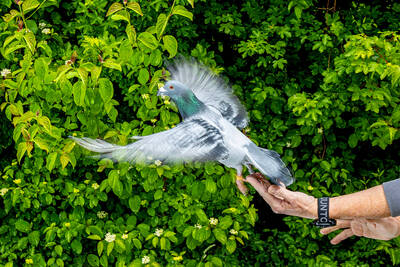
A surprising gut feeling may help pigeons find their way home. Animals use various techniques to navigate, including following the stars and remembering key landmarks. Birds, fish and turtles orient themselves using Earth’s magnetic field as a compass, but it is not yet clear how exactly they do this. Pigeons are a well-known group of frequent flyers that can traverse hundreds of kilometers in a single day. For thousands of years, humans have used them to carry news, notes and military messages. Scientists have long tried to untangle how pigeons travel without getting lost. Some think the birds detect magnetic cues using light-sensitive


 RSS
RSS