


Colombian rebels freed two Euro-pean hostages, handing them over to a humanitarian commission that whisked them by helicopter away from the mountains where they had spent 74 days in captivity.
But there was a tragic outcome in another kidnapping case on Monday with the army saying they recovered a body believed to be that of Japanese businessman Chikao Muramatsu.
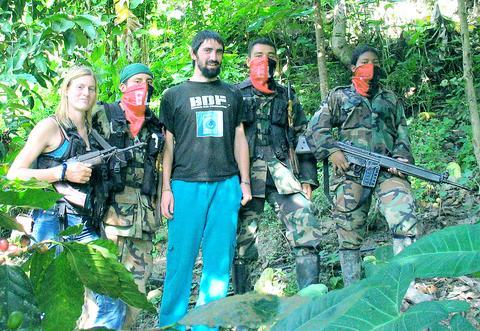
PHOTO: REUTERS
Muramatsu, a executive with the Japanese auto parts maker Yazaki Ciemel, was abducted three years ago by common criminals and later believed turned over to Colombia's largest rebel army, the Revolutionary Armed Forces of Colombia.
During their release in the jungle, the two Europeans smiled and stood for photos with their captors -- members of Colombia's smaller rebel group, the National Liberation Army, or ELN.
One hostage, Reinhilt Weigel of Germany, posed with an AK-47 automatic rifle under her arm, next to rebels wearing bandanas over their faces.
A Catholic church official said he believed the five other kidnapped backpackers could be released before Christmas.
Weigel and Asier Huegen Echeverria, of Spain, were flown by helicopter from the Sierra Nevada mountains where they were handed over to the town of Valledupar.
Echeverria, in a red T-shirt, was heavily bearded, and a smiling Weigel appeared gaunt in a blue tank top and jeans as they emerged from the helicopter, speaking on cell phones. They did not speak to reporters before taking off on a plane for a military base in Bogota.
A government human rights ombudsman said many people will be angered by the photo of Weigel holding an assault rifle.
"Another danger has opened up," Dario Mejia, secretary-general of the government's human rights office, said from Bogota.
"I think it would be best if she left [Colombia]," Mejia said.
The rebels' right-wing paramilitary foes have killed suspected guerrilla supporters and sympathizers. Mejia said he wanted to know whether Weigel was forced to pose for the picture.
The Colombian government's human rights ombudsman, Volmar Perez, said the freed captives were in good shape, even though they had endured hunger and primitive conditions in the wilderness.
Camouflaged gunmen of the leftist ELN abducted Weigel and Echeverria -- along with two Britons and four Israelis -- on Sept. 12 from the Lost City archaeological ruins in the mountains, which rise up from the Caribbean coast in northern Colombia.
One of the hostages, British teenager Matthew Scott, escaped days later by hurling himself down a precipice.
The two freed hostages said they were not mistreated by the rebels, according to Perez.
The ELN said it kidnapped the eight foreign backpackers to raise awareness about the alleged hardship inflicted by outlawed right-wing paramilitary factions and the army on the mainly Indian inhabitants of the Sierra Nevada.
Meanwhile, an army patrol found believed to be that of Muramatsu after hearing several shots fired near the town of San Juan de Rioseco, 60km west of Bogota, said General Carlos Alberto Ospina, the armed forces commander.
The body was dressed in camouflage fatigues and had several bullet marks, he said.
Common criminals disguised as police officers seized Muramatsu from the streets of Bogota in February 2001.
He was later sold to the FARC, which reportedly demanded a US$25 million ransom for his release.
Ospina said the rebels likely killed Muramatsu after discovering the nearby army patrol.

‘CROSSING THE LINE’: China’s embassy in Seoul criticized US Forces Korea Commander General Xavier Brunson, asking if his ‘hostile’ remarks were authorized by Washington South Korea and the US are in talks over recent public remarks by the commander of US Forces Korea, Seoul’s presidential office said yesterday, after the comments drew sharp criticism from China. In a recent podcast interview, US Forces Korea Commander General Xavier Brunson described South Korea as “the dagger in the heart of Asia” from China’s east coast, prompting the Chinese embassy in Seoul to say that he had “truly crossed the line.” The interview came amid growing speculation that Washington might seek to expand the role of US Forces Korea in countering the growing regional influence of China, a key

Through the noise of rushing papers and whirring belts at a print factory in Kyoto, two creators watch their photo essay come to life in broadsheet form — part of an effort to win new audiences in the age of artificial intelligence (AI). Despite the decline of the publishing industry, self-publication and handmade “zine” magazines are growing in popularity in Japan, reflecting the nation’s enduring love of paper in the digital era. While speaking to Agence France-Presse at the plant, his hands black with ink, one of the creators, Kazuma Obara, said: “I think [paper] is a medium that engages all five

Australian researchers have trained lab-grown brain cells on a silicon computer chip to play the 1990s shooter game Doom and said they are just scratching the surface of what the neurons could be capable of doing. It is the science-fiction work of biotech boffins at Cortical Labs, who researched and developed the technology that harnesses the workings of the brain’s networking system. Each so-called “biological computer” contains about 200,000 living human brain cells, grown from stem cells that were harvested from blood donations. Having mastered the simple computer game Pong, where a paddle is moved up and down to send a ball

A surprising gut feeling may help pigeons find their way home. Animals use various techniques to navigate, including following the stars and remembering key landmarks. Birds, fish and turtles orient themselves using Earth’s magnetic field as a compass, but it is not yet clear how exactly they do this. Pigeons are a well-known group of frequent flyers that can traverse hundreds of kilometers in a single day. For thousands of years, humans have used them to carry news, notes and military messages. Scientists have long tried to untangle how pigeons travel without getting lost. Some think the birds detect magnetic cues using light-sensitive


 RSS
RSS