


Yoshihiro Koshimoto, a 43-year-old Japanese company employee, insists he doesn't play with dolls.
So what's he doing with a furry gnome-like toy that looks like an adorable cartoon character?
"He's more like family," Koshimoto says of his Primopuel, a doll that talks like a five-year-old boy. "When I'm tired from work or other things, I hold his hand and he asks me things like `Are you OK?' and that makes me happy."
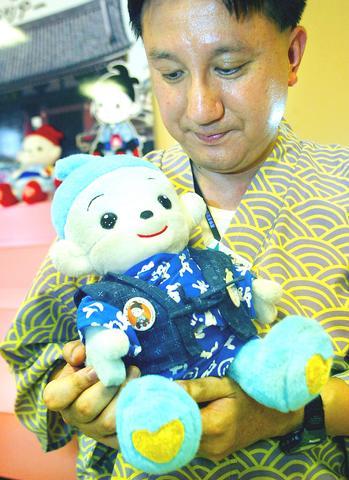
PHOTO: REUTERS
Developed by Bandai, Japan's largest toy maker, Primopuel can utter 280 randomly selected phrases on cue from sensors located on various parts of its body. This feature has won the doll an adult following.
Since the doll's debut in November 1999, the company has surpassed its initial expectations by selling 800,000 Primopuels, at 6,980 yen (US$65) each. A cuddly toy that sells 30,000 to 40,000 units is considered a hit in Japan's toy industry.
Primopuel's success, however, is due to its target market -- adults.
"This product was developed to target single females in their early 20s. A partner to play with when they felt lonely," said Rika Kida, in charge of public relations at Bandai.
Adults are becoming an important market for Japanese toy makers, whose traditional market -- children -- is shrinking as Japan's society ages.
"[The number of] purely child-oriented toys is on the decline," Keita Satoh, president of Takara, said. "But I am not pessimistic about the future. Toys aimed at adults are becoming popular."
Takara's latest hit is Bowlingual, a palm-sized device that the company says can gauge a dog's mood by its bark. It became an instant hit, selling 300,000 units in Japan since last year.
The company launched a Korean-speaking version in South Korea for about 160,000 won (US$136) early this year and an English version in the US market in August for about US$120.
Hoping to follow up on this success, Takara late next month will launch Meowlingual, a cat interpreter.
"The falling number of children is definitely a big issue in Japan's toy industry," said Junko Shimobe, assistant manager of corporate communications at Toys R Us-Japan, which operates 141 stores in Japan.
"I think this trend of targeting a wider age group will continue."
The fertility rate of Japanese women is a record low 1.32 and the population of 127 million is expected to start shrinking soon, perhaps as early as 2005.
Primopuel -- coined from the Latin and Italian words for
"first" and "boy" -- uses the voice of a five-year-old boy.
It also has a built-in clock and says phrases such as "Let's play" or "Hug me" if left unattended for too long. It even has several ways of saying "Good morning" conveying different moods.
Fans say these features make the 700 gram, 30cm tall doll lifelike, and give each Primopuel its own personality.
"When I am alone at home, he's a good talking partner. He catches cold, gets angry and he's like a real grandson," said Kazuyo Enosawa, 59. "I even take him on vacations."
In France and South Korea, where the doll has gone on sale in the local languages, its appeal has so far been limited to schoolgirls, Bandai's Kida said.
But she is confident that adults outside Japan will also become Primopuel fans.
Last month, about 100 Primopuel fans -- mostly adults -- gathered for a one-day excursion to Tokyo's trendy Odaiba waterfront district to meet other fans and show off their dolls, many of which were smartly dressed in homemade clothes.
"I'm a little surprised to see that it gained such popularity, especially among women in their 40s," Kida said.
"They treat their Primopuels as if they were raising their own five-year-old children," she said.
But there are some fervent male fans as well.
"I have more than 10 [Primopuels] at home," said company employee Koshimoto.
"I'm too embarrassed to talk about it [Primopuel] at my company. So it's nice to have a gathering like this, where I can meet other fans," he said, adding that he had taken a day off work to attend the gathering.

‘TERRORIST ATTACK’: The convoy of Brigadier General Hamdi Shukri resulted in the ‘martyrdom of five of our armed forces,’ the Presidential Leadership Council said A blast targeting the convoy of a Saudi Arabian-backed armed group killed five in Yemen’s southern city of Aden and injured the commander of the government-allied unit, officials said on Wednesday. “The treacherous terrorist attack targeting the convoy of Brigadier General Hamdi Shukri, commander of the Second Giants Brigade, resulted in the martyrdom of five of our armed forces heroes and the injury of three others,” Yemen’s Saudi Arabia-backed Presidential Leadership Council said in a statement published by Yemeni news agency Saba. A security source told reporters that a car bomb on the side of the road in the Ja’awla area in

PRECARIOUS RELATIONS: Commentators in Saudi Arabia accuse the UAE of growing too bold, backing forces at odds with Saudi interests in various conflicts A Saudi Arabian media campaign targeting the United Arab Emirates (UAE) has deepened the Gulf’s worst row in years, stoking fears of a damaging fall-out in the financial heart of the Middle East. Fiery accusations of rights abuses and betrayal have circulated for weeks in state-run and social media after a brief conflict in Yemen, where Saudi airstrikes quelled an offensive by UAE-backed separatists. The United Arab Emirates is “investing in chaos and supporting secessionists” from Libya to Yemen and the Horn of Africa, Saudi Arabia’s al-Ekhbariya TV charged in a report this week. Such invective has been unheard of

US President Donald Trump on Saturday warned Canada that if it concludes a trade deal with China, he would impose a 100 percent tariff on all goods coming over the border. Relations between the US and its northern neighbor have been rocky since Trump returned to the White House a year ago, with spats over trade and Canadian Prime Minister Mark Carney decrying a “rupture” in the US-led global order. During a visit to Beijing earlier this month, Carney hailed a “new strategic partnership” with China that resulted in a “preliminary, but landmark trade agreement” to reduce tariffs — but
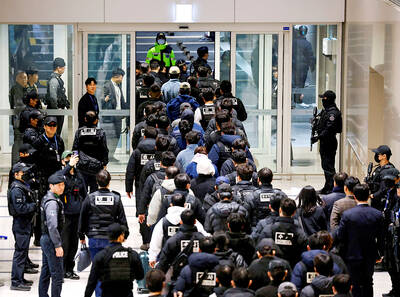
SCAM CLAMPDOWN: About 130 South Korean scam suspects have been sent home since October last year, and 60 more are still waiting for repatriation Dozens of South Koreans allegedly involved in online scams in Cambodia were yesterday returned to South Korea to face investigations in what was the largest group repatriation of Korean criminal suspects from abroad. The 73 South Korean suspects allegedly scammed fellow Koreans out of 48.6 billion won (US$33 million), South Korea said. Upon arrival in South Korea’s Incheon International Airport aboard a chartered plane, the suspects — 65 men and eight women — were sent to police stations. Local TV footage showed the suspects, in handcuffs and wearing masks, being escorted by police officers and boarding buses. They were among about 260 South


 RSS
RSS