


It was 10am when the four Humvees pulled up outside the handsome villa on Shalalat Street and disgorged a party of US soldiers. Over a bullhorn, they told the occupants to come out with their hands up.
What followed was a firefight from the ground and air that reduced the comfortable villa to a smoking hulk. And only then did the troops find out how high the stakes had been: Their targets, they discovered, were Saddam Hussein's sons Uday and Qusay, second in power only to their father.
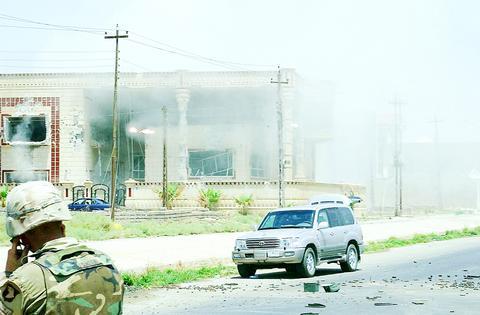
PHOTO: AFP
The raid was a "turning point" in the campaign against Iraq's deposed regime, the commander of coalition forces in Iraq, the American commander, Lieutenant General Ricardo Sanchez, said Wednesday in Baghdad. US President George W. Bush said it would help convince Iraqis that Saddam's regime is over for good.
But soldiers who participated in the raid said they didn't know what they were getting into when they headed out to the wealthy al-Falah neighborhood in the northern city of Mosul on Tuesday morning.
The night before, an unidentified Iraqi had tipped off the Americans that Uday and Qusay were in the house, Sanchez said afterward. But all Sergeant George Granter knew on that blistering hot Tuesday morning was that intelligence was reporting the house was occupied by Baath Party members.
"They heard high guys, but they didn't know how high," Granter said.
The action that played out on the wide boulevard lined with villas, shops and a mosque began like countless others across occupied Iraq: with orders in Arabic to surrender.
"The intent is always to ask the people to come out voluntarily," said Colonel Joe Anderson, commander of the US Army's 101st Division's 2nd Brigade.
The owner of the house, Sheik Nawaf al-Zaydan Muhhamad, walked out with his son Shalan, their hands on their heads, and were whisked away by troops, neighbors said Wednesday.
The other occupants were less cooperative. So after 10 minutes, troops tried to enter the building. From the fortified middle floor of the three-floor building came Kalashnikov fire, raking the troops and wounding four of them. The Americans fell back to regroup and reinforcements were summoned.
Soldiers fanned out in the neighborhood and evacuated families from surrounding houses, said US Major Greg Ebeling.
By 10:45am, reinforcements had arrived, and the Americans began firing machine guns, grenades and rockets, Sanchez said. The area was surrounded so "there was no rush," the general said.
Witnesses said beige and maroon tiles popped from the facade and dust flew from the concrete columns. Still, gunfire rattled back from the mansion.
Just before noon, two Kiowa helicopters skimmed in over the rooftops, and rockets streaked into the villa. More and more troops poured into the neighborhood, witnesses said, until about 200 were surrounding the house.
It was their fire from the ground that proved decisive: .50-caliber machine guns, grenade launchers, then TOW missiles that blew out windows, cratered walls and killed Saddam's sons and a bodyguard, Sanchez said.
At 1:21pm soldiers stormed the wrecked mansion. They rushed up the stairs and shot the final holdout, apparently Qusay's teenage son Mustafa.
On the floor where Saddam's sons had chosen to make their last stand lay clothes, bloodstained bedding, a Pepsi can and a box of Mars Bars.
"It began as gunfire and then it became a battle," said Nasser Hazim, who lives around the corner from the villa.
The person who tipped the Americans off to the hide-out is in protective custody, his identity a secret, US authorities said.
Neighbors, however, suspect the tipster was Muhhamad, Saddam's sons' host, who obeyed the surrender call. They called it suspicious that his wife and four daughters left the house several hours before the raid.
Muhhamad's ties to Saddam cut two ways -- making him rich, but causing him personal grief. Saddam threw Muhhamad's elder brother in jail, reportedly over a tribal disagreement, but released him 18 months into a 17-year sentence.
As the bodies of Uday, 39, and Qusay, 37, were taken to Baghdad International Airport to be flown out of the country, several hundred people gathered outside the razor wire surrounding their still-smoking hide-out Wednesday, chanting pro-Saddam slogans.
"This is terrorism! They are killers!" screamed Saad Badr, a 50-year-old taxi driver who was pressed so close to the razor wire that his left toe was bleeding.
"Americans are unbelievers, and Saddam Hussein is a Muslim. This makes me even more angry at the Americans," said 14-year-old Mohammed Qassem, to a chorus of agreement from the crowd.
The protesters dispersed without incident after the Americans trucked in several dozen Iraqis in civilian clothes and armed with wooden clubs.
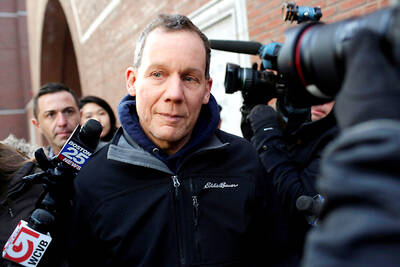
An American scientist convicted of lying to US authorities about payments from China while he was at Harvard University has rebuilt his research lab in Shenzhen, China, to pursue technology the Chinese government has identified as a national priority: embedding electronics into the human brain. Charles Lieber, 67, is among the world’s leading researchers in brain-computer interfaces. The technology has shown promise in treating conditions such as amyotrophic lateral sclerosis and restoring movement in paralyzed people. It also has potential military applications: Scientists at the Chinese People’s Liberation Army have investigated brain interfaces as a way to engineer super soldiers by boosting
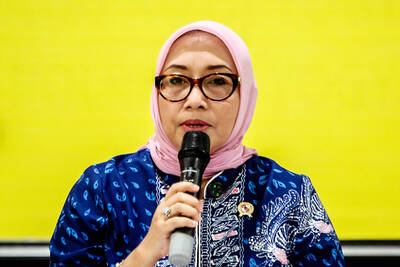
Indonesian police have arrested 13 people after shocking images of alleged abuse against small children at a daycare center went viral, sparking outrage across the nation, officials said on Monday. Police on Friday last week raided Little Aresha, a daycare center in Yogyakarta on Java island, following a report from a former employee. CCTV footage circulating on social media showed children, most younger than two, lying on the floor wearing only diapers, their hands and feet bound with rags. The police have confirmed that the footage is authentic. Police said they also found 20 children crammed into a room just 3m by 3m. “So
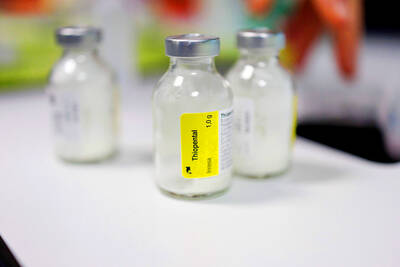
A grieving mother has ended her life at a clinic in Switzerland four years after the death of her only child. Wendy Duffy, 56, a physically healthy woman, died at the Pegasos clinic in Basel after struggling to cope with the death of her 23-year-old son, Marcus. The former care worker, from the West Midlands, England, had previously attempted to take her own life. The case comes as assisted dying would not become law in England and Wales after proposed legislation, branded “hopelessly flawed” by opponents, ran out of time. Ruedi Habegger, the founder of Pegasos, described Duffy’s death as
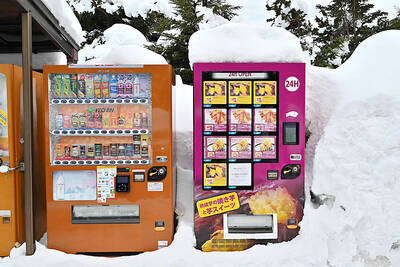
From post offices and parks to stations and even the summit of Mount Fuji, Japan’s vending machines are ubiquitous, but with the rapid pace of inflation cooling demand for their drinks, operators are being forced to rethink the business. Last month beverage giant DyDo Group Holdings announced it would remove about 20,000 vending machines — about 7 percent of their stock nationwide — by January next year, to “reconstruct a profitable network.” Pokka Sapporo Food & Beverage, based in Nagoya, also said last month it would sell its 40,000-machine operation to Osaka-based Lifedrink Co. “The strength of the vending machine


 RSS
RSS