


A Beijing newspaper has been closed after it printed an essay that criticized China's parliament as amateurish, according to its publishing company and a government official.
The shutdown of Beijing Xinbao coincided with what a government spokesman said is a review by communist authorities of all of China's newspapers and magazines. He said others might also be closed.
The crackdown appears to be aimed at tightening media controls despite Beijing's promises of greater openness during the SARS outbreak and official praise of the media's role in publicizing information about the disease.
Beijing Xinbao was shut down after its June 4 issue, which carried the essay, said an official of the State Press and Publication Administration. She wouldn't give her name.
The commentary, which has been posted on several Chinese Web sites, includes the largely ceremonial National People's Congress on a list of "China's Seven Disgusting Things."
The full legislature meets once a year for two weeks to approve Communist Party decisions and endorse the appointment of government officials. Members are appointed by the party.
"Why is it so surprisingly amateurish and unprofessional?" says the essay. "The second thing I don't understand is: Who chose these representatives?"
Meanwhile, authorities are reviewing all of China's publications in line with "media reforms" ordered by the Communist Party at its national congress last November, said a spokesman for the publication administration. He also wouldn't give his name.
"We are doing a full investigation about the quality and quantity of all publications in the country," he said. "Publications that fail to meet regulations will be shut down."
The spokesman refused to say what standards publications were required to meet. He said they have been ordered to stop selling subscriptions until the end of September, but wouldn't give other details.
Though still state-owned, China's newspapers have grown livelier and more independent in recent years, reporting on social problems and other sensitive topics.
The beating death of a young man who was detained in southern China for lacking a residence permit prompted an outcry in the press over police brutality.
The central government said this week it will change the rules on how police handle such cases.
The government has also relaxed some controls in an attempt to make the media financially self-supporting amid falling state subsidies.
Chinese leaders have called for more reporting on industrial accidents to help improve workplace safety.
But reporters also have been fired and a small number jailed after angering authorities by publicizing corruption and other official abuses.
In March, the weekly newspaper 21st Century World Herald in southern Guangdong province was closed after it published an interview with a former aide to communist founder Mao Zedong who called for free elections.

When a hiker fell from a 55m waterfall in wild New Zealand bush, rescuers were forced to evacuate the badly hurt woman without her dog, which could not be found. After strangers raised thousands of dollars for a search, border collie Molly was flown to safety by a helicopter pilot who was determined to reunite the pet and the owner. A week earlier, an emergency rescue helicopter found the woman with bruises and lacerations after a fall at a rocky spot at the waterfall on the South Island’s West Coast. She was airlifted on March 24, but they were forced to
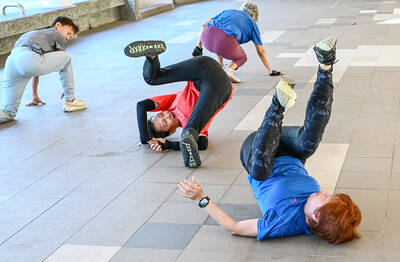
CONFIDENCE BOOSTER: ’After parkour ... you dare to do a lot of things that you think only young people can do,’ a 67-year-old parkour enthusiast said In a corner of suburban Singapore, Betty Boon vaults a guardrail, crawls underneath a slide, executes forward shoulder rolls and scales a steep slope, finishing the course to applause. “Good job,” the 69-year-old’s coach cheers. This is “geriatric parkour,” where about 20 retirees learned to tackle a series of relatively demanding exercises, building their agility and enjoying a sense of camaraderie. Boon, an upbeat grandmother, said learning parkour has aided her confidence and independence as she ages. “When you’re weak, you will be dependent on someone,” she said after sweating it out with her parkour classmates in suburban Toa Payoh,
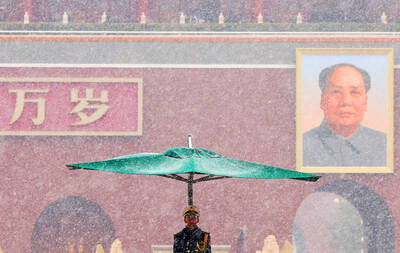
Chinese dissident artist Gao Zhen (高兟), famous for making provocative satirical sculptures of former Chinese leader Mao Zedong (毛澤東), was tried on Monday over accusations of “defaming national heroes and martyrs,” his wife and a rights group said. Gao, 69, who was detained in 2024 during a visit from the US, faces a maximum three-year prison sentence, said his wife, Zhao Yaliang (趙雅良), and Shane Yi, a researcher at the Chinese Human Rights Defenders group which operates outside the nation. The closed-door, one-day trial took place at Sanhe City People’s Court in Hebei Province neighboring the capital, Beijing, and ended without a
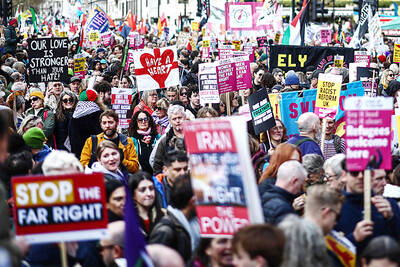
‘TOXIC CLIMATE’: ‘I don’t really recognize Labour anymore... The idea that you can implement far-right ideas in order to stop the far right is nonsense,’ a protester said Tens of thousands of people on Saturday marched through central London to protest against the far right, weeks ahead of local elections and six months after Britain saw one of its largest far-right demonstrations. Organized by hundreds of civic groups, including trade unions, anti-racism campaigners and Muslim representative bodies, Saturday’s Together Alliance event was billed as the biggest in UK history to counter right-wing extremism. A separate pro-Palestinian march had also converged with the main rally. While organizers claimed 500,000 had turned out in total, the police gave a figure of about 50,000. Protesters carrying placards with slogans such as


 RSS
RSS