


Delia Kalia learnt the hard way that while in Japan you must obey the rules.
The 25-year-old New Zealander said she was overpowered by 15 policemen, bound hand and foot and thrown into jail for a week after a run-in with the police over parking her car in someone else's spot got out of hand.
Hundreds of foreigners have been arrested here for misdemeanors to which authorities in other countries would likely turn a blind eye, such as shaking a vending machine or selling a friend's unwanted football ticket.
The police insist arrested foreigners and Japanese are treated alike, but some lawyers and human rights groups argue that in practice, when handling relatively minor offences, people from overseas receive a rougher deal.
Kalia, a dental nurse, left her car in a private space while visiting a friend in Aoyama, an upperclass part of Tokyo, one afternoon last month.
Upon her return she found the owner of the parking spot had come back, blocked her in with his van and called the police.
"I told him I was really sorry and if he moved his van I would get out of the way," Kalia recalled in an interview.
But the man refused and a police officer who had arrived at the scene demanded to see her passport.
"They could not speak English, I could not speak Japanese, we weren't getting anywhere and I started to get annoyed," admitted the young woman.
Fighting back
After a heated exchange, Kalia said she jumped into her car to escape, but the policeman forcefully grabbed her arm "so I slapped him two times across the face."
In an instant more officers arrived, bundled her into their car and whisked her off to the police station.
Kalia spent a week in detention while the incident was investigated. Confined to a small cell with seven other women, she had only one shower the whole time and was handcuffed and led by a rope when taken anywhere.
Her experience was made more confusing because hardly anyone spoke English, no one immediately explained her assault charges and police wanted her to sign a statement in Japanese that she could not read.
"Some [foreign] suspects are detained for a long time and it is quite hard for lawyers to gain access," said Makoto Teranaka, Secretary General for Amnesty International Japan.
There "is some sort of grounds for suspecting ill-treatment in police custody ... we have a problem with this system," he said in an interview.
Police have 48 hours after making an arrest to decide whether they want to investigate a case, press charges or release the suspect.
A judge must give police permission to hold someone for up to 10 days, this period can be extended another 10 days and on exceptional cases a further five until a charge is brought.
John Jones, 43, a jeweller from London was held in solitary confinement for 20 days before being fined ?150,000 (US$1,280) for trying to sell a World Cup football ticket on behalf of a friend.
"He admitted to the offence [of touting] so should have been allowed to pay a fine and then be released within two days," said his lawyer, Akira Takashima.
"At big events there are a lot of ticket touts, and Japanese people frequently do it in front of the police but are not arrested," he said.
"I think there is often a violation of human rights when foreigners are arrested."
No distinction
A spokesman from the National Police Agency said no distinction was made between Japanese and foreign culprits.
"We treat and punish them the same way," he said.
As a signatory to the International Covenant of Civil and Political Rights, Japan respects human rights, said Satoru Ohashi, assistant director in the Justice Ministry's security division.
"But may be foreigners looking at our system might think it is too strict," Ohashi conceded.
Japan's Prison Code, a dated document promulgated in 1908, was under review, but it was likely to be some time before any reforms were made, he said.
Fundamentally, say embassies in Japan, rules are rules and although deviations are tolerated to a point, once someone crosses a certain line the heavy hand of the law comes crashing down.
"One of the misapprehensions is that I can call in the Queen's gunboat and steam up the river [to rescue someone]," said British consulate Alan Sutton.
"That is absolutely wrong ... all I can do is advise."
The best way to beat the system is to play along with it, confided a foreign lawyer in Tokyo who has helped a number of foreigners avoid charges.
"The key to having a charge dropped is to show you are terribly sorry for what you have done and that you will do everything in your power to compensate the person you have wronged," said the lawyer, who asked to remain anonymous.
For Kalia, money talked, and she was allowed to walk free after her husband paid off the man in whose space she parked.
"This experience has changed my whole opinion of Japan," she said.
"I can't wait until the day I leave. They really need to change as they can't continue to treat people like this."

An American scientist convicted of lying to US authorities about payments from China while he was at Harvard University has rebuilt his research lab in Shenzhen, China, to pursue technology the Chinese government has identified as a national priority: embedding electronics into the human brain. Charles Lieber, 67, is among the world’s leading researchers in brain-computer interfaces. The technology has shown promise in treating conditions such as amyotrophic lateral sclerosis and restoring movement in paralyzed people. It also has potential military applications: Scientists at the Chinese People’s Liberation Army have investigated brain interfaces as a way to engineer super soldiers by boosting

Indonesian police have arrested 13 people after shocking images of alleged abuse against small children at a daycare center went viral, sparking outrage across the nation, officials said on Monday. Police on Friday last week raided Little Aresha, a daycare center in Yogyakarta on Java island, following a report from a former employee. CCTV footage circulating on social media showed children, most younger than two, lying on the floor wearing only diapers, their hands and feet bound with rags. The police have confirmed that the footage is authentic. Police said they also found 20 children crammed into a room just 3m by 3m. “So
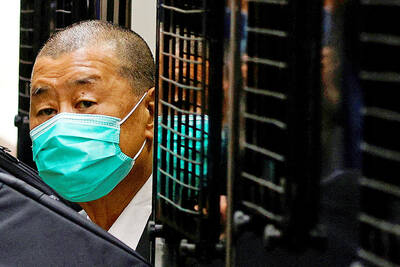
Jailed media entrepreneur Jimmy Lai (黎智英) has been awarded Deutsche Welle’s (DW) freedom of speech award for his contribution to Hong Kong’s pro-democracy movement. The German public broadcaster on Thursday said Lai would be presented in absentia with the 12th iteration of the award on June 23 at the DW Global Media Forum in Bonn. Deutsche Welle director-general Barbara Massing praised the 78-year-old founder of the now-shuttered news outlet Apple Daily for standing “unwaveringly for press freedom in Hong Kong at great personal risk.” “With Apple Daily, he gave journalists a platform for free reporting and a voice to the democracy movement in
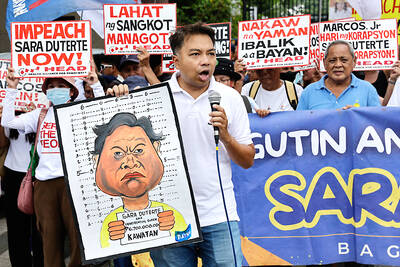
PHILIPPINE COMMITTEE: The head of the committee that made the decision said: ‘If there is nothing to hide, there is no reason to hide, there is no reason to obstruct’ A Philippine congressional committee on Wednesday ruled that there was “probable cause” to impeach Philippine Vice President Sara Duterte after hearing allegations of unexplained wealth, misuse of state funds and threats to have the president assassinated. The unanimous decision of the 53-member committee in the Philippine House of Representatives sends the two impeachment complaints to deliberations and voting by the entire lower chamber, which has more than 300 lawmakers. The complaints centered on Duterte’s alleged illegal use and mishandling of intelligence funds from the vice president’s office, and from her time as education secretary under Philippine President Ferdinand Marcos Jr. Duterte and the


 RSS
RSS