


The Taiwan Provincial Fishery Association (
The Tungkang Fishery Association (
"The ban will pose great troubles to our offshore fishing industry as many local ship owners rely heavily on mainland workers to operate their fishing vessels," said Chen Kun-yu (陳焜煜), secretary-general of the Tungkang Fishery Association.
According to Chen, Tungkang and the Suao Fishery Association (
At present, some 1,130 mainland fishermen are staying aboard special "floating hotels" off the Tungkang fishing port, Chen said.
Can't let go
"As most of them still have valid working permits, we'll try to persuade them to stay there for the time being," he said, adding that "we are afraid that they won't be able come to Taiwan again once they return to the mainland."
Most local ship owners prefer to hire Chinese fishery workers as they speak the same language and share a common cultural background, Chen said.
"Although there are some Indonesian, Philippine, Thai and Vietnamese fishery workers in the Tungkang area, they can't compete with their counterparts from China due to the language barrier and different living habits," Chen explained.
There have been reports about the mainland Chinese decision to ban its people from working aboard Taiwanese fishing boats since the beginning of this year.
With the assistance of mainland manpower agencies, the Tungkang association has come to know for certain that the mainland fishery labor export ban is for real, Chen said.
Previous press reports said the temporary export ban was mainly aimed at forcing Taiwanese ship owners to improve working terms and living conditions for mainland fishery workers.
Chen said the Fishery Administration under Taiwan's Cabinet-level Council of Agriculture (COA) has offered financial subsidies to major regional fishery associations to build new placement centers for mainland and foreign fishery workers.
For instance, Chen's association will hold an open tender in the near future to select a qualified contractor to build a new placement center near Tungkang fishing port with a view to offering a safe and comfortable living environment for mainland and foreign fishery workers. "The new center is expected to be completed by the end of this year," he added.
hopes for resolution
As most local ship owners have years of experience in cooperating with mainland fishery workers, they still hope that relevant government agencies can continue consultations with mainland authorities on gaining a lifting of the labor export ban or achieving mutually acceptable alternative measures.
Fishery sources said about 1,000 fishing boats at major Taiwan fishing ports have been affected by the mainland labor export ban, with the northern port of Keelung and the northeastern port of Nanfangao being hardest hit.
Many Nanfangao-based fishing ships are facing similar problems. A "floating hotel" operator said he managed to persuade 200-plus mainland fishery workers not to return to the mainland for family reunions before the Chinese New Year holiday. However, the Nanfangao area needs more than 2,000 fishery workers.
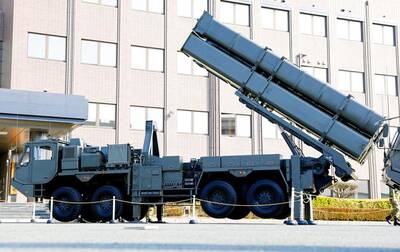
Japan has deployed long-range missiles in a southwestern region near China, the Japanese defense minister said yesterday, at a time when ties with Beijing are at their lowest in recent years. The missiles were installed in Kumamoto in the southern region of Kyushu, as Japan is attempting to shore up its military capacity as China steps up naval activity in the East China Sea. “Standoff defense capabilities enable us to counter the threat of enemy forces attempting to invade our country ... while ensuring the safety of our personnel,” Japanese Minister of Defense Shinjiro Koizumi said. “This is an extremely important initiative for

Chinese Nationalist Party (KMT) Chairwoman Cheng Li-wun (鄭麗文) today accepted an invitation from Chinese President Xi Jinping (習近平) to lead a delegation to China next month, saying she hopes to promote the peaceful development of cross-strait relations and bring stability to the Taiwan Strait. “I am grateful and happy to accept this invitation,” Cheng said in a statement from the KMT chairperson’s office. Cheng said she hopes both sides can work together to promote the peaceful development of cross-strait relations, enhance exchange and cooperation, bring stability to the Taiwan Strait and improve people’s livelihoods. At today's news conference, Cheng said any efforts to
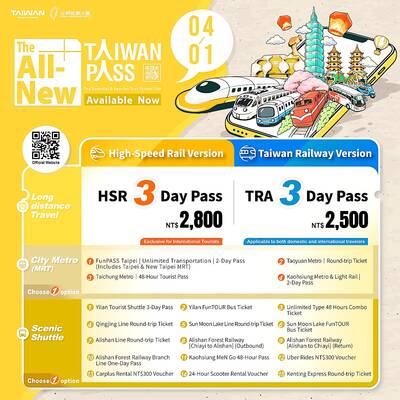
MORE POPULAR: Taiwan Pass sales increased by 59 percent during the first quarter compared with the same period last year, the Tourism Administration said The Tourism Administration yesterday said that it has streamlined the Taiwan Pass, with two versions available for purchase beginning today. The tourism agency has made the pass available to international tourists since 2024, allowing them to access the high-speed rail, Taiwan Railway Corp services, four MRT systems and four Taiwan Tourist Shuttles. Previously, five types of Taiwan Pass were available, but some tourists have said that the offerings were too complicated. The agency said only two types of Taiwan Pass would be available, starting from a three-day pass with the high-speed rail and a three-day pass with Taiwan Railway Corp. The former costs NT$2,800

The nation’s fastest supercomputer, Nano 4 (晶創26), is scheduled to be launched in the third quarter, and would be used to train large language models in finance and national defense sectors, the National Center for High-Performance Computing (NCHC) said. The supercomputer, which would operate at about 86.05 petaflops, is being tested at a new cloud computing center in the Southern Taiwan Science Park in Tainan. The exterior of the server cabinet features chip circuitry patterns overlaid with a map of Taiwan, highlighting the nation’s central position in the semiconductor industry. The center also houses Taiwania 2, Taiwania 3, Forerunner 1 and


 RSS
RSS