


Taipei Times: Why after only eight months since the airline's first management shakeup in the company's 10-year history has the president's position yet again been reshuffled?
Kitty Yen (嚴若琪): I've been with the group for nearly a quarter century and never asked my boss why he transferred me to another post. This is not my character and also not our culture in this conglomerate.
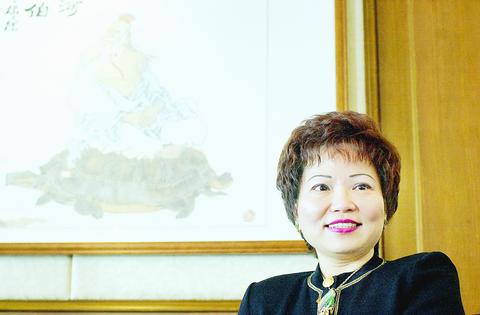
PHOTO: CHEN CHENG-CHANG, TAIPEI TIMES
TT: What makes you right for the job?
Yen: I'm full of energy, I'm honest, I'm willing to do the job. I'm fully prepared to take this challenge working with my colleagues. I was brought up from the very bottom from office clerk. For me this is one of my biggest advantages, as I have strong relations and communication channels throughout the company. And while I know how things are progressing all the time, the most important thing in a corporate culture is trust. Truly understanding the worker's faith. With this understanding I will delegate but retain the final say.
TT: Did you have any second thoughts about taking on this position at a time when airlines are suffering their worst downturn ever?
Yen: I like the challenge. Nobody dreamed that 9/11 could have happened. But as Chinese people say: A crisis can be a turning point. This group has been through so many challenges, like the Middle East war, and we were the outsiders entering the Far East Europe maritime trade. We were also the first company to operate round-the-world, two-direction freight lines. These are accomplishments you can't ignore. And then more than 11 years ago we successfully diversified from maritime into aviation. A lot of people questioned us at the time, saying we didn't know airlines and we didn't have the resources to do the business. Yet see what we have done in the last 10 and a half years. Our level of service has stimulated our competitors.
TT: Last year EVA reported a net loss. What are your predictions for 2002?
Yen: That's just one year's performance. I don't think it will affect our long-term performance. Last year we made financial adjustments before Sept. 11, and after Sept. 11 it was only changed slightly. We limited our losses and fully controlled our costs. It was a flexible, prompt reaction. We have very good teamwork. If we can overcome 9/11 what can't we overcome? As for our revenue, in our initial estimates we are expecting a 10 percent increase to around NT$57.7 billion in 2002. On revenue we are working to be more flexible, to be more market oriented, more prompt in coping with market changes. This is what we have been really good at for so many years, so we look forward to doing even better.
TT: EVA has already cut staff by around 800 and is planning wage cuts of up to 30 percent. When can employees expect to see the situation stabilize?
Yen: Salary cuts and layoffs stop here. I came from the bottom so I have clear communication channels and a good understanding of employee sentiment. And what they want is stability and to know that there is hope for the company. So we want to finalize the planned wage cuts and layoffs in as short a time as possible and let them know that it stops here. At the same time we will also send e-mails to employees to let them know that these measures are temporary. As soon as the economy picks up or our own performance improves we will be dynamic in our response and bring it up for review. I hope the employees understand.
TT: What kind of major changes do you propose to make to the company?
Yen: You must go forward, you must be looking ahead, you must change -- especially in the service sector. You can't wait for customers to approach you asking for what they want. You must think what they want in advance -- this is service. If you don't change you are not qualified for this industry.
TT: With Christine Tsung (
Yen: The media love to use this comparison in the headlines. But let me ask you, what if it were two men? In this day and age men and women are both the same.
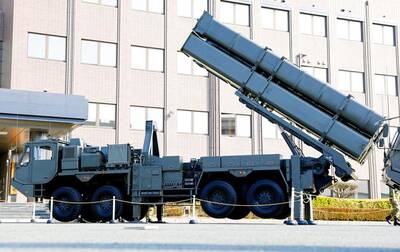
Japan has deployed long-range missiles in a southwestern region near China, the Japanese defense minister said yesterday, at a time when ties with Beijing are at their lowest in recent years. The missiles were installed in Kumamoto in the southern region of Kyushu, as Japan is attempting to shore up its military capacity as China steps up naval activity in the East China Sea. “Standoff defense capabilities enable us to counter the threat of enemy forces attempting to invade our country ... while ensuring the safety of our personnel,” Japanese Minister of Defense Shinjiro Koizumi said. “This is an extremely important initiative for
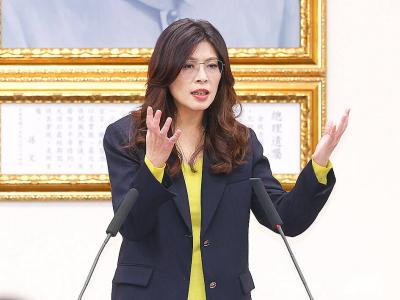
Chinese Nationalist Party (KMT) Chairwoman Cheng Li-wun (鄭麗文) today accepted an invitation from Chinese President Xi Jinping (習近平) to lead a delegation to China next month, saying she hopes to promote the peaceful development of cross-strait relations and bring stability to the Taiwan Strait. “I am grateful and happy to accept this invitation,” Cheng said in a statement from the KMT chairperson’s office. Cheng said she hopes both sides can work together to promote the peaceful development of cross-strait relations, enhance exchange and cooperation, bring stability to the Taiwan Strait and improve people’s livelihoods. At today's news conference, Cheng said any efforts to
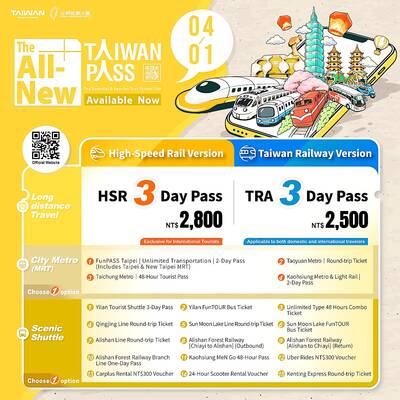
MORE POPULAR: Taiwan Pass sales increased by 59 percent during the first quarter compared with the same period last year, the Tourism Administration said The Tourism Administration yesterday said that it has streamlined the Taiwan Pass, with two versions available for purchase beginning today. The tourism agency has made the pass available to international tourists since 2024, allowing them to access the high-speed rail, Taiwan Railway Corp services, four MRT systems and four Taiwan Tourist Shuttles. Previously, five types of Taiwan Pass were available, but some tourists have said that the offerings were too complicated. The agency said only two types of Taiwan Pass would be available, starting from a three-day pass with the high-speed rail and a three-day pass with Taiwan Railway Corp. The former costs NT$2,800

The nation’s fastest supercomputer, Nano 4 (晶創26), is scheduled to be launched in the third quarter, and would be used to train large language models in finance and national defense sectors, the National Center for High-Performance Computing (NCHC) said. The supercomputer, which would operate at about 86.05 petaflops, is being tested at a new cloud computing center in the Southern Taiwan Science Park in Tainan. The exterior of the server cabinet features chip circuitry patterns overlaid with a map of Taiwan, highlighting the nation’s central position in the semiconductor industry. The center also houses Taiwania 2, Taiwania 3, Forerunner 1 and


 RSS
RSS