


Lee Leslie was a Coca-Cola collector long before he lived in Atlanta.
So will he admit to moving here merely to be closer to Coke? No, but it certainly crossed his mind.
"It didn't hurt that Coca-Cola was down here," he said.
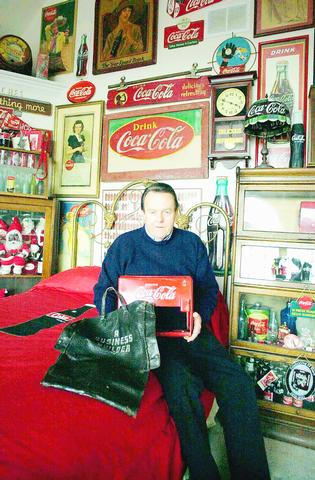
PHOTO: NY TIMES
Leslie is part of the legion of Coke collectors around the world. Thanks to the Internet, more and more people are involved in swapping Coke goods. The auction site eBay, for instance, recently listed more than 14,000 items that mentioned Coca-Cola.
Thanks to the company's size and long history, Coke has one of the biggest collector groups of any corporation. While Coca-Cola itself doesn't sponsor collector activities, the company is more than willing to feed its fan base.
Coke now has 350 licensees internationally. They produce about 10,000 different Coke items a year, ranging from toy bears to lunch boxes.
The stuff dating from the 1800s and early 1900s is what hard-core collectors really want, however.
Coke archivist Phil Mooney has long tried to keep track of everything that gets produced with the company's approval. Mooney is probably the ultimate Coke collector, given that he is charged with maintaining a corporate archive.
While most collectors probe online sites, flea markets and antique shows for rare Coke items, Mooney guards the door to the best selection that exists.
His archive is deep in a basement at Coke's complex on North Avenue in Atlanta. A nondescript pair of doors marked "storage" hides an 743m2 room filled with everything from one-of-a-kind Coke paintings by Norman Rockwell to vintage Coke calendars.
Everything is in mint condition, or close to it. Much of it is rare. One 1908 calendar carries the slogan "Good to the last drop," a line used for a few years by Coke and later adopted by Maxwell House.
"It's just a collector's dream," said Leslie, who is president of the Atlanta chapter of the Coca-Cola Collectors Club.
The rarest Coke collectible, Mooney said, is the original prototype of the company's trademark glass bottle. The bottle -- actually fatter than the one that went into production -- is on display at Atlanta's World of Coca-Cola.
The archive also holds artifacts that people might never imagine. Mooney has about 20 pieces of Coca-Cola Gum, for example. The product was sold only from 1911 to 1920.
The gum is now quite rare, of course. A single stick sold for US$8,000 at auction several years ago, Mooney said, although that was an unusually high price.
Mooney isn't sure how the product tastes.
"I don't chew US$8,000 pieces of gum," he said.
Only in relatively recent times have prices reached such stunning levels, corresponding to the growing numbers within Coke's collecting community.
Thompson, a 65-year-old architect from Versailles, Kentucky, started collecting Coke paraphernalia in 1970, before collectors were organized into a club and when old items were easier to find.
One of his specialties is Coke gum.
"The second and third sticks I bought were in 1976," Thompson said, and he paid US$110 for one and US$90 for the other. "That was a record at the time."
While collectors would surely like to rummage through Coke's archive, the space isn't meant for visitors. Coke keeps its old materials mostly for research, and the space looks more like a warehouse than a museum.
Coke also doesn't sponsor the national collectors club, although the company provides assistance. Mooney sometimes serves as a guest speaker at club events.
"It's a fan club, and we try to help them," he said.
The current national president happens to be an Atlantan, too: Karleen Buchholz. She's at the top of an organization that has 4,500 members and 54 chapters worldwide.
After 25 years of collecting, Buchholz still enjoys the hobby. She remains a purist who has little interest in acquiring items via the Internet.
"You can buy things off eBay, but you don't make the friendships," she said. That comes from face-to-face trading.
And the search never ends. Leslie has been looking for one specific item -- a 1929 longnose Metalcraft Coke truck -- for the past 40 years.
Today's price? Probably US$4,000 to US$5,000.
Leslie could be persuaded to pay it, too. "I might -- if it was in original condition."

‘NO SECURITY RISK’: The Railway Bureau reassured the public that the technicians’ activities were limited to technical guidance and did not involve sensitive systems The Railway Bureau yesterday said it had invited eight Chinese technicians to assist with an airport MRT construction project. The bureau issued the confirmation after an Internet user said Chinese nationals had entered the construction zone of Taiwan Taoyuan International Airport’s Terminal 3 project. They asked why “individuals from an enemy state” were allowed access to such a major national infrastructure project, which raised serious concerns over Taiwan’s industrial safety, sensitive systems and information security. The bureau’s Northern Region Engineering Branch Office said subcontractor Taiwan Handle Industrial Co (台灣手把工業) of the Taoyuan airport MRT’s “Contract No. CU05 Project A14 Station Civil, MEP &

A US uncrewed surface vessel (USV) encountered multiple Chinese warships during an autonomous transit of the Taiwan Strait, US defense company Seasats said in a statement on Wednesday. Seasats announced that a Lightfish USV had completed the first autonomous transit of the Taiwan Strait. Over five days, the USV traversed the entire length of the Strait while constantly monitoring surface vessel traffic, the company said. The Lightfish encountered multiple Chinese warships, one of which was a Chinese People’s Liberation Army Navy (PLAN) Type 056 corvette, it said. The Chinese vessels were operating “well within Taiwan’s exclusive economic zone without transmitting their identity via the
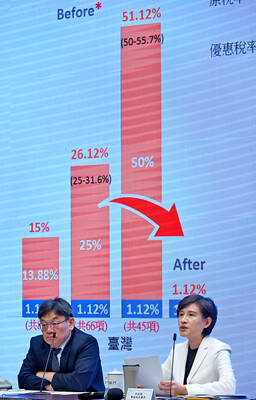
GREATER REACH? Auto parts and wood products would face tariffs of up to 15%, matching those targeting the EU, Japan and South Korea, Vice Premier said The US has announced that preferential tariff treatment for Taiwan’s non-semiconductor Section 232 goods would take effect retroactively from May 1, the Executive Yuan said yesterday. The US government yesterday posted a notice on the Federal Register’s public inspection Web site previewing tariff concessions for Taiwan under a memorandum of understanding (MOU) on Taiwan-US investment after two months of negotiations. The MOU signed on Jan. 15 stipulated three major preferential tariff arrangements: a 15 percent “reciprocal” tariff rate for Taiwan without stacking most-favored nation (MFN) rates; preferential Section 232 treatment for semiconductors and related products; and preferential Section 232 treatment for non-semiconductor

TIT-FOR-TAT: The US allegedly revoked the visa of a Chinese national working at Xinhua News Agency in the US in response to Beijing’s expulsion of Vivian Wang The Presidential Office yesterday condemned China for expelling a New York Times correspondent from Beijing following the newspaper’s interview with President William Lai (賴清德), saying the move highlighted Beijing’s suppression of press freedom and its threat to international news media. Taiwan has noted a series of recent incidents in which Beijing used similar tactics to “threaten and pressure international media outlets and journalists,” Presidential Office spokeswoman Karen Kuo (郭雅慧) said in a statement. “This concerns not only press freedom and freedom of expression, but also the safety of journalists, and Taiwan and relevant partners are paying close attention to the situation,” she


 RSS
RSS