


In its bid to transform the personal computer industry, VIA Technolo-gies Inc (
So far, VIA has been able to overcome these obstacles and grow at a phenomenal rate, last year reporting a 174 percent increase in revenue over 1999. In just one year, VIA jumped from being a US$350 million a year company to a US$1 billion a year firm, as a result of what Marketing Director Richard Brown called "a culmination of years of research and hard work."

PHOTO: CHEN CHENG-CHANG, TAIPEI TIMES
VIA accounts for over a third of the world's US$3 billion market for computer chipsets, which control the flow of information between the central processing unit (CPU), memory and other chips inside a computer. The firm plays second fiddle worldwide only to Intel Corp.
Now, the economic downturn has added strain atop reinvigorated competition from Intel and Taiwanese chipset makers like Silicon Integrated and Acer Labs. In October, VIA's third quarter earnings dropped 64 percent year on year to NT$880 million (US$25.5 million) due to increased competition and fallout from multiple legal battles with Intel.
Market share
The firm also slashed its earnings forecast for the year by 38 percent to NT$5.3 billion (US$153 million). It had predicted a pretax profit of NT$8.4 billion for the year. VIA's stock has dropped 37 percent from its high this year to close at NT$143 last Friday.
Another company stung by the downturn, Intel, opened this year with renewed vigor in taking back the lead CPU speed and looking to regain market share it had lost to VIA in the chipset business.
In mid-1999, Intel began promoting the use of a memory chip based on new Rambus technology in combination with its Pentium 3 CPU. The computer market balked both at the heavy cost of the new memory chips and the new manufacturing techniques that would be required. A number of companies looked for a different memory chip which could also boost the performance of a computer, but at a lower cost. The answer was VIA's PC-133.
VIA became a leader in this revolt against Intel's Rambus initiative by creating the first chipsets to connect PC-133 memory with Pentium 3 chips. Intel responded with lawsuits, contending the company needed a technology license to make the chipsets and to pay royalties. The case was settled out of court for an undisclosed amount, but many analysts say the settlement was probably close to the amount VIA would have had to pay in royalties anyway. The Pentium 3 chipset made by VIA became a cornerstone in its becoming a US$1 billion company last year.
History repeated itself with Intel's launch of the Pentium 4 chip series. The firm again told the computer industry that Rambus would be necessary to keep up with the processing power of its new Pentium 4 chips. The industry again balked at the cost, and promoted PC-133 and its new cousin, DDR memory as less expensive alternatives. VIA again launched a new chipset to connect the low cost DDR memory chips with Intel's P4 CPU -- without a technology license from Intel. Intel again sued, charging VIA with violating five patents. That was in August.
Intel soon stepped up the pressure on VIA by suing motherboard maker Elitegroup Computer Systems Co (
VIA responded with its own lawsuit, accusing Intel of anti-competitive behavior, patent in-fringement on technology owned by VIA's Texas-based Centaur division and willful destruction of VIA property, in an assault on balloons and other marketing material used at Computex Taipei in June of this year.
The company responded in the business arena by launching its own motherboard making division, dubbed VIA Platform Solution Division, and soon claimed to be shipping one million Pentium 4 compatible motherboard units per month.
Vindication
Recently, the company has been vindicated on court cases with Intel unrelated to the Pentium 4 dispute. A few years ago, Intel sued VIA for making chipsets for Advanced Micro Devices Inc (AMD), Intel's top competitor in the US$29 billion market for computer CPUs. Intel claimed the chipsets contained Pentium 3 technology illegally used by VIA in those provided to AMD. A US judge threw out one claim last month, then another last week.
"Intel's [Pentium 4-related lawsuit] is designed to put uncertainty and doubt in people's minds about the legitimacy of VIA's products. I think now this case has shown that we are willing to defend ourselves and we are obviously pleased with the outcome. I think overall it is a little bit too early to say whether it impacts [other legal battles with Intel], but it certainly vindicates the stance that VIA has taken," said Brown.
If the two-year-old case is any indicator, it could take years to resolve the current Pentium 4 case.
In the meantime, VIA is carrying on with a number of new business initiatives. Pumping its marketing slogan of "VIA, We Connect ..." the company is moving forward with its open, industry-wide Total Connectivity initiative -- an idea that was stopped dead in its tracks early this year -- the low cost information PC and I-appliance.
A number of companies developed I-appliances and low cost PCs in response to the dotcom craze. As people's appetite for the Net grew, marketers began to look for an alternative to the costly PC. The idea is simple: To surf the Internet, download photos, music and other files, and run word processing, spreadsheets and other common programs, consumers don't need the expensive computing power found in today's PCs.
VIA is trying to move the industry forward with products like its Ultra-Compact Mini-iTX Mainboard. Mainboards, or motherboards, are the main circuit board that connects and contains all the chips and other components inside a computer.
Up to now, each company working on a low-cost PC or I-appliance had built their own proprietary mainboard in the hope it would become the industry standard. The winner takes home the ultimate prize, cash in the form of royalties by every company that manufactures a mainboard based on the design. This is how intellectual property makes companies rich, providing royalty revenues long after the product becomes mass produced. IBM, for example, still earns royalties from motherboards and other parts of the PC since it helped pioneer the industry and created a host of standards still in use today.
Industry-wide recognition
VIA created the Mini-iTX Main-board design as an open reference, meaning anyone can use the board without paying royalties -- putting the design more firmly on the road to mass production. The benefit for VIA comes in industry-wide recognition and the possibility to gain market share in another arena -- the US$29 billion computer chip industry.
The Mini-iTX Mainboard assumes the slimmed down I-appliance or low cost PC will use fewer components and a lower-cost chip that does not need a fan. PCs and notebooks today all come with fans inside to cool down the CPU. Only a handful of companies offer CPU products able to operate without a fan, including Transmeta Corp and some Intel chips like those used in Compaq's iPaq personal digital assistant.
VIA integrated graphics and sound functions on the chipsets used on the Min-iTX and placed its CPU, dubbed C3, on the board. The C3 processor gives off minimal heat, eliminating the need for a fan, while operating at speeds up to 866MHz. Brown said a faster version of the C3 is due out later this year or early next year, it will join the 1GHz chip alongside Intel and AMD.
With the motherboard venture, low-cost PC and CPU, a separate joint wireless technology project in Sweden, a tablet PC and other efforts, Brown believes VIA's efforts will result in the same rapid growth the firm experienced last year. In the meantime, Intel lawsuits and the current tech slump will continue to keep the company busy.

‘NO SECURITY RISK’: The Railway Bureau reassured the public that the technicians’ activities were limited to technical guidance and did not involve sensitive systems The Railway Bureau yesterday said it had invited eight Chinese technicians to assist with an airport MRT construction project. The bureau issued the confirmation after an Internet user said Chinese nationals had entered the construction zone of Taiwan Taoyuan International Airport’s Terminal 3 project. They asked why “individuals from an enemy state” were allowed access to such a major national infrastructure project, which raised serious concerns over Taiwan’s industrial safety, sensitive systems and information security. The bureau’s Northern Region Engineering Branch Office said subcontractor Taiwan Handle Industrial Co (台灣手把工業) of the Taoyuan airport MRT’s “Contract No. CU05 Project A14 Station Civil, MEP &

A US uncrewed surface vessel (USV) encountered multiple Chinese warships during an autonomous transit of the Taiwan Strait, US defense company Seasats said in a statement on Wednesday. Seasats announced that a Lightfish USV had completed the first autonomous transit of the Taiwan Strait. Over five days, the USV traversed the entire length of the Strait while constantly monitoring surface vessel traffic, the company said. The Lightfish encountered multiple Chinese warships, one of which was a Chinese People’s Liberation Army Navy (PLAN) Type 056 corvette, it said. The Chinese vessels were operating “well within Taiwan’s exclusive economic zone without transmitting their identity via the

Taiwan is still in the process of assessing the possibility of recruiting workers from Eswatini, the Ministry of Foreign Affairs said yesterday, adding that its goal is to help Eswatini upgrade its vocational training centers. If there are plans to recruit workers from Eswatini, safeguarding national security, protecting public health and ensuring the employment rights of Taiwanese would be prerequisites, Department of West Asian and African Affairs Director-General Yen Chia-liang (顏嘉良) told a news conference. Key considerations would also include filling labor shortages in specific industries, and fostering bilateral professional and technical exchanges, he said. Yen was asked about the progress of labor
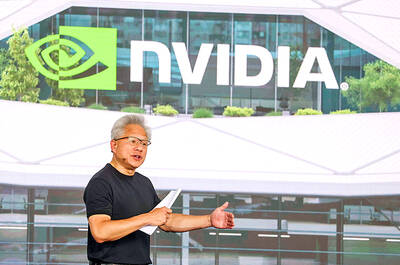
‘BOOMING’: ’ The number of partners we have here is incredible. You can see from their stock prices. They’re doing so well, they’re so happy,’ Jensen Huang said Nvidia Corp’s spending in Taiwan has ballooned to about US$150 billion a year, 10 times the US$10 billion to US$15 billion the company spent five years ago, Nvidia chief executive officer Jensen Huang (黃仁勳) said yesterday, suggesting Taiwan’s strategic importance in the global artificial intelligence (AI) supply chain. “Taiwan is the epicenter of the AI revolution. This is where the chips come, packaging comes. This is where the systems are made. This is where AI supercomputers were created,” Huang said at a meeting for the company’s employees in Beitou-Shilin Technology Park (北投士林科技園區) in Taipei, the planned site of Nvidia’s Taipei headquarters. “Taiwan


 RSS
RSS