


Taipei Time: What's the most important message the Economic Development Advisory Conference (EDAC) has tried to convey?
Wu Rong-I (吳榮義): EDAC was called in order to target short-term problems facing Taiwan's economy. Morris Chang (張忠謀), chairman of Taiwan Semiconductor Manufacturing Co (台積電), put it quite correctly that the conference was to tackle short-term problems.
In fact, since President Chen Shui-bian (陳水扁) and the DPP took power, Taiwan's economy has been slowing down fast. With so many people involved in the stock market and watching the price index plummet, they blamed the government for its lack of experience in dealing with an economic downturn. While I don't know who advised Chen to form the EDAC, it proved to be a success for him, as the conference enabled people from different parties, business groups, the private sector and the government to sit down and discuss solutions to Taiwan's sagging economy. In my understanding, it's been very difficult for the government to get all the parties to sit down and create an agenda [for, discussion] in the past.
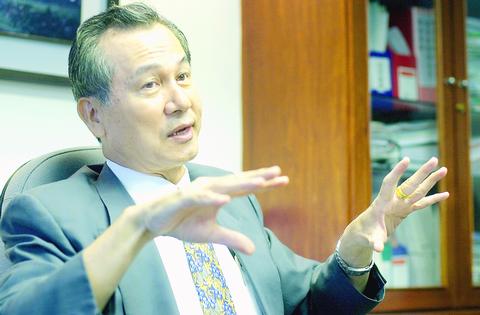
PHOTO: CHIANG YING-YING, TAIPEI TIMES
TT: Do you believe the outcome of the conference will be followed by smooth formulation and implementation of its 322 proposals?
Wu: I remember President Chen said at the conference's opening ceremony that consensus proposals reached during the conference should be implemented. In addition, Legislative Yuan Speaker Wang Jing-ping (王金平) also said he would make consensus-based proposals the first priority in the Legislature's process. So, from the administration's point of view, I think the Executive Yuan will be 100 percent dedicated to implementing all 322 proposals. As for the Legislative Yuan, which started a new session last week, there is heavy pressure on lawmakers not to oppose the proposals. We will see.
TT: As a member of EDAC's cross-strait panel, what's your position on China-bound investment policy and the direct links issue?
Wu: To be honest, I'm quite conservative, in that I still think the original `no haste, be patient' (戒急用忍) policy is better than the new `active opening, effective management' (積極開放,有效管理) policy. I have to admit though, that the problem with the old policy was it didn't have a clear agenda and in reality, people can make investments wherever they want, with or without government approval.
However, there is a problem regarding the new policy, in that people can take the part they want. If they are pro-opening, they will take the first part -- active opening; if they are against active opening they will choose the second part -- effective management.
While we have also agreed to replace a US$50 million limit on individual investments in China by local companies with other measures, I think that ... many others -- such as direct links and opening Taiwan to mainland Chinese tourists -- actually need further negotiations with China.
TT: So, do you think WTO will become a forum for discussing cross-strait links with China?
Wu: I think cross-strait negotiations are the most difficult part. Some have asked, if China doesn't agree to negotiate, how should Taiwan respond? Others say, if Taiwan doesn't accept the "one China" policy, then China won't negotiate with us. There is a problem, but we hope that China and Taiwan can each make certain concessions and sit down with equal dignity and hold discussions.
One possibility is that Taiwan will have year-end elections and maybe China will also change its leaders and therefore have a different mindset. To me, trade, economics and investment with China are very important. But whether they are that important to Taiwan, I have a different view. We don't need to open up direct links in order to save Taiwan's economy -- we have other options. But for China, they need new investments to create more jobs. So, despite what many others may think, I think WTO is a very good opportunity for China to make some concessions in terms of negotiating with Taiwan and they should learn to negotiate with Taiwan under the WTO framework.
TT: Do you think this issue, in the end, will go in that direction?
Wu: It is not totally impossible, but frankly speaking, I really don't know what will happen after Taiwan and China enter the WTO. But if we really think only in terms of trade and investment, and if we think only about the benefits to both sides, there's no reason that the two sides cannot sit down, talk and find solutions to the economic problems facing us.
TT: Taiwan businesses have invested over US$70 billion in China since the late 1980s. With China's low cost, incentive-laden investment environment, how can Taiwan avoid being swallowed up by its neighbor and remain relevant as a regional economy?
Wu: This is a very difficult question. I can't offer a clear-cut answer. But I think we should be very careful about China's economy, because it could collapse at anytime in the next three to five years, as happened in the former Soviet Union.
In some parts of China, economic development is quite advanced, but in other parts it isn't. As China is encountering various social, political, economic and regional problems -- and now the WTO issues -- I believe it will be a very difficult and complicated task for it to deal with while maintaining stable development.
For the US, there's a system set up and president doesn't have to worry about every issue. But for China, President Jiang Zemin (
TT: Speaking of businessmen, in Taiwan business leaders such as Wang Yung-ching (王永慶, chairman of the Formosa Plastics Group) and Morris Chang have played a very vocal role in urging political change on matters ranging from cleaning up "black gold" politics to liberalizing trade with China. How do you view the role business people play in Taiwan politics?
Wu: Businesses are only one of the interest groups that want to influence government policymaking. In the past business groups might have played an important role in supporting certain political parties. But now I don't think business leaders can just ask their employees to support certain candidates. Of course, a successful business sector is important to a democratic country and political leaders need to listen to business leaders carefully. But I think what Wang has said [in supporting `one-China' principle] is really going too far and many people don't agree with him.
Some have criticized Wang, saying that if he wants to make more money on the mainland, that's OK -- but if he wants to surrender to China, why not just go there himself and not try to take all of Taiwan with him. As an individual, Wang has every right to say what he likes to [such as accepting Beijing's `one China' principle], but as a business leader in Taiwan, he should stick with business and stay out of politics. Actually, it is understandable that many businessmen have pro-China opinions because most of their business stakes are in the mainland -- they have no choice.
TT: As one of the minds behind former president Lee Teng-hui's (李登輝) "no haste, be patient" policy, how do you feel about EDAC's proposal to consign it to history?
Wu: It's not necessary to feel sorry for the change in China-bound investment policy. As both Taiwan and China are expected to join the WTO early next year, it is time for us to face a new situation and prepare to negotiate with China. The first part of the new measure -- active opening -- is not just good in political sense but also good in terms of business. But what concerns me is the second part of the new measure -- effective management -- and how the government is to implement it.
TT: Exactly how will entry into the WTO impact Taiwan's economy?
Wu: I don't think the impact will be serious on the agricultural sector because that sector is very small, accounting for less than 2 percent of GDP. Many farmers are actually part-time farmers -- they have other jobs in the commercial and public sectors. The maintain the title in order to hold onto their land. So I think Taiwan's unemployment rate shouldn't be too affected by changes in the agriculture sector -- and the government has already budgeted NT$100 billion to protect the sector. The government can also subsidize farmers, which is not against WTO rules, although subsidizing the prices of agricultural products is not allowed.
As for the industrial sector, it is already very open to, and competitive in, the world market. With many small- and medium-sized enterprises moving to China and Southeast Asia, the sector should not be much of a problem in terms of adjustment after WTO entry.
For the service sector, we have seen telecom markets open up to foreign companies and I feel the increased competition in the banking sector will force banks to improve their performance. Indeed, foreign capital will improve management and competitiveness in the service sector. I think the impact of WTO entry on the economy will not be so serious, but how we deal with China will be.
TT: As an economic adviser to both Lee and Chen, how do you compare Lee's views on the economy and his management methods to those of his successor?
Wu: They are quite different. Lee thinks he is an economic guru, since he was a professor and has a Ph.D from Cornell University. So he has a lot of self-confidence. He reads a lot, talks with many people and has access to a wide variety of information. Judging from his performance as president, economically, he is OK and he can make immediate decisions.
As for Chen, he is a young leader and doesn't know very much about economics. Although he has carefully listened to advice on economic problems, I question how he makes quick decisions.
Also Chen's premier is not trained in economics, so I doubt whether they really communicate with each other about the complicated economic issues, let alone solving economic problems.
TT: So how would you rate the performance of Chen's administration in managing the economy after 15 months in power?
Wu: I think the Cabinet minis-ters still need to coordinate among themselves more. As they come from different parties, they did have some problems initially in learning how to work as a team, but they have performed much better recently. Learning to work as a team takes time.
At present, the majority of the people of Taiwan support the administration regarding China-bound investment policy. But some have also warned that the DPP should be aware of the danger of loosing support, especially in southern Taiwan, if Chen's admin-istration moves forward with the new policy too fast -- which will cause unemployment to rise much higher there.
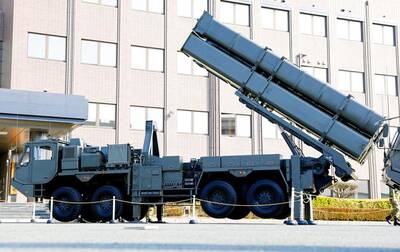
Japan has deployed long-range missiles in a southwestern region near China, the Japanese defense minister said yesterday, at a time when ties with Beijing are at their lowest in recent years. The missiles were installed in Kumamoto in the southern region of Kyushu, as Japan is attempting to shore up its military capacity as China steps up naval activity in the East China Sea. “Standoff defense capabilities enable us to counter the threat of enemy forces attempting to invade our country ... while ensuring the safety of our personnel,” Japanese Minister of Defense Shinjiro Koizumi said. “This is an extremely important initiative for
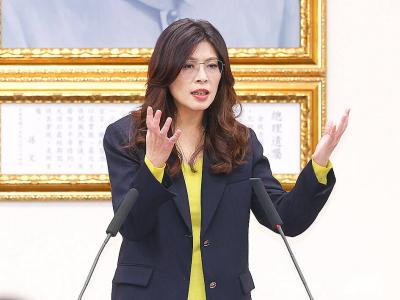
Chinese Nationalist Party (KMT) Chairwoman Cheng Li-wun (鄭麗文) today accepted an invitation from Chinese President Xi Jinping (習近平) to lead a delegation to China next month, saying she hopes to promote the peaceful development of cross-strait relations and bring stability to the Taiwan Strait. “I am grateful and happy to accept this invitation,” Cheng said in a statement from the KMT chairperson’s office. Cheng said she hopes both sides can work together to promote the peaceful development of cross-strait relations, enhance exchange and cooperation, bring stability to the Taiwan Strait and improve people’s livelihoods. At today's news conference, Cheng said any efforts to
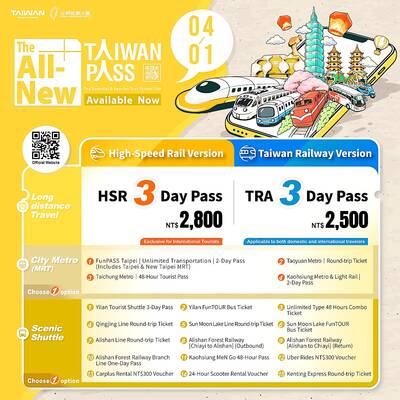
MORE POPULAR: Taiwan Pass sales increased by 59 percent during the first quarter compared with the same period last year, the Tourism Administration said The Tourism Administration yesterday said that it has streamlined the Taiwan Pass, with two versions available for purchase beginning today. The tourism agency has made the pass available to international tourists since 2024, allowing them to access the high-speed rail, Taiwan Railway Corp services, four MRT systems and four Taiwan Tourist Shuttles. Previously, five types of Taiwan Pass were available, but some tourists have said that the offerings were too complicated. The agency said only two types of Taiwan Pass would be available, starting from a three-day pass with the high-speed rail and a three-day pass with Taiwan Railway Corp. The former costs NT$2,800

The nation’s fastest supercomputer, Nano 4 (晶創26), is scheduled to be launched in the third quarter, and would be used to train large language models in finance and national defense sectors, the National Center for High-Performance Computing (NCHC) said. The supercomputer, which would operate at about 86.05 petaflops, is being tested at a new cloud computing center in the Southern Taiwan Science Park in Tainan. The exterior of the server cabinet features chip circuitry patterns overlaid with a map of Taiwan, highlighting the nation’s central position in the semiconductor industry. The center also houses Taiwania 2, Taiwania 3, Forerunner 1 and


 RSS
RSS