


Taipei Times: Could you give our readers some background about Ulead and why your company decided to focus on digital imaging/photographic software?
Danielle Liao (廖信伶): Ulead Systems (
We thought there would be a market for color image-editing software for use with Windows so we released our first products, I-Pallet and I-photo. Then we had our first professional digital imaging software, Photo-Styler, that we launched at Comdex in 1989 and then we entered the market.
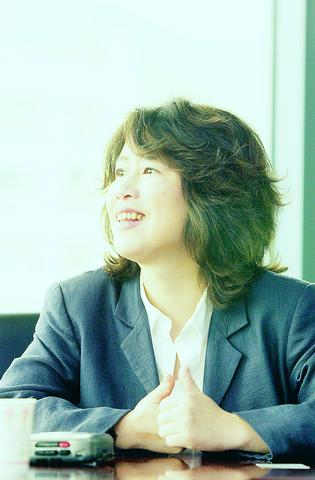
PHOTO: GEORGE TSORNG, TAIPEI TIMES
So it's been about 12 years since we began developing ourselves into a digital media software provider. Our channel covers the world, including the major markets -- Japan, the US, Australia and Europe. Dataquest ranks us number three in digital image software and I think we are number one or number two in digital video. In all the markets we enter into, digital video, digital image and 3D Web prophet, we are in the top three.
TT: Your company teamed up with Intel at the recent Computex trade show. Intel seems to think photo and video editing software like Ulead's will be a market mover for their latest high-speed chips. Are you working on co-branding?
Liao: We have been working with Intel since 1998, so when they release a new CPU, our software is able to take full advantage [of the power]. But also, I think, like last year when they released their new Celeron series, we were one of 10 worldwide software partners that they promoted as working best with their CPU. So, we are in their worldwide program. Intel not only likes our software, they also know we have the worldwide distribution network to market it through.
TT: Have you seen a rise in demand for your software since higher-speed processors began entering the market?
Liao: As you know, the market is in a recession and most companies are trying to keep sales from dropping and just keep them steady. We are a little bit lucky. ... I think we will be able to maintain steady growth. I think primarily that Web page and digital video applications are the areas that have primary interest to consumers right now.
The users' attention has been dispersed from just the computer and into different areas such as Web sites, mobile phones and Palm Pilots. So, our intention is not only to look at the PC platform and make it more powerful, but also to look at providing server solutions like server tools and also we are developing Windows CE based photo organizers.
The most important thing when a user has multiple computing platforms is to have solutions that make the three platforms all work together and make their experience easier.
For example, if a person has a photo album on their PC, they have the ability to upload a picture onto their server and into a Web site, for all their friends and family to take a look at. They are also able to download photos to a pocket PC and show it to anyone on the road. Our job is to make these tasks easier. That's one of our strengths, we will be able to provide a full range of software for all of those [electronic devices].
TT: Most analysts recognize Ulead as one of the top software providers in Taiwan, can you tell our readers what it takes to build a competitive software firm in Taiwan?
Liao: Well, we have many Taiwanese software partners and they all ask me the same question, how do you build a global presence? I think the first thing is you have to have the right product at the right time.
A lot of Taiwanese companies really like to do "me, too." So if we do image editing, they follow us. But then, you know, it won't work for them because you have to be early in the market. The way Taiwanese companies do business is we invest in a business based on the return in one year or two years. A lot of American companies are not looking at profit but market share, but that does not work for Taiwanese companies because they are looking at profit growth.
So looking at the criteria, you have to have the right product or technology. We entered into the digital image market in 1989, and the digital video market in 1993 and then Web graphics in 1995. So, you have to be there early enough to be the leader without investing big on marketing and you have to gain user awareness by working with a lot of partners and a lot of growth in the media. Then you prove that you are the best on the market.
So, the number one issue is you have to be innovative, don't be a follower. Number two is that you have to really decide that you want to be a player in that market, so you don't just sell to that market, you really service that market. So we should have technical support in Japan, the US and Europe if we want to sell in those markets.
TT: A lot of Taiwanese companies are looking to get into the China market. Are you also compelled to make the move?
Liao: I don't know ... If I look at history, I think that 10 years ago the US was not in very good shape because Japan was developing a lot of new technology and a lot of new products. At that time it looked like the US was no longer the world leader.
But in the past 10 years, the US has come back as a leader in the worldwide market, especially in the IT industry. A lot of people say the reason that the US was able to come back and lead the world for so many years is due to inventions and the sizeable investment in leading technology.
My opinion is that for a company to really provide value to the market, you must be innovative -- not just have lower costs. For the past 10 years, you found lower costs in Taiwan and the Philippines. Now you find lower costs in China and maybe in the future you'll find it in Africa.
People are always looking for the next cheapest place, but you cannot find innovation ... you cannot replace it. So, it does not matter where you put your production facility, what matters is can we find the best idea for our next new product. A lot of Taiwanese companies are overheated by the idea of going to China because it is cheaper. So, they expend a huge effort in improving their production process and opening a plant in China in the shortest amount of time possible.
This is all very well, but our government wants to make Taiwan the key hub for going to China. If that's the goal then this hub must have something that is not replaceable, such as the ability to design a new product, or the ability to create a new application, create a new solution, better financial service or logistics service. Right now, I think we are still weak in this area and we need to build this up as quickly as possible.
TT: The government has put effort into a lot of initiatives to creating a "knowledge-based" economy in Taiwan. Are they having any impact in the software industry?
Liao: Actually, I think that [the government] talks too much, too high. A lot of Taiwanese companies do not even have a basic information system to keep their information flow streamlined.
You can see that the price of labor is relatively low in Taiwan compared to the US or other countries so a lot of work is very labor intensive. So going into any company here to see how the internal processes and work flow, you will see companies here are relatively inefficient. Companies are still weak in this area.
If we want to become a knowledge-based economy, internal processes must be efficient. The only people who implement [efficient internal processes] are the big enterprises, but Taiwan's economy is built on small and medium enterprises, not like Japan where they have more big corporations rather than small businesses.
So, looking at our economy, the way to improve overall productivity is by helping small and medium-sized companies build their internal processes by offering them complete [information technology] systems like ASPs (application service providers, or Internet-based software to help run a business with software for accounting and inventory control), or by offering them other forms of cost-effective software.
We see that in Singapore and in Scandinavia, the governments there are doing that for the majority of enterprises to help boost the economy. That would be the first step, building up the first level of information systems, then we could work on the knowledge-based economy for companies of all sizes.
So, I think that is a good idea, but I think there is a missing layer in terms of their plan because they don't have a solution for building up the first level of information systems for those companies.
TT: My last question is bit more personal. In Taiwan, most companies are still led by men, with few exceptions. What is it like for a woman in Taiwan to rise to such a high position, and what challenges have you faced?
Liao: I don't know, actually, I think I have a lot of advantages being female in my company and also working in the software industry. The same question was raised last night with some of our Japanese customers.
We had a party for some of our Japanese customers and everybody was very surprised that I am a woman.
I'm just doing the job I feel I can do best and I think that people give me a lot of encouragement. If I have the same results as a man, they give me a lot of praise just because I am a woman -- I don't think I deserve that. Just because there are few women in the high-tech industry they see this as very special.

‘NO SECURITY RISK’: The Railway Bureau reassured the public that the technicians’ activities were limited to technical guidance and did not involve sensitive systems The Railway Bureau yesterday said it had invited eight Chinese technicians to assist with an airport MRT construction project. The bureau issued the confirmation after an Internet user said Chinese nationals had entered the construction zone of Taiwan Taoyuan International Airport’s Terminal 3 project. They asked why “individuals from an enemy state” were allowed access to such a major national infrastructure project, which raised serious concerns over Taiwan’s industrial safety, sensitive systems and information security. The bureau’s Northern Region Engineering Branch Office said subcontractor Taiwan Handle Industrial Co (台灣手把工業) of the Taoyuan airport MRT’s “Contract No. CU05 Project A14 Station Civil, MEP &

A US uncrewed surface vessel (USV) encountered multiple Chinese warships during an autonomous transit of the Taiwan Strait, US defense company Seasats said in a statement on Wednesday. Seasats announced that a Lightfish USV had completed the first autonomous transit of the Taiwan Strait. Over five days, the USV traversed the entire length of the Strait while constantly monitoring surface vessel traffic, the company said. The Lightfish encountered multiple Chinese warships, one of which was a Chinese People’s Liberation Army Navy (PLAN) Type 056 corvette, it said. The Chinese vessels were operating “well within Taiwan’s exclusive economic zone without transmitting their identity via the
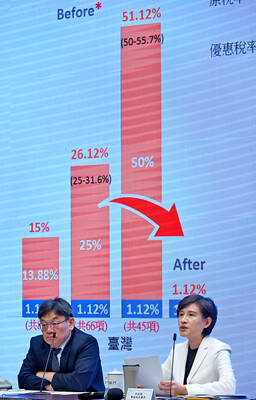
GREATER REACH? Auto parts and wood products would face tariffs of up to 15%, matching those targeting the EU, Japan and South Korea, Vice Premier said The US has announced that preferential tariff treatment for Taiwan’s non-semiconductor Section 232 goods would take effect retroactively from May 1, the Executive Yuan said yesterday. The US government yesterday posted a notice on the Federal Register’s public inspection Web site previewing tariff concessions for Taiwan under a memorandum of understanding (MOU) on Taiwan-US investment after two months of negotiations. The MOU signed on Jan. 15 stipulated three major preferential tariff arrangements: a 15 percent “reciprocal” tariff rate for Taiwan without stacking most-favored nation (MFN) rates; preferential Section 232 treatment for semiconductors and related products; and preferential Section 232 treatment for non-semiconductor

The National Chungshan Institute of Science and Technology yesterday showcased its locally developed variants of the Vision 60 robotic patrol dog, which it plans to deploy on the nation’s outlying territories in the South China Sea. The variants were produced under the Joint Lab project — created by the institute and domestic companies — and assembled with domestically produced motors, lenses and artificial intelligence (AI) systems alongside licensed tech from the US, Missile and Rocket Systems Research Division deputy director Jen Kuo-kang (任國光) told the media event at a military base in Taipei’s Dazhi (大直) area. Taiwan has built up its strengths


 RSS
RSS