


Taipei Times: There is a big concern in the market over the future fate of the economy as Taiwan's GDP growth slides below 5 percent and the unemployment rate rises above 4 percent this year. What is your current view on the state of the economy?
Chen Po-chih (
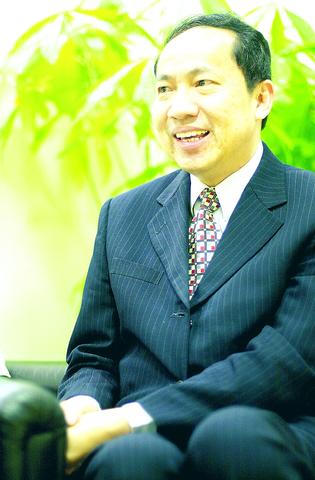
PHOTO: CHEN CHENG-CHANG, TAIPEI TIMES
To achieve 5-percent growth rate for this year, it depends not only on what happens in the global economy but also what happens in Taiwan. If we can have our policies carried out with the cooperation of the people, then we will have the possibility to achieve the 5-percent goal. We are quite confident that this year's growth rate will be higher than 4 percent. But the figure really depends on the global economy especially the US economy. If US economy keeps on declining further, then every country in the world will be in trouble, including Taiwan.
TT: How do you address public concerns over the unemployment rate? Some say Taiwan's rising jobless rate is a result of the global economic downturn, coupled with changes in the domestic industrial structure. What is the outlook for Taiwan's employment situation?
Chen: It is difficult for Taiwan to deal with the unemployment problem and in some ways it is even more difficult than dealing with the economic growth rate. The declining growth rate is mainly due to the decline in the world economy and partly due to the bust of our bubble economy. But for the unemployment problem, there is an additional but important factor -- the structural change in our industry.
In fact, the reason that we are facing such a high unemployment rate is because the burst of our bubble economy over the last decade. Currently, construction workers in Taiwan have the highest unemployment rate at above 7 percent -- almost double other industries. The reason for that is because the bubble economy in the past 10 years led to increased demand for laborers in the construction industry. But as the economy went down -- leaving a lot of empty houses -- the industry demand for labor shrunk sharply.
In the past 10 years, our traditional industries already released around 600,000 workers. But the unemployment problem wasn't that acute in the past because those unemployed workers were absorbed by both the information technology (IT) industry -- which was developing very fast -- and the luxury industry, which were both nurtured by the bubble economy. But much has changed in the last few years -- slowing demand in the US market, the burst in our bubble economy, and the passage in the legislature last year of a law to reduce our working hours to 84 hours per two weeks, Taiwan's economy finds itself in a crucible.
According to our investigation, after the law passed by the Legislature, 20 percent of the island's manufacturers reduce production and 21 percent said they want to move their production abroad, as they felt the law doesn't give them flexibility in the management of their labor. To me, the law passed by the legislature has actually forced our firms to move out faster or to reduce their domestic production faster, and put many people out of work.
TT: Will the government intervene in the labor market to increase employment, and if so how?
Chen: To ease the rising unemployment rate, the government will try to help the functioning of the labor market. For instance, the government has proposed several policies to fight the unemployment problem. The first policy is a fiscal policy to increase public spending so that we can create more than 50,000 jobs for people. In addition, we are also working to adjust the use of public expenditure with the aim of creating over 40,000 jobs. With the two policies, we hope to provide around 100,000 jobs.
But this will not be enough. We also have to encourage private spending to help the economy pick up. So businesses may have the need to add to their payrolls and some may hire more workers. To boost private consumption, we are in the process of organizing some product exhibitions around the island to let people know more about Taiwan's good products. In addition, we are also working to promote domestic tourism and encourage our civil servants to spend their short-term vacations in Taiwan. This is part of the government's recent announcement to extend civil servants' vacation from seven to 14 days. The government will offer incentives to them for spending their vacation in Taiwan instead of in foreign countries.
The government will also try harder in the mediation of job opportunities and pay more attention to job training. For instance, the social welfare industry in Taiwan is quite weak with some 120,000 foreign workers currently in Taiwan to serve in the home care sector. But these foreign workers may not provide the best care to our people because of the language gap and cultural differences. More importantly, many are not trained in home care. Therefore we want to establish more institutions to recruit domestic labor for these kind of jobs.
TT: Are foreign workers being blamed for taking away jobs from Taiwanese workers?
Chen: We should not blame foreign workers because they actually have helped the country a lot. And we still need foreign workers. We should put the blame on ourselves, however, since we don't have good institutions to make use of domestic labor. Moreover, we also have to blame the development of the bubble economy in the last few years which had led our labor force to focus [only] on earning easy money. Rather than expelling foreign workers from the country, what we are trying to do is to keep as many job opportunities as possible for domestic laborers.
TT: Given Taiwan's strong trade ties with the US, has Taiwan made a mistake by putting too much emphasis on the IT sector?
Chen: Well, any policy or any direction for development has both benefits and costs. If we just look at the current state, we may think that we depend too much on the IT industry and on the US economy. But, frankly speaking, without this dependence we could not have had such a high economic growth rate and rapid [progress] over the past 10 years. Now the global competition is so fierce that most of the world's small countries concentrate their industries in just a few sectors. For instance, more than half of Finland's economy depends not just on one product, but also on one company -- Nokia. That's quite risky but the benefits are quite high. For the IT industry in Taiwan, we have to notice that the industry involves not only personal computers. Now we have wafer foundries and TFT-LCDs (thin film transistor-liquid crystal displays). In addition, IC (integrated circuit) design in Taiwan is quite strong already. Therefore I believe that our past dependence on the IT industry is adequate.
What we were not successful at is establishing the new foundations for other industries. For instance, we spent 20 years to develop our biotech industry but without any major success. Fortunately, we still have many scientists and technicians in other industries, so we will try to expand our base of manufacturing not just in the IT industry, although further development in new IT products still is very important in the coming 5 to 10 years.
TT: To help Taiwan's industries grow in line with the world economy, your agency has formulated a plan ofr a knowledge-based economy (
Chen: Our plan for the knowledge-based economy is a little bit different from that in other countries. While the so-called knowledge-based economy is based on the creation and utilization of knowledge in the economy, Taiwan has to face the fact that our science and technology are not as advanced as those in advanced industrial countries such as the US.
So the opportunity for Taiwan to create new knowledge is not comparable to those countries. But what makes Taiwan's industries so internationally competitive is their strong manufacturing proficiency. So the major focus of our knowledge-based economy will be the utilization of knowledge in our production sector.
The plan to develop a knowledge-based economy in Taiwan was approved by the Executive Yuan in August 2000. Under the plan, we will promote the application of information technology and the Internet, in production as well as in daily life. We will also carry out a thorough review on all relevant aspects of basic infrastructure, laws and regulations, manpower supply, and government administrative procedure for the development of the knowledge-based economy. Overall, the government will invest NT$36 billion in 57 projects within the next five years. The ultimate goal is to increase the production value of knowledge-based industry to 60 percent of GDP. It will also involve raising combined public and private expenditure on education to 7 percent of GDP, and increasing research and development expenditure to 3 percent of GDP. The new venture growth rate is expected to reach 6 percent a year and the economic growth rate to remain above 5 percent.
TT: What strategies will Taiwan use to develop the knowledge-based economy?
Chen: Our strategies will lay equal emphasis on knowledge and manufacturing. Generally speaking, Taiwan's IT industry is quite successful but our technical capabilities are not yet up to those of some advanced industrial countries. We want to put more effort into creating and directly marketing knowledge. But given the current economic state, what we feel [is most] necessary is to keep up with the new technology developed in advanced countries.
Meanwhile, Taiwan's economy possesses a relatively high proportion of small- and medium-sized businesses and traditional industries. When it comes to the creation, infusion and application of knowledge, they are likely to face more difficulties than their large foreign counterparts because of their limited scale and lack of information. Therefore, the third main focus of our strategy to develop a knowledge-based economy is to tap our public and private research institutes. We hope these institutes can provide intermediary services in the development and application of knowledge for small and medium-sized firms as well as traditional industries.
TT: Are you suggesting that traditional industries seek alliances and cooperation with companies abroad to obtain new knowledge and technical know-how?
Chen: Yes. The success in Taiwan's economy in the past decade has been made through cooperation, both locally and abroad. In fact, the ability of Taiwan's small and medium-sized companies to work together as business clusters has allowed them to operate with high flexibility and efficiency. Therefore, once knowledge has become the most important factor in the economy, we should develop this aspect of private-sector work division and cooperation.
To further encourage this type of work division, we are particularly targeting the development of a knowledge-based service industry, which is expected to introduce new information and knowledge and to help our small and medium-sized firms in knowledge management. We expect this kind of knowledge-based service industry to play an intermediary role in forging cooperation among traditional industries. Based on the plan, we encourage the traditional industries to spend their efforts in global logistics as well as in research and development. Indeed, some firms in the traditional industries are quite successful such as the shoe-maker Pou Chen Industrial Corp (寶成工業). The company has already set up a very advanced research center in Taiwan and is also doing global logistics for major brandnames.
TT: What is the timeframe for the establishment of the knowledge-based economy?
Chen: It is estimated to take at least 10 years for the development of the knowledge-based economy in Taiwan. However, we will complete all the policies and the legal framework regarding the knowledge-based economy this year. As for the infrastructure, such as broadband network construction, it may take us more time to complete. But some actions have been taken. The Ministry of Finance has completed the tax policies, for instance, in order to ensure that the island's existing high-tech industries are not lured to move overseas because of competition in international markets. So far, we already have the policy whenever our industries face foreign tax competition, we will try to give them some tax incentives. It is the policy already adopted.
TT: The global demand for the labor pool is very competitive and different countries are fighting for the same people. How will Taiwan compete?
Chen: If Taiwan wants to attract global expertise, just like the US is trying, Singapore is trying or Hong Kong or China, the country has to have a platform to compete on. Therefore, we have to change the regulations regarding foreign technicians working here. We want to invite more foreign scientists and experts to work in Taiwan. To do so, we will not only have to relax the controls but also try to build adequate residential and shopping areas and offer a quality living environment for foreigners.
TT: Finally, how do you feel after being the current position for almost one year?
Chen: Many criticized us over the past year and some even said I am not good at playing the role in intra-agency coordination. In fact, we have presented many new policies through discussion and negotiation with other government agencies. For example, we made around 200 conclusions during the National Economic Development Conference (
In addition, we also negotiated with the finance ministry on expanding capital market for new ventures and reached a consensus recently to allow insurance companies and securities firms to invest in venture capital.
More importantly, the Executive Yuan's Development Fund (
However, one thing which I really feel bad about is the drastic reduction in work hours. The legislature passed the law ... but they forgot to allow our businesses flexibility in the management of their workers.

‘NO SECURITY RISK’: The Railway Bureau reassured the public that the technicians’ activities were limited to technical guidance and did not involve sensitive systems The Railway Bureau yesterday said it had invited eight Chinese technicians to assist with an airport MRT construction project. The bureau issued the confirmation after an Internet user said Chinese nationals had entered the construction zone of Taiwan Taoyuan International Airport’s Terminal 3 project. They asked why “individuals from an enemy state” were allowed access to such a major national infrastructure project, which raised serious concerns over Taiwan’s industrial safety, sensitive systems and information security. The bureau’s Northern Region Engineering Branch Office said subcontractor Taiwan Handle Industrial Co (台灣手把工業) of the Taoyuan airport MRT’s “Contract No. CU05 Project A14 Station Civil, MEP &

The National Chungshan Institute of Science and Technology yesterday showcased its locally developed variants of the Vision 60 robotic patrol dog, which it plans to deploy on the nation’s outlying territories in the South China Sea. The variants were produced under the Joint Lab project — created by the institute and domestic companies — and assembled with domestically produced motors, lenses and artificial intelligence (AI) systems alongside licensed tech from the US, Missile and Rocket Systems Research Division deputy director Jen Kuo-kang (任國光) told the media event at a military base in Taipei’s Dazhi (大直) area. Taiwan has built up its strengths

NOT IMMEDIATE: Taiwan has a chance to appeal the proposed 10 percent tariff before it starts, while other countries face a 12.5 percent tariff from the trade office Taiwan is among 60 economies determined by the US to have failed to impose or enforce a ban on the importation of goods produced with forced labor, according to a notice released on Tuesday by the Office of the US Trade Representative (USTR), which proposed imposing an additional 10 percent or more tariff on them. The USTR in a statement said that following an investigation, it had determined under Section 301 of the Trade Act of 1974 that the failure of the 60 economies to impose and effectively enforce a prohibition on the importation of goods produced with forced labor is

TIT-FOR-TAT: The US allegedly revoked the visa of a Chinese national working at Xinhua News Agency in the US in response to Beijing’s expulsion of Vivian Wang The Presidential Office yesterday condemned China for expelling a New York Times correspondent from Beijing following the newspaper’s interview with President William Lai (賴清德), saying the move highlighted Beijing’s suppression of press freedom and its threat to international news media. Taiwan has noted a series of recent incidents in which Beijing used similar tactics to “threaten and pressure international media outlets and journalists,” Presidential Office spokeswoman Karen Kuo (郭雅慧) said in a statement. “This concerns not only press freedom and freedom of expression, but also the safety of journalists, and Taiwan and relevant partners are paying close attention to the situation,” she


 RSS
RSS