


Taipei Times: Yahoo bought Kimo.com two weeks ago for NT$5.6 billion (US$146 million) in stock. What does that deal mean for Yam?
J.R. Chen
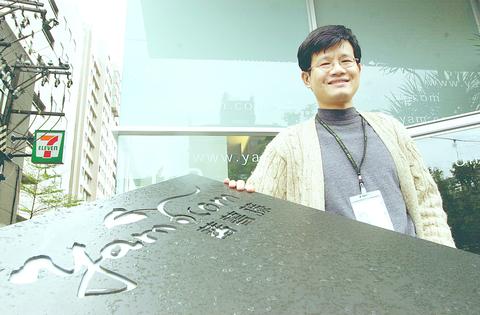
PHOTO: CHEN CHENG-CHANG, TAIPEI TIMES
TT: Does Yahoo's purchase of Kimo put pressure on Yam to cooperate with other Taiwanese portals or with a foreign company?
Chen: No opportunity or possibility has been ruled out. Since the beginning of this year we have invited a number of international investors to join us, including Bertelsman, the third largest media group in the world, and Microsoft is also our investor and sits on our board ... and the Acer Group also invests in Yam. If a Web site wants to survive they must have international investors to help them create vision, for expansion and to help build connections with [Internet] players around the world.
TT: The local media has speculated that Yam and Microsoft Network might be looking for a deal similar to Yahoo and Kimo. Is there any truth to this rumor?
Chen: We did talk about a closer relationship with each other, however, it's different [than Kimo-Yahoo]. We talked about forming a new joint venture company to provide local flavor content and services here in Taiwan instead of talking about mergers.
TT: Do you still see space in Taiwan's Internet arena for new Internet portals such as Kimo or Yam?
Chen: I think the market has matured. The existing players in the leading group will fight with each other for more users and revenue.
TT: Internet investment: How difficult is it to draw new investment in Taiwan now? Investors have pulled back from Internet ventures since the NASDAQ dotcom crash in the US. What is the situation in Taiwan?
Chen: I think the hype of investment [in the Internet sector] is gone, but that doesn't mean investors don't look at dotcoms anymore. They have simply become very careful in selecting Internet companies.
The best way to find new investment is to migrate to an international capital market.
To gain funds, you have to show the ability to deliver something. You have to show you can deliver some revenue and you have to show you have an [Internet] audience.
There is no one-way solution to solving the current cash flow situation. You have to cut costs as well as find multiple threads of new income.
TT: Where is Yam's revenue currently coming from?
Chen: We have seen ad revenues grow 250 percent this year and we have tried to use our technology to help other companies.
We have increased our Web content to attract more users and help them make purchases online. We have also developed a new category of users in SME's (small and medium-sized enterprises).
In Taiwan, over 98 percent of companies are SME's and they have to use the Internet to increase their competitiveness. But, they cannot afford an MIS manager (information systems manager to fix computer problems, maintain servers and the Web site), so we lease this kind of service to them ... we help them build a Web site and manage their online services.
For example, we have signed EVA Air (
We have also signed a contract with Eslite Book Store (
TT: Is Yam turning a profit right now or when do you expect that to happen?
Chen: We target the fourth quarter of next year or the first quarter of 2002 because we have spent a lot on research and development. We are also investing a lot in expanding throughout the greater China area.
TT: What is Yam doing in China?
Chen: Actually, right now we already have [shares in] seven malls [dedicated to computer and electronic goods] and two more will open by the end of the year, for a total of nine malls in China. They're all big malls, I think we've set the record for big malls in China.
We opened the malls to develop an e-commerce platform in China. We saw that you have to set up an entire system for e-commerce there, you have to find a way to deliver goods to the consumer, you have to find a way to connect with the warehouse and logistics system and you have to deal with customer returns and product warranties. If you want to take advantage of e-commerce in China, you either have to find good partners who can provide that kind of support or you have to build it up yourself. We found that in China, [potential partners] didn't even have network know-how, so we had to do it. That's how we came up with the mall idea.
I think many of our competitors think "Yam is crazy" to invest in physical malls, but we think that within three-to-five years, China will have the infrastructure and laws in place to handle this kind of [e-commerce] system and users need time to get used to it. So we set up the support system and made a goal to have more than 50 cities throughout China covered by this computer shopping mall system within three years.
TT: It has been said many times that in Internet ventures, Taiwan is the key to China. What's your view?
Chen: Yes, I think that's right. Taiwan has always been a bridge between Western style management knowledge and technology and Oriental business and culture. For the past 20 years, Taiwan has molded these two ways together and come up with a very specific way of doing business with Oriental society and Western society.
You can probably find someone very capable in Western-style management in Hong Kong or Singapore, but they are too Westernized.
They don't know how to deal with the Chinese. Sometimes the implicit rule is more important than a contract, and you have to understand how to work with that. Taiwan has that kind of experience.
In fact, the world's largest IT companies have all hired their "Greater China" managers here in Taiwan. IBM, Microsoft, HP, Cisco -- their greater-China managers are all from here. Taiwan is the only place that has Oriental cultural background and exposure to the state of management knowledge in Western society.
TT: Can Taiwanese Internet portals attract an audience from China?
Chen: You must have local content for China. You really can't look at China as a whole entity. The people in Shanghai are culturally different than people from Beijing or Canton. In daily life, they don't even speak the same language. In Shanghai they speak Shanghainese, in Canton, they speak Cantonese, in Sichuan they speak Sichuanese. In each place they have a specific cultural background and way of life, so it is very important to provide Internet content to that local way of life.
TT: What does the future hold for Yam in Taiwan and China?
Chen: Actually, we will target our services for the greater Chinese community under two different categories, individual users and SMEs [small and medium sized companies]. We will also look for any opportunities with both international and local players.

LEVERAGE: China did not ‘need to fire a shot’ to deny Taiwan airspace over Africa when it owns ‘half the continent’s debt,’ a US official said, calling it economic warfare The EU has raised concerns about overflight rights following the delay of President William Lai’s (賴清德) planned state visit to the Kingdom of Eswatini after three African nations denied overflight clearance for his charter at the last minute. Taiwanese allies Paraguay and Saint Kitts and Nevis, as well as several US lawmakers and the Inter-Parliamentary Alliance on China (IPAC) condemned China for allegedly pressuring the countries. Lai was scheduled to fly directly to Taiwan’s only African ally from yesterday to Sunday to celebrate the 40th anniversary of King Mswati III’s accession and his 58th birthday, but Seychelles, Mauritius and Madagascar suddenly revoked
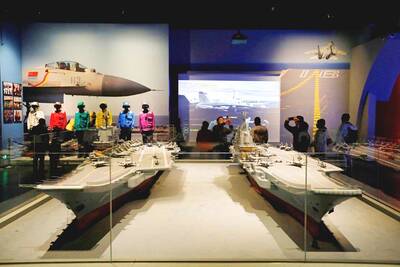
China on Wednesday teased in a video an aircraft carrier that could be its fourth, and the first using nuclear power, while making an allusion to Taiwan and vowing to further build up its islands, as it looks to boost maritime power, secure resources and bolster territorial claims. The video, issued on the eve of the 77th founding anniversary of the Chinese People’s Liberation Army Navy, featured fictional officers with names that are homophones of three commissioned aircraft carriers, the Liaoning (遼寧), Shandong (山東) and Fujian (福建). Titled Into the Deep, it showed a 19-year-old named “Hejian” (何劍) joining the group, sparking
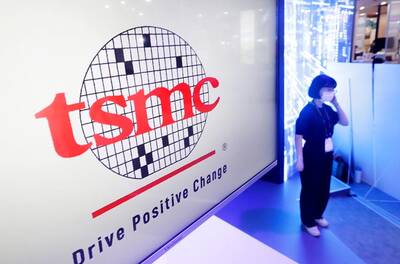
BIG YEAR: The company said it would also release its A12 chip the same year to keep a ‘reliable stream of new silicon technologies’ flowing to its customers Taiwan Semiconductor Manufacturing Co (TSMC, 台積電) yesterday said its newest A13 chip is to enter volume production in 2029 as the chipmaker seeks to hold onto its tech leadership and demand for next-generation chips used in artificial intelligence (AI), high-performance-computing (HPC) and mobile applications. TSMC, the world’s biggest contract chipmaker, also unveiled its A12 chip at its annual technology symposium in Santa Clara, California. The A12 chip, which features TSMC’s super-power-rail technology to provide backside power delivery for AI and HPC applications, is also to enter volume production in 2029, a year after the scheduled release of the A14 chip. The technology moves
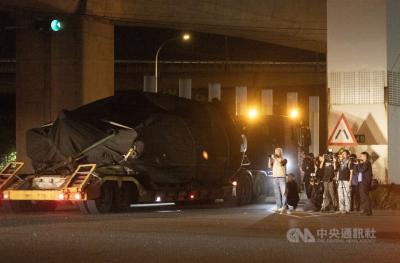
The final batch of 28 M1A2T Abrams tanks purchased from the US arrived at Taipei Port last night and were transported to the Armor Training Command in Hsinchu County’s Hukou Township (湖口), completing the military’s multi-year procurement of 108 of the tanks. Starting at 12:10am today, reporters observed more than a dozen civilian flatbed trailers departing from Taipei Port, each carrying an M1A2T tank covered with black waterproof tarps. Escorted by military vehicles, the convoy traveled via the West Coast Expressway to the Armor Training Command, with police implementing traffic control. The army operates about 1,000 tanks, including CM-11 Brave Tiger


 RSS
RSS