

Taiwan ranked seventh globally in civil participation last year and showed notable improvements in the effective parliament category, a report published today by the International Institute for Democracy and Electoral Assistance (IDEA) said.
The Stockholm-based intergovernmental organization’s annual Global State of Democracy (GSoD) Report assesses effective representation, rights, rule of law, civil participation and judicial systems in democracies worldwide.
This year’s report found that last year 57 percent of the 173 countries assessed “suffered a decline in at least one factor of democratic performance compared with their own performance five years earlier.”
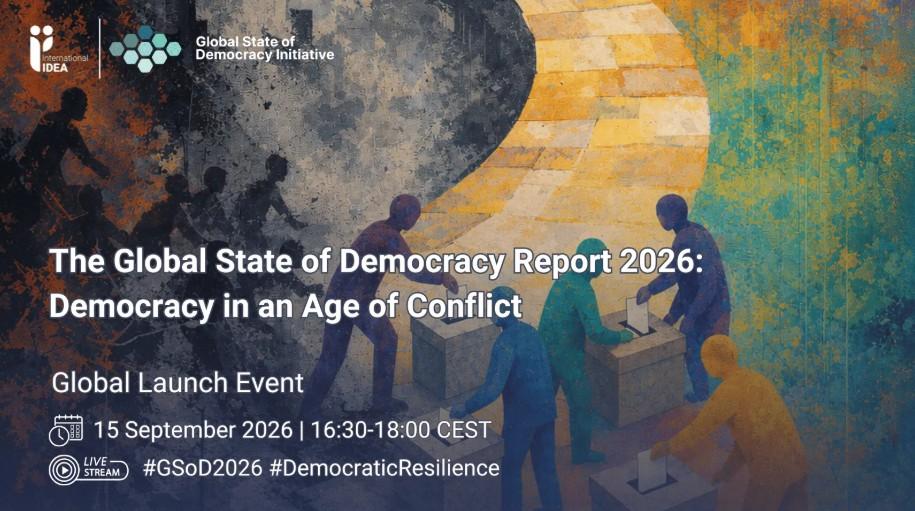
Photo: Screen grab from the International Institute for Democracy and Electoral Assistance’s Web site
Taiwan ranked seventh in civic participation, tied with Finland, the same ranking as it received in last year’s report.
Only 13 countries showed improvement in measures of parliamentary effectiveness, including five in Asia and the Pacific: Taiwan, Fiji, Papua New Guinea, Tajikistan and Thailand, the report said.
Taiwan and the US both “fell from high to mid-range performance” in the judicial independence category last year, with Argentina, Belgium, India and Nigeria’s performance also declining, it said.
The report also highlighted regional security and geopolitical pressures, saying that border tensions and conflict-related incidents involving India and Pakistan, Cambodia and Thailand, and the Taiwan Strait last year affected regional stability.
“Regional stability and the risk that securitized pressures will shape democratic governance” would be important factors to watch, it said.
Furthermore, “the USA is experiencing a period of marked democratic decline,” the report said.
The US saw seven statistically significant declines from 2020 through last year across the access to justice, economic equality, effective parliament, freedom of expression, freedom of the press, free political parties and judicial independence categories, the report said.
Apart from free political parties, “these factors are now at their lowest-ever levels in the history of the GSoD dataset,” which began in 1975, it added.
“The USA has emboldened authoritarian leaders” under the leadership of US President Donald Trump, as his administration has abandoned certain democratic values and detracted from the rules-based international order, the report said.
“Patient zero of this global epidemic is the current president of the United States,” IDEA secretary-general Kevin Casas-Zamora, former vice president of Costa Rica, told Agence France-Presse.
“What happened in the US in 2020 has really had a global impact in terms of legitimizing this kind of attack on the credibility of the electoral process,” Casas-Zamora said of Trump’s refusal to acknowledge his defeat in the election against former US president Joe Biden.
“Arguments that were used to gut and close down the US Agency for International Development were used in Serbia by the government to clamp down on civil society organizations,” he added.
International IDEA was established in 1995 by 14 founding member states to promote electoral processes and monitor the functioning of democratic systems.
It now has more than 30 member states, although the US withdrew as an observer this year.

Taiwan’s growing defense preparations might be sending a stronger signal to the US than to Beijing, highlighting the need for Taipei to tailor its deterrence efforts to different audiences, a US security academic said yesterday. Stanford University Freeman Spogli Institute for International Studies fellow Oriana Skylar Mastro made the comment during a Taipei Security Dialogue panel examining lessons Taiwan could draw from the wars in Ukraine and the Middle East. Mastro said she was impressed by Taiwan’s increased defense spending, emphasis on asymmetric capabilities and efforts to prepare society for conflict, but questioned whom those initiatives were influencing. She said when she asked

A total of 400 foreign “high- level” professionals have been naturalized as Republic of China (Taiwan) citizens over the past decade as the government has eased nationality rules to attract talent from a wider range of fields, the Ministry of the Interior said yesterday. The 400th high-level professional, who works in the electronics industry, was approved for ROC citizenship on Aug. 26, the MOI said. The MOI quoted the newly naturalized citizen as saying that Taiwan is a leader in fields such as semiconductors, electronics manufacturing, artificial intelligence development and energy technology. He also said
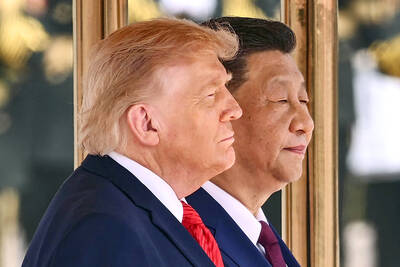
China has warned that it could cancel a planned US-China leaders’ summit if Washington approves new arms sales to Taiwan, a Japanese media outlet quoted sources as saying yesterday. US President Donald Trump, “apparently eager to showcase some diplomatic achievements ahead of November’s midterm congressional elections, places great importance on holding the summit with Chinese President Xi Jinping (習近平),” Japan’s Kyodo News reported. “While preparing for Xi’s upcoming trip, China has restated its position that the Taiwan issue is a ‘red line’ in bilateral relations,” the report said. The report said that when Xi met with Trump in Beijing in May, Xi said
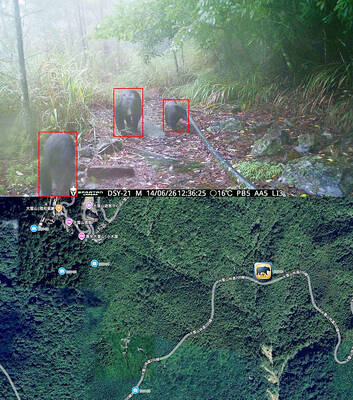
RARE PEEK: The footage released showed one of the bears staying in a cave for as long as 70 days, providing the first record of Formosan black bear’s overwintering The Forestry and Nature Conservation Agency yesterday released tracking records of released Formosan black bears for the first time, showing that they get much closer to human settlements than previously thought. The agency said it had captured two bears, Da Qu-ali (達古阿里) and Aziman (阿里曼), in indigenous villages in Hualien County and began to track them with a camera-mounted satellite collar after releasing them back into the wild. The results confirmed that the bears have moved from deep mountain areas into lowland hills closer to human communities, leading to an increase in human-bear conflicts, it said. The agency has introduced artificial intelligence-assisted early


 RSS
RSS