

The head of a public health center in Tainan has been fined NT$100,000 for allegedly purchasing injectable GLP-1 drugs for weight loss and privately supplying them to people without a prescription.
An audit by the Tainan Public Health Bureau found that the Sinhua District (新化) Health Station had purchased 780 doses of injectable GLP-1 drugs, but only five doses were in inventory.
It was unable to provide the corresponding doctor’s prescription and usage records of the missing doses.
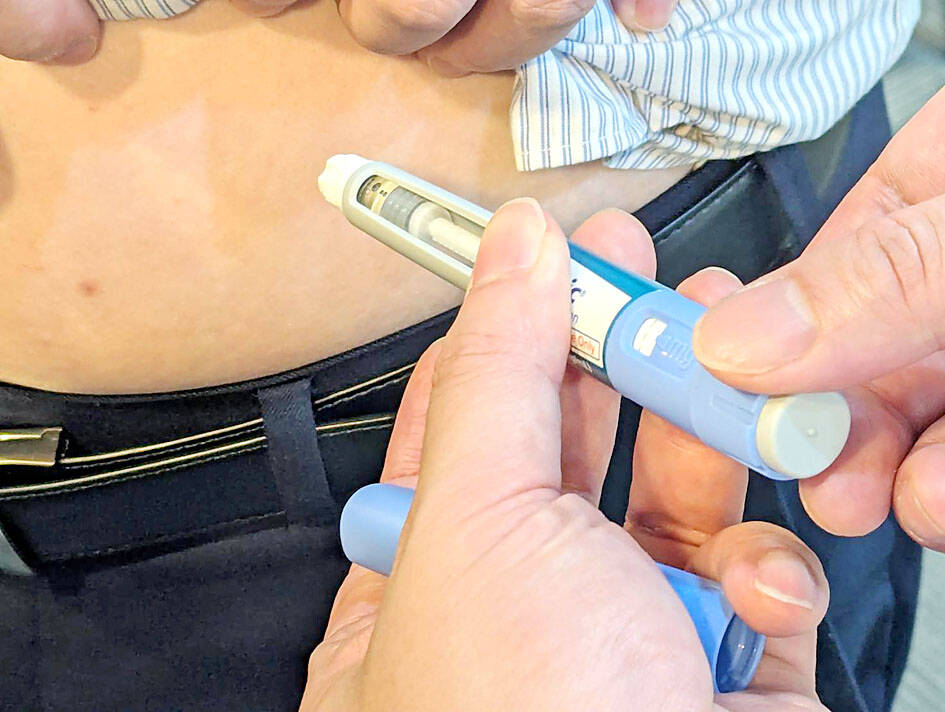
Photo: Wu Liang-yi, Taipei Times
Station director Wu Cheng-ta (吳政達) yesterday admitted that he purchased the drugs and provided them to his friends and relatives, adding that he sold them at cost without making any profit.
Wu said he has acknowledged his mistake, and that his behavior lacked thorough consideration.
Food and Drug Administration (FDA) Division of Medicinal Products senior specialist Liu Chia-ping (劉佳萍) called for the government to tighten oversight of the distribution and use of GLP-1 drugs, adding that the agency has collaborated with local health bureaus since 2024 to conduct special audits.
Starting in October last year, GLP-1 drugs were included into a drug traceability tracking and management system, requiring pharmaceutical companies to report monthly drug distribution data, she said.
The FDA this year expanded the scope of the audit by analyzing drug reporting data to identify abnormal distribution patterns, Liu said.
The agency has provided records to local health bureaus for further investigation, including the Sinhua District Health Station, she added.
While GLP-1s have gained wide public attention for their use in weight loss, the drugs cannot be purchased or used as over-the-counter products, the FDA said.
People seeking to lose weight should see a doctor for professional evaluation, and should only use drugs according to medical instructions, it said.
The FDA urged people not to acquire GLP-1s through relatives, friends, online platforms or other illegal channels, and avoid administering it on their own.
The agency would continue to monitor the supply of GLP-1s through drug traceability and reporting systems, it said, adding that any illegal supply or usage would be investigated and penalized according to the law.

Taiwan’s growing defense preparations might be sending a stronger signal to the US than to Beijing, highlighting the need for Taipei to tailor its deterrence efforts to different audiences, a US security academic said yesterday. Stanford University Freeman Spogli Institute for International Studies fellow Oriana Skylar Mastro made the comment during a Taipei Security Dialogue panel examining lessons Taiwan could draw from the wars in Ukraine and the Middle East. Mastro said she was impressed by Taiwan’s increased defense spending, emphasis on asymmetric capabilities and efforts to prepare society for conflict, but questioned whom those initiatives were influencing. She said when she asked

A total of 400 foreign “high- level” professionals have been naturalized as Republic of China (Taiwan) citizens over the past decade as the government has eased nationality rules to attract talent from a wider range of fields, the Ministry of the Interior said yesterday. The 400th high-level professional, who works in the electronics industry, was approved for ROC citizenship on Aug. 26, the MOI said. The MOI quoted the newly naturalized citizen as saying that Taiwan is a leader in fields such as semiconductors, electronics manufacturing, artificial intelligence development and energy technology. He also said
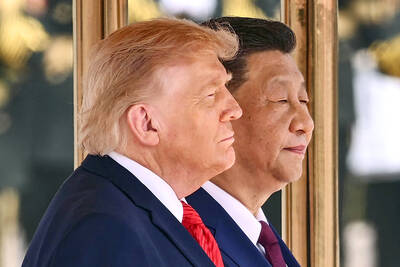
China has warned that it could cancel a planned US-China leaders’ summit if Washington approves new arms sales to Taiwan, a Japanese media outlet quoted sources as saying yesterday. US President Donald Trump, “apparently eager to showcase some diplomatic achievements ahead of November’s midterm congressional elections, places great importance on holding the summit with Chinese President Xi Jinping (習近平),” Japan’s Kyodo News reported. “While preparing for Xi’s upcoming trip, China has restated its position that the Taiwan issue is a ‘red line’ in bilateral relations,” the report said. The report said that when Xi met with Trump in Beijing in May, Xi said
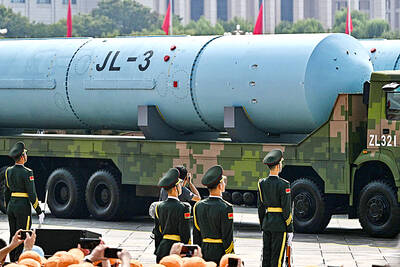
SUB-LAUNCHED SUBOPTIMAL: The JL-3, an upgraded version of the missile test-fired earlier in the summer, would have the range to strike at much of the country Refits to Chinese nuclear submarines to carry JL-3 intercontinental ballistic missiles would put much of the US in striking distance, Taiwanese defense analysts said in a report commissioned by the Mainland Affairs Council. Researchers from National Defense University’s Graduate Institute of China Military Affairs Studies said that the Chinese People’s Liberation Army Navy (PLAN) in July test-fired a missile with a training warhead. Chinese state media reported without elaborating that a PLAN nuclear-powered ballistic missile submarine (SSBN) launched a missile with a training warhead, which accurately hit the designated target area in the Pacific, the report said. The launch was a rare display


 RSS
RSS