

Taiwan-Europe relations continue to deepen as Vice President Hsiao Bi-khim (蕭美琴) frequently visits non-allied European countries under a “Team Taiwan Diplomacy” working model, a foreign affairs official said yesterday.
Hsiao was invited to the Ventotene European Conference for Freedom and Democracy in Italy last week after she attended the annual summit of the Inter-Parliamentary Alliance on China in Brussels in November last year.
An official speaking on condition of anonymity said that this shows that high-level interactions between Taiwan and Europe are deepening, shifting from “highly sensitive” exceptions to a new interactive mode.

Photo from Hsiao’s Facebook page
Frontline diplomatic and security teams were highly discreet about Hsiao’s visit to Italy in terms of itinerary planning, communication with European personnel and emergency response, given that it was a vice president-level visit to a non-allied nation, the official said.
Alert levels were also raised after President William Lai’s (賴清德) visit to Eswatini in April was disrupted by China’s weaponization of flight information regions, they said.
The Ministry of Foreign Affairs immediately reported to Lai after it received the invitation from the conference, the official said.
The ministry discussed the invitation with Hsiao and personnel from the offices of the president and vice president, as well as the national security team, they said.
The official cited Lai as saying that Taiwan should seize every opportunity that helps expand its international space and deepen partnerships with like-minded countries, the official said.
Lai ordered the ministry and relevant teams to facilitate and asked Minister of Foreign Affairs Lin Chia-lung (林佳龍) to communicate with involved parties, they said.
Lai also hosted the itinerary and contingency meeting before Hsiao’s departure and ordered officials to “follow the host country’s lead,” the official said.
Hsiao’s two visits to Europe brought about a new diplomatic working model, they said.
Lai provides strategic direction and political authorization, while Lin and the diplomatic team continue to expand Taiwan’s political credit and activities in Europe, the official said, adding that Hsiao can transform the diplomatic gains into higher-level political interactions based on her extensive diplomatic experience and strong connections in Western countries.
Another foreign affairs official yesterday said the balance between diplomatic breakthroughs and security is also a key concern.
Hsiao’s schedule was not announced prior to the visit to ensure her safety, they said, adding that it took the delegation 27 hours to travel by plane, vehicle and ferry to Italy.
Additional reporting by CNA
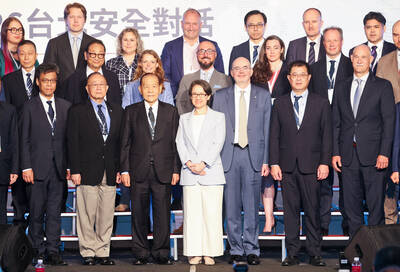
Taiwan’s growing defense preparations might be sending a stronger signal to the US than to Beijing, highlighting the need for Taipei to tailor its deterrence efforts to different audiences, a US security academic said yesterday. Stanford University Freeman Spogli Institute for International Studies fellow Oriana Skylar Mastro made the comment during a Taipei Security Dialogue panel examining lessons Taiwan could draw from the wars in Ukraine and the Middle East. Mastro said she was impressed by Taiwan’s increased defense spending, emphasis on asymmetric capabilities and efforts to prepare society for conflict, but questioned whom those initiatives were influencing. She said when she asked
A total of 400 foreign “high- level” professionals have been naturalized as Republic of China (Taiwan) citizens over the past decade as the government has eased nationality rules to attract talent from a wider range of fields, the Ministry of the Interior said yesterday. The 400th high-level professional, who works in the electronics industry, was approved for ROC citizenship on Aug. 26, the MOI said. The MOI quoted the newly naturalized citizen as saying that Taiwan is a leader in fields such as semiconductors, electronics manufacturing, artificial intelligence development and energy technology. He also said
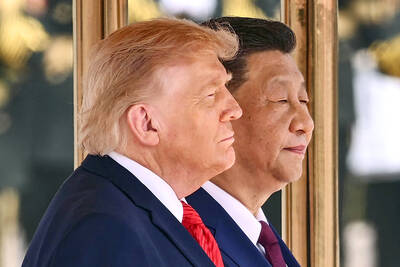
China has warned that it could cancel a planned US-China leaders’ summit if Washington approves new arms sales to Taiwan, a Japanese media outlet quoted sources as saying yesterday. US President Donald Trump, “apparently eager to showcase some diplomatic achievements ahead of November’s midterm congressional elections, places great importance on holding the summit with Chinese President Xi Jinping (習近平),” Japan’s Kyodo News reported. “While preparing for Xi’s upcoming trip, China has restated its position that the Taiwan issue is a ‘red line’ in bilateral relations,” the report said. The report said that when Xi met with Trump in Beijing in May, Xi said
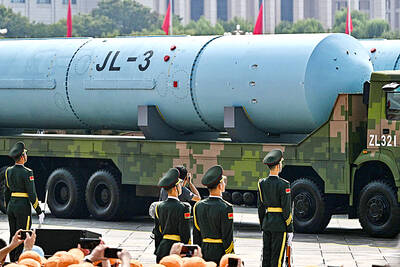
SUB-LAUNCHED SUBOPTIMAL: The JL-3, an upgraded version of the missile test-fired earlier in the summer, would have the range to strike at much of the country Refits to Chinese nuclear submarines to carry JL-3 intercontinental ballistic missiles would put much of the US in striking distance, Taiwanese defense analysts said in a report commissioned by the Mainland Affairs Council. Researchers from National Defense University’s Graduate Institute of China Military Affairs Studies said that the Chinese People’s Liberation Army Navy (PLAN) in July test-fired a missile with a training warhead. Chinese state media reported without elaborating that a PLAN nuclear-powered ballistic missile submarine (SSBN) launched a missile with a training warhead, which accurately hit the designated target area in the Pacific, the report said. The launch was a rare display


 RSS
RSS