

Newly appointed Academia Historica director Chen Tsui-lien (陳翠蓮) yesterday said she would prioritize research into Taiwan’s democratization, saying that historical distortion has become more serious in the past few years.
The agency held a handover ceremony yesterday for its outgoing and incoming directors.
Chen, a distinguished professor in National Taiwan University’s Department of History, said President William Lai (賴清德) unexpectedly summoned her in June and asked why, more than 30 years after Taiwan’s democratization, many people’s understanding of history remained rooted in narratives from the authoritarian era.
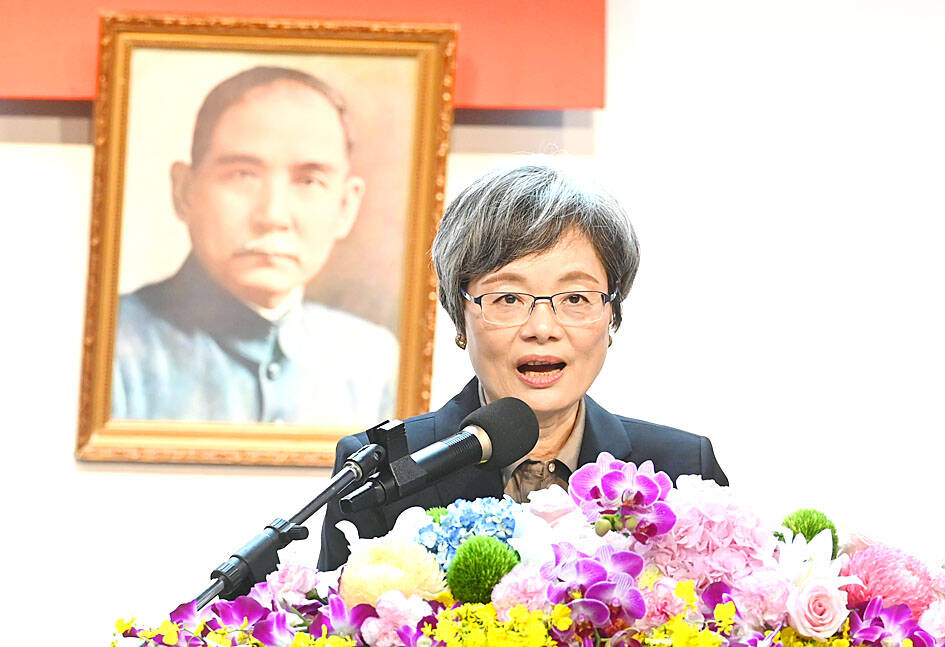
Photo: Wang Yi-sung, Taipei Times
Lai asked why political identities remain so deeply divided and whether something had gone wrong during the transition to democracy, she said.
Chen said the invitation was unexpected, as she had been enjoying a comfortable academic career.
Moving into public service could mean having to “wear a helmet,” she said, but added that after 30 years of peaceful life and benefiting from state support for her education, she felt a responsibility to give back.
Chen said her first priority would be to continue research into Taiwan’s democratization, including examining what authoritarian rule means and why it harms society.
Such work should help society remember the struggle for democracy and freedom, and encourage people to cherish the democratic system, she said.
However, recent political events have shown a deliberate trend of bad-faith historical distortion, Chen said.
Some people have portrayed the elected government, whose powers are subject to checks and oversight, as authoritarian or dictatorial, while others have described Taiwan as a “terror state,” she said, adding that such claims could cause irreparable harm to society.
The democratic system can be defended only through continued remembrance and efforts to clarify the historical record, she said.
Chen also said the institution should promote research into Taiwan’s history and confront difficult aspects of the past.
The release of political surveillance records has helped society better understand Taiwan’s history, but has raised difficult questions, she said.
People identified as informants should not be regarded as perpetrators automatically, she said, adding that their roles, whether they harmed others and the reliability of intelligence records all require consideration.
The records contain extensive private information about people who were surveilled, she said, warning that its publication could cause harm.
Transitional justice has entered deeper and more difficult territory, she said, adding that these issues must be confronted.
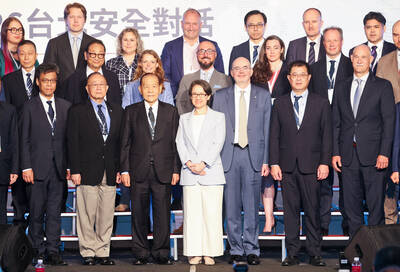
Taiwan’s growing defense preparations might be sending a stronger signal to the US than to Beijing, highlighting the need for Taipei to tailor its deterrence efforts to different audiences, a US security academic said yesterday. Stanford University Freeman Spogli Institute for International Studies fellow Oriana Skylar Mastro made the comment during a Taipei Security Dialogue panel examining lessons Taiwan could draw from the wars in Ukraine and the Middle East. Mastro said she was impressed by Taiwan’s increased defense spending, emphasis on asymmetric capabilities and efforts to prepare society for conflict, but questioned whom those initiatives were influencing. She said when she asked
A total of 400 foreign “high- level” professionals have been naturalized as Republic of China (Taiwan) citizens over the past decade as the government has eased nationality rules to attract talent from a wider range of fields, the Ministry of the Interior said yesterday. The 400th high-level professional, who works in the electronics industry, was approved for ROC citizenship on Aug. 26, the MOI said. The MOI quoted the newly naturalized citizen as saying that Taiwan is a leader in fields such as semiconductors, electronics manufacturing, artificial intelligence development and energy technology. He also said
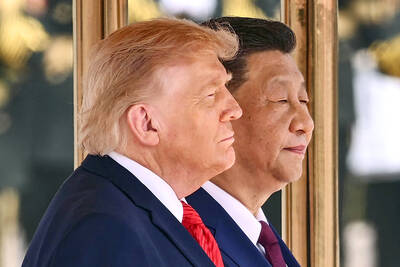
China has warned that it could cancel a planned US-China leaders’ summit if Washington approves new arms sales to Taiwan, a Japanese media outlet quoted sources as saying yesterday. US President Donald Trump, “apparently eager to showcase some diplomatic achievements ahead of November’s midterm congressional elections, places great importance on holding the summit with Chinese President Xi Jinping (習近平),” Japan’s Kyodo News reported. “While preparing for Xi’s upcoming trip, China has restated its position that the Taiwan issue is a ‘red line’ in bilateral relations,” the report said. The report said that when Xi met with Trump in Beijing in May, Xi said
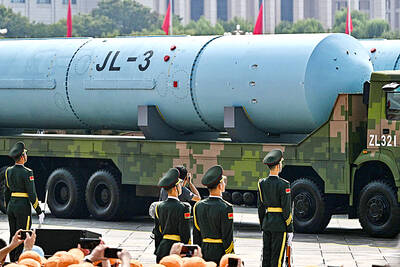
SUB-LAUNCHED SUBOPTIMAL: The JL-3, an upgraded version of the missile test-fired earlier in the summer, would have the range to strike at much of the country Refits to Chinese nuclear submarines to carry JL-3 intercontinental ballistic missiles would put much of the US in striking distance, Taiwanese defense analysts said in a report commissioned by the Mainland Affairs Council. Researchers from National Defense University’s Graduate Institute of China Military Affairs Studies said that the Chinese People’s Liberation Army Navy (PLAN) in July test-fired a missile with a training warhead. Chinese state media reported without elaborating that a PLAN nuclear-powered ballistic missile submarine (SSBN) launched a missile with a training warhead, which accurately hit the designated target area in the Pacific, the report said. The launch was a rare display


 RSS
RSS