

Taiwan is expanding semiconductor research infrastructure and developing homegrown chip-design software under a government initiative aimed at maintaining the nation's technological edge, the Executive Yuan said yesterday.
The government plans to invest NT$300 billion (US$9.51 billion) through 2033 in areas including next-generation chip design and advanced semiconductor processes, Executive Yuan spokeswoman Michelle Lee (李慧芝) said after a Cabinet meeting.
“Taiwan has a world-leading semiconductor ecosystem, but we still need to continue investing in advanced technology research and development and cultivating high-level talent to consolidate our advantages in the chip industry,” Lee quoted Premier Cho Jung-tai (卓榮泰) as saying.
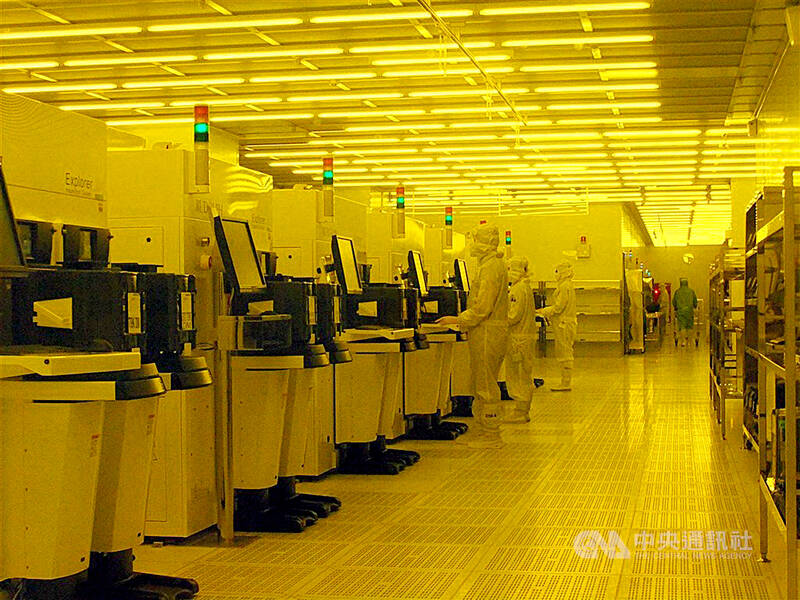
Photo: CNA
Two projects under the Taiwan Chip-based Industrial Innovation Program are being carried out from 2024 to 2028, focusing on research infrastructure and chip-design software, said Peter Hong (洪樂文), head of the National Science and Technology Council’s Department of Engineering and Technologies.
Under the hardware project, seven university semiconductor institutes would receive subsidies for equipment that would be linked through a single service platform, Hong said.
Two research institutes under the National Institutes of Applied Research also plan to establish an atomic-scale process verification line for sub-1-nanometer processes, he said.
The most advanced semiconductor process in mass production is 2 nanometers. Taiwan Semiconductor Manufacturing Co (TSMC) began high-volume production using its 2-nanometer process in the fourth quarter of last year.
The government-backed Industrial Technology Research Institute (ITRI) would also build an advanced semiconductor pilot line for start-ups and small and medium-sized enterprises (SMEs) that need low-volume, high-mix trial production, Hong said.
On the software side, the government wants to enhance Taiwan’s ability to independently develop electronic design automation (EDA) tools used in chip design, layout and verification, Hong said.
Such software has traditionally been “in the hands of a few major international companies,” Hong said.
However, EDA tools for emerging areas such as advanced packaging remain relatively underdeveloped, creating “a very good opportunity” for Taiwan to enter the market, he said.
Universities would develop key EDA tools for advanced packaging, while ITRI would build an intelligent EDA cloud platform and integrate tools developed by industry and research institutions into a complete chip-design toolchain, Hong said.
Separately, the Cabinet outlined an expanded support plan for SMEs and microenterprises, which together account for 98.9 percent of businesses in Taiwan and nearly 80 percent of employment.
The government wants technological advances in Taiwan’s high-tech and manufacturing sectors to benefit smaller businesses across industries, said G.J. Lee (李冠志), director-general of the Ministry of Economic Affairs’ Small and Medium Enterprise and Startup Administration.
The government aims to help at least 1 million SMEs and microenterprises adopt digital technologies and artificial intelligence, with annual funding expected to reach nearly NT$25 billion from next year, Lee said.
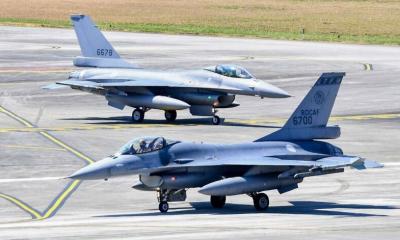
The first two F-16V Block 70 jets Taiwan purchased from the US were spotted unexpectedly turning back after departing from Hawaii yesterday, potentially further delaying delivery of the aircraft. Taiwan has purchased 66 of the F-16 C/D Block 70 jets to be deployed at Chihhang Air Base (志航基地) in Taitung County and operated by the air force's 7th Tactical Fighter Wing to defend Taiwan’s eastern region. Two single-seat jets, bearing serial No. 6727 and 6728, were spotted taking off from Hickam Field in Hawaii yesterday, observers said. Based on the precedent set during the delivery of Taiwan's older F-16 Block 20s, the new
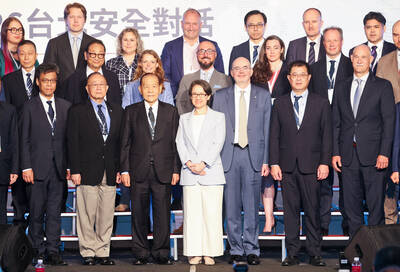
Taiwan’s growing defense preparations might be sending a stronger signal to the US than to Beijing, highlighting the need for Taipei to tailor its deterrence efforts to different audiences, a US security academic said yesterday. Stanford University Freeman Spogli Institute for International Studies fellow Oriana Skylar Mastro made the comment during a Taipei Security Dialogue panel examining lessons Taiwan could draw from the wars in Ukraine and the Middle East. Mastro said she was impressed by Taiwan’s increased defense spending, emphasis on asymmetric capabilities and efforts to prepare society for conflict, but questioned whom those initiatives were influencing. She said when she asked
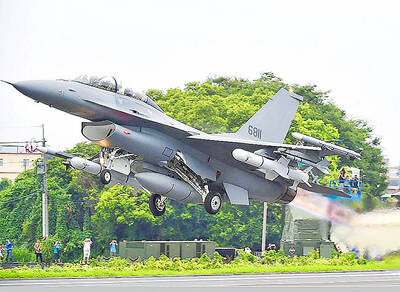
A sharp rise in compensation to be paid by air force officers who leave before completing their required service could indicate an increase in pilots leaving the military early, an analyst said on Friday, warning that the trend could worsen a shortage of experienced personnel. Chieh Chung (揭仲), a researcher at the Association for Strategic Foresight, issued the warning even though the number of volunteer military personnel is expected to increase next year. The planned headcount for volunteer military personnel, covering officers, noncommissioned officers (NCO) and enlisted soldiers, is 158,223 for next year, up 4,258 from 153,965 this year, Chieh said. The increase
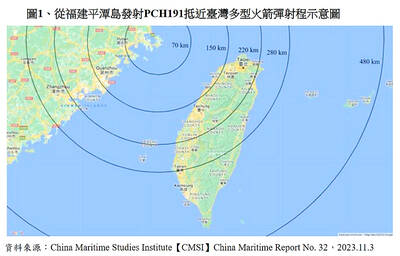
Potential improvements to munitions used by China’s long-range rocket-artillery units could extend their range to cover the entire Miyako Strait, which might give the Chinese People’s Liberation Army (PLA) the ability to secure the strategic waterway, the Mainland Affairs Council (MAC) said in a report. The PLA’s long-range rocket-artillery units deployed along the Taiwan Strait are concentrated along the coast of Fujian Province, including Changle, Pingtan and Shishi, the quarterly report on China said. The artillery brigades of the PLA’s 71st, 72nd and 73rd group armies have been deployed, with preparations for potential battlefield operations under way since August 2022, the report


 RSS
RSS