

The Executive Yuan yesterday approved a draft proposal for an eight-year, NT$100 billion (US$3.17 billion) program to support the development of micro, small and medium-sized enterprises (MSMEs) through expanded tax breaks, relaxed investment thresholds and targeted loans.
More than 4,000 MSMEs are expected to benefit from the initiative, generating more than NT$50 billion in investment, the Ministry of Economic Affairs said.
A notice to commence a period of public comments for the proposal was announced yesterday, with public hearings to be held to gather feedback from business owners.
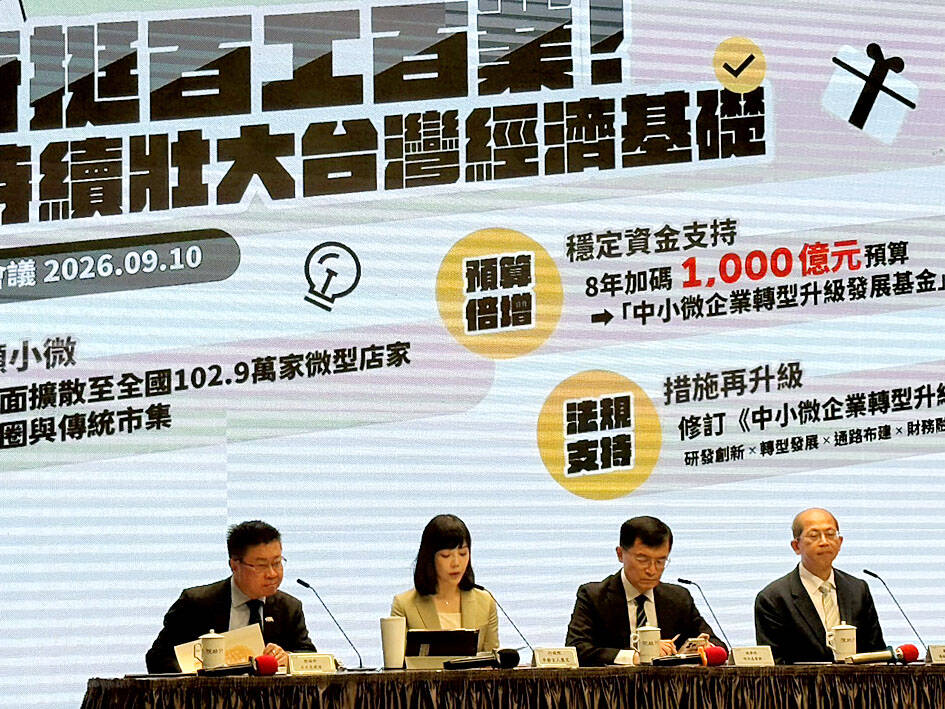
Photo: Chung Li-hua, Taipei Times
It is expected to be submitted to the Executive Yuan for approval next month before being forwarded to the legislature for review.
According to the government’s White Paper on Small and Medium Enterprises last year, Taiwan has 1.716 million MSMEs, accounting for 98.9 percent of all businesses and employing nearly 80 percent of the workforce, or about 9.194 million people.
The draft plans to extend government assistance to 1.029 million microbusinesses, including sole proprietorships and partnerships, which account for about 60 percent of all businesses.
The program would also cover commercial districts, public markets, local specialty industries, agricultural enterprises, tourism businesses and start-ups.
It includes measures to improve the business environment in 353 commercial districts and 1,030 public markets.
A chapter dedicated to start-up development discussed encouraging large corporations and venture capital firms to nurture start-ups, and creating an environment for innovation and experimentation. Larger companies would be encouraged to help MSMEs connect with high-tech supply chains and digital platforms.
For businesses with fewer than 30 employees, the government would provide simplified loan applications, project-based loans and short-term interest subsidies, while expanding credit guarantee coverage.
A Small and Medium Enterprise Credit Guarantee Fund would also increase its risk coverage to help smaller businesses that lack substantial collateral to obtain financing for transformation.
Businesses could obtain additional credit guarantee coverage if funds are used to raise employee wages, the ministry said.
The program would significantly expand tax incentives for equipment investment, and research and development (R&D), and lower the minimum investment required to qualify for tax credits on smart machinery, artificial intelligence, digital transformation and net zero equipment from NT$1 million to NT$250,000, under the Industrial Innovation Act (產業創新條例).
Digital management systems needed by service businesses and outsourced R&D spending would also qualify for the first time, while the R&D tax credit rate would rise to 20 percent.
Tax incentives for hiring would be expanded, with the eligible age range widened from 24 or younger and 65 or older to 29 or younger and 55 or older.
The additional tax deduction for wage increases would rise from 175 to 200 percent.
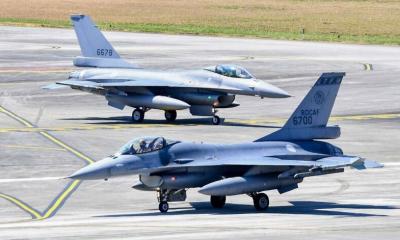
The first two F-16V Block 70 jets Taiwan purchased from the US were spotted unexpectedly turning back after departing from Hawaii yesterday, potentially further delaying delivery of the aircraft. Taiwan has purchased 66 of the F-16 C/D Block 70 jets to be deployed at Chihhang Air Base (志航基地) in Taitung County and operated by the air force's 7th Tactical Fighter Wing to defend Taiwan’s eastern region. Two single-seat jets, bearing serial No. 6727 and 6728, were spotted taking off from Hickam Field in Hawaii yesterday, observers said. Based on the precedent set during the delivery of Taiwan's older F-16 Block 20s, the new
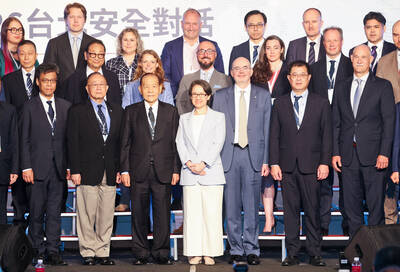
Taiwan’s growing defense preparations might be sending a stronger signal to the US than to Beijing, highlighting the need for Taipei to tailor its deterrence efforts to different audiences, a US security academic said yesterday. Stanford University Freeman Spogli Institute for International Studies fellow Oriana Skylar Mastro made the comment during a Taipei Security Dialogue panel examining lessons Taiwan could draw from the wars in Ukraine and the Middle East. Mastro said she was impressed by Taiwan’s increased defense spending, emphasis on asymmetric capabilities and efforts to prepare society for conflict, but questioned whom those initiatives were influencing. She said when she asked
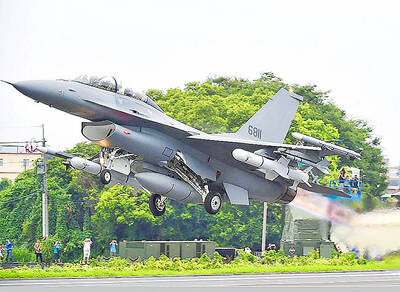
A sharp rise in compensation to be paid by air force officers who leave before completing their required service could indicate an increase in pilots leaving the military early, an analyst said on Friday, warning that the trend could worsen a shortage of experienced personnel. Chieh Chung (揭仲), a researcher at the Association for Strategic Foresight, issued the warning even though the number of volunteer military personnel is expected to increase next year. The planned headcount for volunteer military personnel, covering officers, noncommissioned officers (NCO) and enlisted soldiers, is 158,223 for next year, up 4,258 from 153,965 this year, Chieh said. The increase
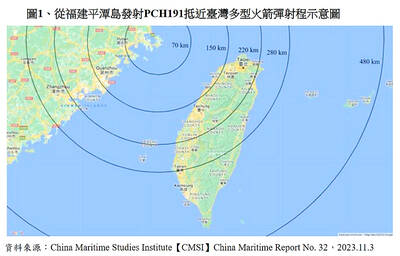
Potential improvements to munitions used by China’s long-range rocket-artillery units could extend their range to cover the entire Miyako Strait, which might give the Chinese People’s Liberation Army (PLA) the ability to secure the strategic waterway, the Mainland Affairs Council (MAC) said in a report. The PLA’s long-range rocket-artillery units deployed along the Taiwan Strait are concentrated along the coast of Fujian Province, including Changle, Pingtan and Shishi, the quarterly report on China said. The artillery brigades of the PLA’s 71st, 72nd and 73rd group armies have been deployed, with preparations for potential battlefield operations under way since August 2022, the report


 RSS
RSS