

The Ministry of Environment and the New Taipei City Government yesterday held a heat response drill, the first time a drill aimed to tackle the hybrid impacts of high temperatures.
Fifty units participated in the drill — 30 central government agencies, 16 city government agencies, three business entities and Far Eastern Memorial Hospital — Deputy Minister of the Environment Hsieh Yein-rui (謝燕儒) said.
Focused on health and lifeline infrastructure, the drill simulated temperatures of 40°C or higher lasting over a three-day period in Taipei, New Taipei City and Taoyuan, he said.
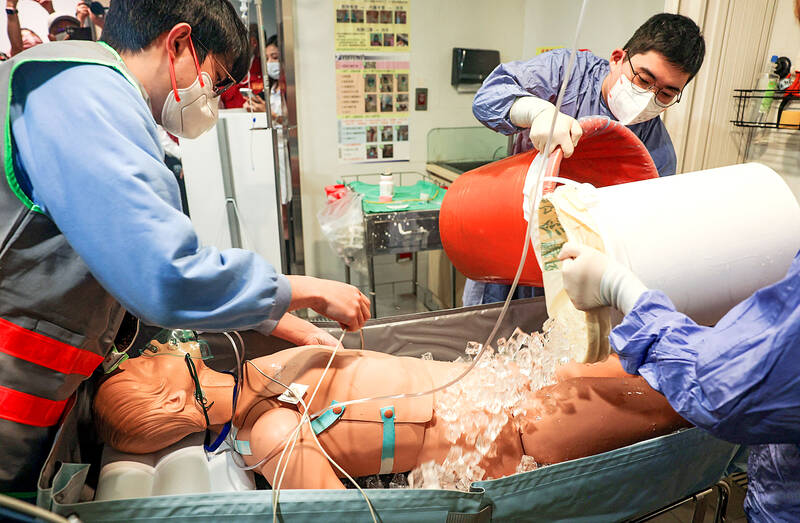
Photo:I-Hwa Cheng, AFP
Although the Disaster Prevention and Protection Act (災害防救法) has yet to include extreme heat as a natural disaster, its hazards have become evident in the heat waves that have swept the world this year, particularly in the US and Europe, Hsieh said.
This is the first time Taiwan has organized a heat response drill for such high temperatures, he said.
Power supply stability and restoration was prioritized in the exercise, as most people in Taiwan rely on air-conditioning to defend against heat, Hsieh said.
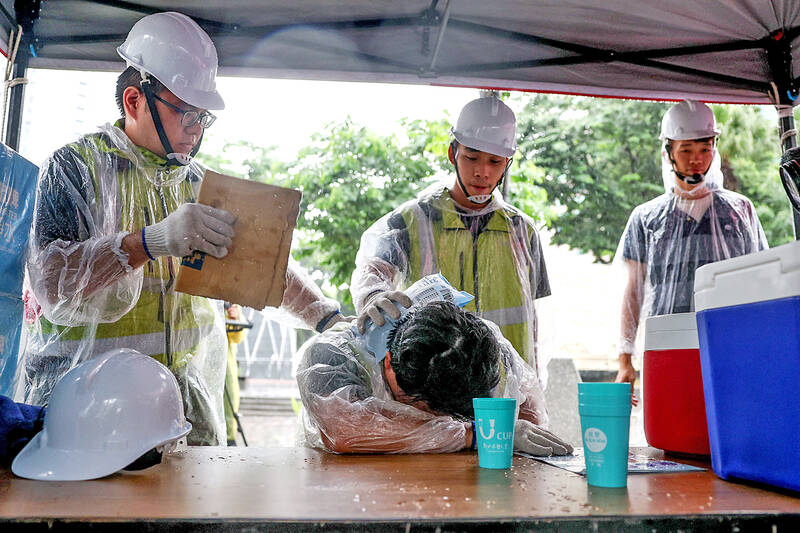
Photo: I-Hwa Cheng, AFP
Finding nearby cooling spots was also a key drill item, as prolonged time outdoors often leads to heat injuries, he said, adding that the ministry’s Cool Map platform shows more than 11,000 cooling spots.
Although 40°C temperatures remain uncommon in Taiwan, the nation must be prepared, given rising temperatures and international examples, Hsieh said.
Asked what differentiated it from the 38°C heat drill last year, Hsieh said the 2°C change would cause more significant discomfort and damage, and place greater strain on healthcare capacity.
The hospital’s Emergency Medicine Department chief Fan Chieh-min (范傑閔) said extreme temperatures could result in heat-related injuries.
For example, people who feel dizzy due to heat might fall while walking, he said, adding that such incidents would also pressure healthcare capacity.
The drill could help medical facilities prepare cooling equipment, he added.
New Taipei City Deputy Mayor Liu Ho-jan (劉和然) cautioned people against going outdoors under the midday sun and reminded them to stay hydrated.
The MRT system should also worry about potential power outages, Liu added.

A Straits Exchange Foundation official today warned that yielding to political pressure in exchange for access to China’s entertainment industry rarely ends well, amid rumors that China is seeking to lure Taiwanese K-pop star Chou Tzu-yu (周子瑜). Chou, more commonly known as Tzuyu, is the only Taiwanese member of the girl group Twice. Her contract with JYP Entertainment is set to expire at the end of this year, and there have been widespread reports that she would not renew it. She is reportedly planning to pursue solo activities under her parents’ agency, Yu Hai Entertainment (瑜海娛樂), although China has also reportedly offered
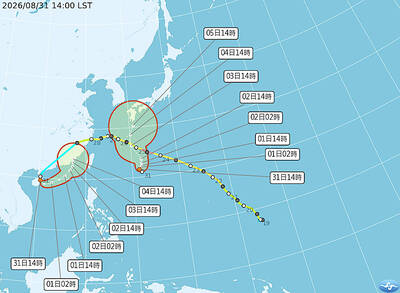
A tropical depression near Hainan that was once Typhoon Saudel may once again strengthen into a tropical storm, the Central Weather Administration (CWA) said yesterday, but a sea warning for waters around Taiwan is unlikely. CWA forecaster Huang En-hung (黃恩鴻) said that Saudel would return to being a weak tropical storm by late yesterday or early this morning. However, as the storm is to gradually weaken again and would head toward China’s Guangdong Province away from Taiwan, the chances that it would affect Taiwan enough for the CWA to issue a sea warning are relatively low,

Yielding to political pressure in exchange for access to China’s entertainment industry rarely ends well, a Straits Exchange Foundation official said yesterday amid rumors that China is seeking to lure Taiwanese K-pop star Chou Tzu-yu (周子瑜). Chou, who goes by Tzuyu, is the only Taiwanese member of the girl group Twice. Her contract with JYP Entertainment is set to expire at the end of this year, and there have been widespread rumors that she would not renew it. She is reportedly planning to pursue a solo career under her parents’ agency, Yu Hai Entertainment, although China has also reportedly offered to help Tzuyu
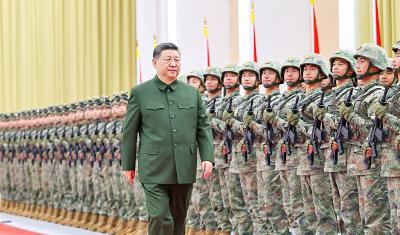
China has revised its National Defense Mobilization Law to prepare for a rapid transition to wartime, with an official today saying the measures are aimed at helping Chinese President Xi Jinping (習近平) fulfill his “historic mission of national unification.” The revised version of the mobilization law is to take effect on Oct. 1, marking the first major revision since the law was enacted in 2010. The amendments define national defense mobilization as measures taken in response to threats to national sovereignty, unification, territorial integrity, security and development interests, including efforts to ensure rapid transition between peacetime and wartime and convert economic and


 RSS
RSS