

The Hualien District Prosecutors’ Office yesterday launched an investigation following allegations by a former foreign correspondent in Taiwan of widespread vote-buying in Hualien County.
In an interview with Formosa TV (FTV, 民視) aired on Saturday, former Financial Times Taiwan correspondent Kathrin Hille spoke about Taiwan’s democracy and said that she now lives in rural Hualien, where “all the votes are bought.”
Neighbors would talk about who had come by and leave cash on the table showing “how much each vote was worth that year,” Hille said.

Photo: Wang Chin-yi, Taipei Times
The practice needs to be addressed, considering Taiwan has been a democracy for many years, she said.
In response to media queries for comment on Hille’s remarks, Hualien Chief Prosecutor Liao Jung-kuan (廖榮寬) yesterday said that prosecutors have assigned it for investigation.
Authorities are investigating vote-buying cases, he said, calling on the public to help safeguard fair and impartial elections and warned candidates not to break the law.
Democratic Progressive Party (DPP) Hualien County Councilor Hu Jen-shun (胡仁順) yesterday said Hualien’s corrupt election environment is nothing new, and for years, prosecutors and investigators have pledged to conduct aggressive crackdowns, but to no avail.
Hopefully they prosecute someone this time, and “don’t start taking the issue seriously just because a foreign national [Hille] brought it up,” he said.
The DPP has very limited resources in the county, so most of its candidates continue to seek voters’ support through low-cost, open and transparent methods during elections, such as door-to-door campaigning and holding policy presentation events, while supporting judicial authorities’ “anti-bribery and encouraging reporting” campaigns, he added.
The Chinese Nationalist Party’s (KMT) Hualien County commissioner candidate Candy Yu (游淑貞) yesterday said Hille painted all elected representatives with a broad brush and dismissed their efforts.
Yu said Hille should provide concrete evidence, adding that otherwise she does not rule out legal action against her, as her remark constitutes an attack on the character of hardworking representatives, and amounts to slander and defamation.
Independent Hualian County commissioner candidates Chang Chun (張峻) and Wei Chia-hsien (魏嘉賢), former KMT members, also urged Hille to provide evidence to back her claim.
Prosecutors should investigate the situation, and clear voters in Hualien of this accusation if no such activity is found, they said.
The Hualien County Government declined to comment, saying the issue is not within its jurisdiction.
The Hualien County Election Commission said its role is to administer election operations, and investigating vote-buying is beyond its scope of duties.
Meanwhile, election-related enforcement records over the years suggested the severity of vote-buying in Hualien.
In 2018, investigators uncovered cases in which as much as NT$10,000 (US$316) was allegedly paid for a single vote.
Hualien has long been one of the areas where the most rewards for reporting vote-buying have been paid. Of the NT$500 million in reporting rewards issued nationwide in 2018, about 10 percent went to cases in Hualien.
During the 2022 election, the Hualien District Prosecutors’ Office mounted a major crackdown, conducting searches at 72 locations and questioning 147 people. Prosecutors sought detention for seven suspects, all of whom were placed in custody, and seized more than NT$620,000 in suspected vote-buying funds.
Acting Prosecutor-General Hsu Hsi-hsiang (徐錫祥) in June traveled to Hualien to launch operations against vote-buying.
Vote-buying is not always a one-way transaction, investigators said, adding that some voters would offer to sell their votes, asking candidates for cash or even free meals and entertainment in return.
Some voters have come to regard vote-buying as part of the political process, and candidates do not necessarily hand out money indiscriminately, the investigators said.
Political staffers often maintain so-called “safe lists” of voters known to be willing to take cash, they said.
With neither party reporting the other and both sides protecting one another, vote-buying can be extremely difficult for authorities to uncover, they said.
Additional reporting by CNA

China deployed a record number of coast guard, scientific research and other ships near Taiwan’s waters last month, the Coast Guard Administration (CGA) said, as Beijing dials up pressure on Taipei. The coast guard warned of an increasingly severe situation, as analysts say the increased activity is part of China’s bid to map the region for submarine warfare. The number of Chinese ships detected around Taiwan proper soared to a record 244 last month — an average of nearly eight every day, official data showed. That compares with 55 ships detected in June and 30 in May, and 58 in July last year. In
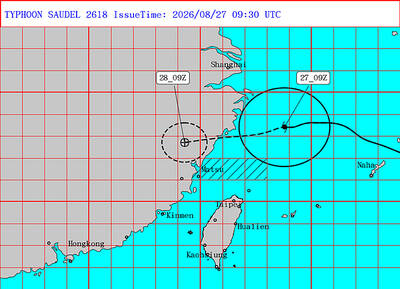
Taiwan is bracing for heavy rain in the south and rough seas around outlying Lienchiang County (Matsu), as Typhoon Saudel passes north toward eastern China, with forecasters yesterday warning of localized flooding over the next two days. Saudel is expected to pass closest to Taiwan today, when its outer rain bands are forecast to brush past Matsu, before making landfall at about noon in China’s Zhejiang Province and weakening significantly, the Central Weather Administration said. The storm’s outer bands, combined with strengthening southwesterly winds, are expected to bring heavy rain to southern and southeastern Taiwan today, it said. As the storm approaches Matsu,

LIMITED: The bill’s NT$40bn annual spending cap would prevent Taiwan from effectively building up its drone combat capabilities, National Defense Minister Wellington Koo said The legislature yesterday rejected the Executive Yuan’s NT$210 billion (US$6.62 billion) special budget proposal to buy military drones and instead passed its own plan, which earmarks NT$40 billion per year over six consecutive years. The Executive Yuan said its plan to buy about 210,000 drones by 2031 could not wait, as the wars in Ukraine and Iran showed the importance of uncrewed systems in modern warfare amid a rising threat from China. However, the Chinese Nationalist Party (KMT) and Taiwan People’s Party (TPP) used their opposition majority to pass a bill providing NT$240 billion through annual budgets over six years, with annual

INCREASING IMBALANCE: The percentage of working-age people is expected to shrink to 42.3% of the population, while older people would comprise 52.9%, the agency said Taiwan’s population is projected to shrink by almost half over the next five decades, intensifying labor shortages and placing a growing drag on economic growth as the technology-intensive economy confronts a rapidly aging workforce. The population is expected to fall to 12.15 million by 2075, a 48 percent decline from this year, National Development Council projections released yesterday showed. The decline would fundamentally alter Taiwan’s workforce. From 2037, more than half of the working-age population is projected to be aged between 45 and 64, signaling the end of an era when the economy could rely on a relatively large labor force. The shift


 RSS
RSS