

China has revised its National Defense Mobilization Law to prepare for a rapid transition to wartime, with an official today saying the measures are aimed at helping Chinese President Xi Jinping (習近平) fulfill his “historic mission of national unification.”
The revised version of the mobilization law is to take effect on Oct. 1, marking the first major revision since the law was enacted in 2010.
The amendments define national defense mobilization as measures taken in response to threats to national sovereignty, unification, territorial integrity, security and development interests, including efforts to ensure rapid transition between peacetime and wartime and convert economic and social resources into national defense capabilities.
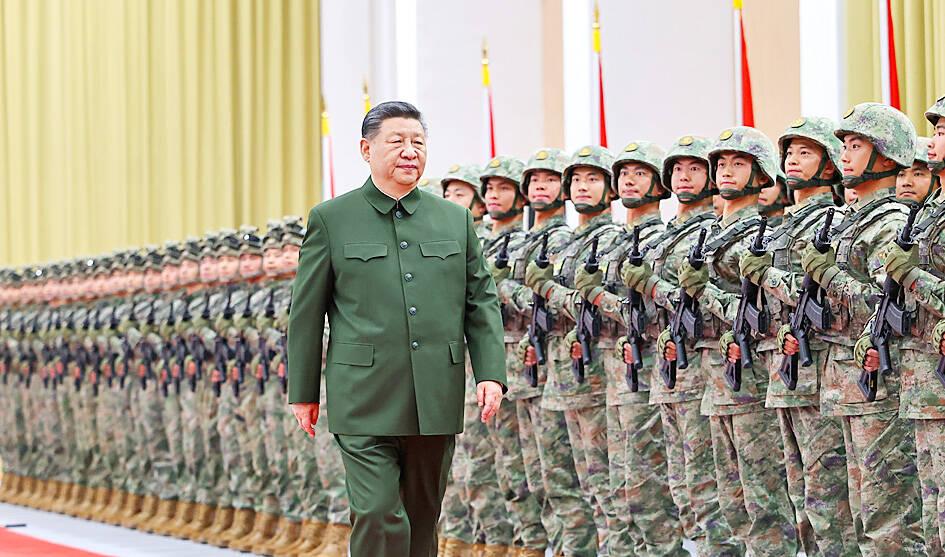
Photo: EPA
The law stipulates that once China declares a “national defense mobilization status,” it can convert peacetime resources, including personnel, transportation, communications, energy, healthcare and media, into wartime resources under strict government control.
The State Council of China and the Central Military Commission determine the size, type and method of reservist recruitment based on mobilization needs, the law says.
Reservists are required to participate in training, while Chinese men aged 18 to 60 and women aged 18 to 55 are required to perform national defense duties, it says.
The revisions are preparatory measures, as Xi is determined to remain in power and fulfill his “historic mission of national unification,” an official familiar with cross-strait relations said.
Xi believes in military dominance and is working to strengthen China’s wartime resilience, the official said.
While Taiwan is focusing on whole-of-society resilience, China is building “offensive resilience” to ensure its attacks face no obstacles or international sanctions and can achieve its war aims, they said.
Taiwan is unsurprised by China’s war preparations, they said, adding that democratic allies should closely monitor its next moves, particularly its wartime mobilization plans.
Beijing is also continuing its baseless accusations that Taiwan is seeking independence and Japan is reviving militarism, the official added.
Beijing is writing planned measures into law and mobilizing national resources to concentrate its strength for major undertakings, but could also “do something foolish” amid nationalist fervor, posing a global and geopolitical threat, the official said.
Xi has few achievements to show for his tenure, as China’s economy is struggling, people are living under difficult conditions and youth unemployment remains high, they said.
The cheapest way to maintain his grip on power is to appeal to nationalism, the official said, warning that excessive nationalism leads to the export of military dominance.
Nationalism cannot “rejuvenate the Chinese nation,” but would only result in tragedy, they said, adding that Taiwan must strengthen its defenses.

Minister of Sports Lee Yang (李洋) today said the Chinese Taipei Basketball Association (CTBA) has been urged not to undermine Taiwan’s credibility in international competitions, after a Taiwanese team advanced to the semi-finals of the 45th William Jones Cup over the Philippines last week due to a controversial new rule guaranteeing a semi-final place to the host team. The Republic of China Blue team advanced to the semi-finals after winning just one game in the group round due to a “host guarantee” spot, overtaking the Philippines, who held a 5-1 record ahead of the semi-finals. The Blue team finished the tournament
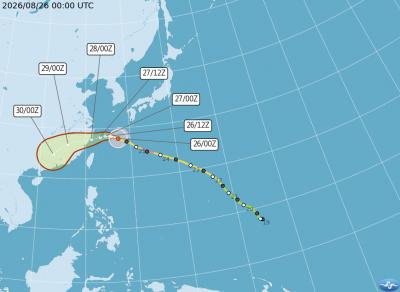
A sea warning for Typhoon Saudel, which has shifted to a more northerly track as it nears Taiwan, is expected early tomorrow, the Central Weather Administration (CWA) said today. As of this morning, Saudel was about 650km east-northeast of Taipei, moving west-northwest at 12kph with maximum sustained winds of 162kph, CWA data showed. Although Saudel remains a moderate typhoon, it has weakened and is expected to weaken further as it nears Taiwan due to unfavorable atmospheric and ocean conditions, CWA forecaster Lin Po-tung (林伯東) said. The storm is forecast to make its closest approach to Taiwan tomorrow and on Friday, Lin added. According to
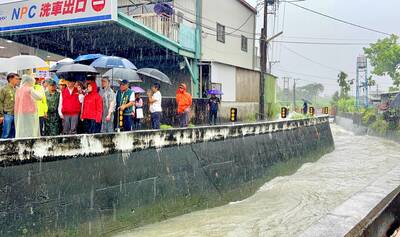
SEA WARNING EXPECTED: As atmospheric conditions are unfavorable for its development, the storm’s intensity is continuing to weaken, a CWA official said Typhoon Saudel is continuing to weaken and shift its path northward, with a sea warning expected to be issued this evening, the Central Weather Administration (CWA) said yesterday. The agency did not rule out issuing a land warning for outlying Lienchiang County (Matsu) tomorrow morning, although all storm warnings could be lifted by Friday night. Saudel is expected to be closest to Taiwan from tomorrow night to Friday, bringing localized heavy rain to northern and southern Taiwan, as well as central mountainous areas, the agency said. As of 2pm yesterday, the center of moderate Typhoon Saudel was about 890km east-northeast
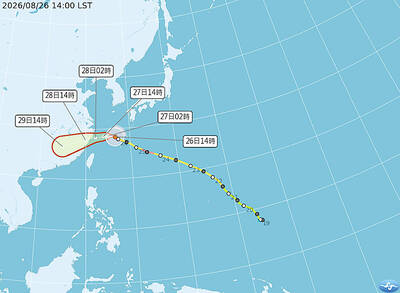
MODERATE TYPHOON: Localized heavy rain is forecast to hit central and southern Taiwan, the CWA said, adding that the storm would likely move away on Saturday A sea warning for Typhoon Saudel, which shifted to a more northerly track as it approached Taiwan, is likely early today, the Central Weather Administration (CWA) said yesterday. As of 2pm yesterday, the center of typhoon was about 630km northeast of Taipei, moving west-northwest at 14kph with maximum wind gusts of up to 162kph, CWA data showed. Saudel is a moderate typhoon and is expected to weaken as it nears Taiwan due to atmospheric and ocean conditions, CWA forecaster Lin Po-tung (林伯東) said. A sea warning indicates hazardous typhoon conditions in waters surrounding Taiwan within 24 hours, Lin said. The storm is forecast to


 RSS
RSS