

A taxi driver was arrested early this morning after allegedly ramming his vehicle into the Taipei District Prosecutors’ Office, likely in protest against court rulings against him, the Taipei City Police Department said.
The department's Zhongzheng First Precinct said in a statement that it received a report at 5:46am that a taxi was driven into the front door of the office, which is near the Presidential Office Building.
Upon arriving at the scene, officers arrested a taxi driver surnamed Shao (邵) and seized his cab, police said, adding that the incident caused property damage but no injuries.
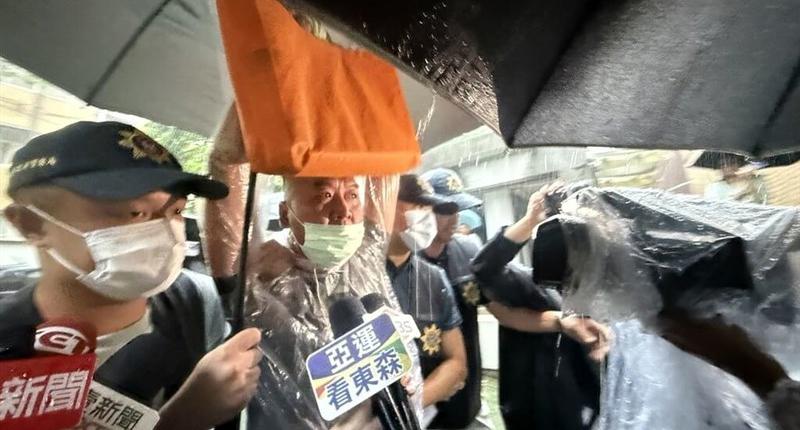
Photo: CNA
Although Shao's motive is under investigation, preliminary findings suggest he might have acted out of dissatisfaction with the outcomes of several legal cases involving him, including a ruling issued yesterday, police said.
Shao vented his dissatisfaction with Taiwan's judicial system on social media following yesterday’s ruling and later surveilled the prosecutors' office before driving his taxi into the building early yesterday, police said.
The vehicle had slogans including "the judicial system is dead" painted on it, they said.
Shao was not under the influence of drugs or alcohol, police said, adding that he was arrested on suspicion of contravening several provisions of the Criminal Code, including obstruction of justice, public disorder and property damage.
Police have turned the case over to the Taipei Prosecutors' Office, which said it would seek to determine the motive for Shao's actions.
United Daily News reported that Shao had been involved in a civil defamation lawsuit with a medical professional and two traffic-related legal cases.
Yesterday’s ruling involved one of the traffic offenses, United Daily News reported, adding that Shao was sentenced to more than five months in prison for the three cases.
ETtoday reported that Shao was 53 and said that surveillance footage showed him walking toward his vehicle near the Taipei District Prosecutors’ Office at about 5am before getting into the cab.
He then made a U-turn and drove directly toward the office, accelerating before impact, Ettoday reported.

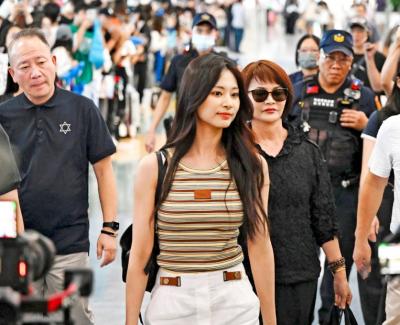
A Straits Exchange Foundation official today warned that yielding to political pressure in exchange for access to China’s entertainment industry rarely ends well, amid rumors that China is seeking to lure Taiwanese K-pop star Chou Tzu-yu (周子瑜). Chou, more commonly known as Tzuyu, is the only Taiwanese member of the girl group Twice. Her contract with JYP Entertainment is set to expire at the end of this year, and there have been widespread reports that she would not renew it. She is reportedly planning to pursue solo activities under her parents’ agency, Yu Hai Entertainment (瑜海娛樂), although China has also reportedly offered
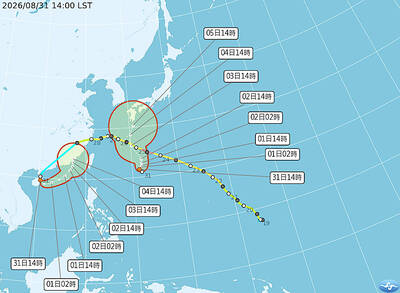
A tropical depression near Hainan that was once Typhoon Saudel may once again strengthen into a tropical storm, the Central Weather Administration (CWA) said yesterday, but a sea warning for waters around Taiwan is unlikely. CWA forecaster Huang En-hung (黃恩鴻) said that Saudel would return to being a weak tropical storm by late yesterday or early this morning. However, as the storm is to gradually weaken again and would head toward China’s Guangdong Province away from Taiwan, the chances that it would affect Taiwan enough for the CWA to issue a sea warning are relatively low,

Yielding to political pressure in exchange for access to China’s entertainment industry rarely ends well, a Straits Exchange Foundation official said yesterday amid rumors that China is seeking to lure Taiwanese K-pop star Chou Tzu-yu (周子瑜). Chou, who goes by Tzuyu, is the only Taiwanese member of the girl group Twice. Her contract with JYP Entertainment is set to expire at the end of this year, and there have been widespread rumors that she would not renew it. She is reportedly planning to pursue a solo career under her parents’ agency, Yu Hai Entertainment, although China has also reportedly offered to help Tzuyu
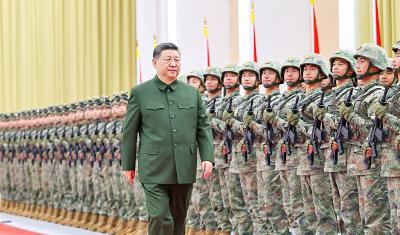
China has revised its National Defense Mobilization Law to prepare for a rapid transition to wartime, with an official today saying the measures are aimed at helping Chinese President Xi Jinping (習近平) fulfill his “historic mission of national unification.” The revised version of the mobilization law is to take effect on Oct. 1, marking the first major revision since the law was enacted in 2010. The amendments define national defense mobilization as measures taken in response to threats to national sovereignty, unification, territorial integrity, security and development interests, including efforts to ensure rapid transition between peacetime and wartime and convert economic and


 RSS
RSS